
Dead Bug
How to do Dead Bug?
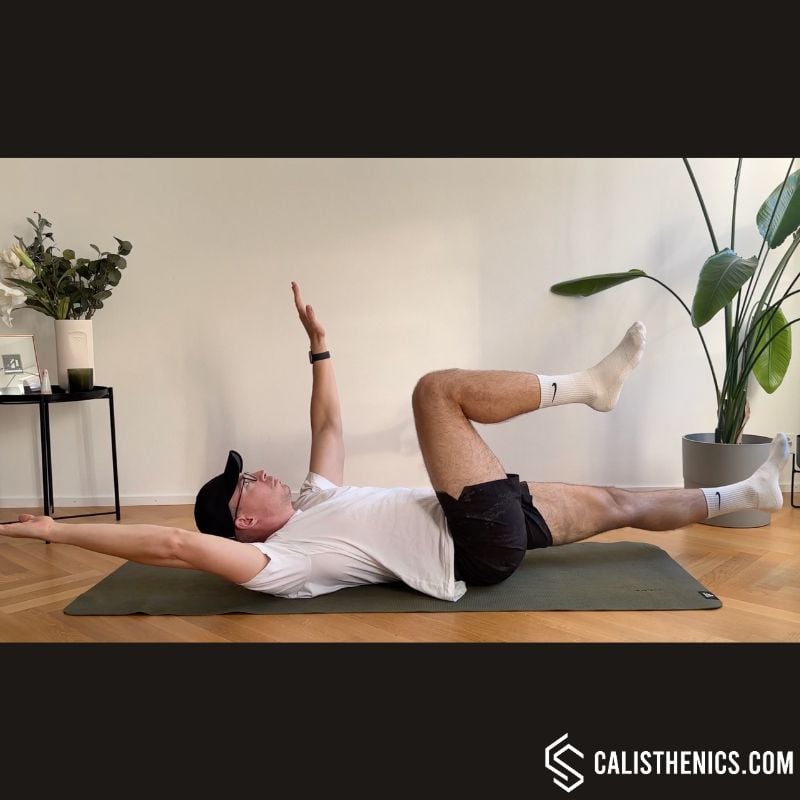
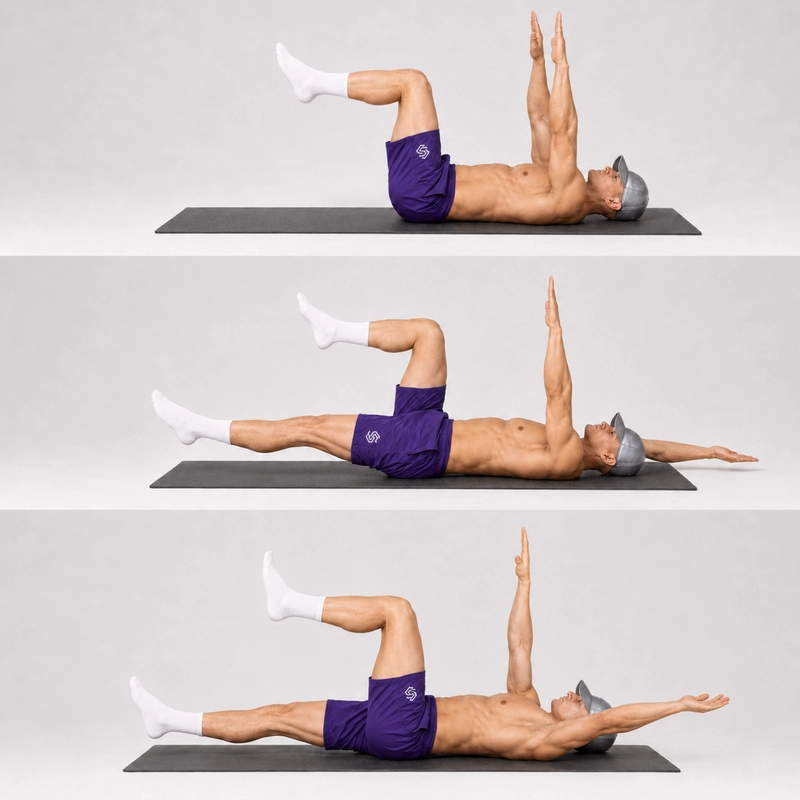
The Dead Bug is a controlled core stability exercise performed lying on your back, where you move opposite arm and leg away from your center while keeping your lower back gently pressed into the floor. Instead of crunching or flexing the spine, the goal is to prevent your lower back from arching as your limbs move. This makes it a classic “anti-extension” core drill that teaches your trunk to stay strong and stable while the arms and legs do the work.
Before you start practicing Dead Bugs, it helps to have basic body awareness on the floor: you should be able to lie on your back with your knees bent, flatten your lower back slightly into the ground (posterior pelvic tilt), and breathe calmly through your ribcage. Mobility-wise, you’ll want comfortable shoulder flexion (arms overhead) and hip flexion to about 90° without pain. If you have a history of acute lower back pain, it’s wise to start with a very small range of motion and, ideally, get cleared by a professional first.
Equipment needs are very minimal. At the simplest level, all you need is enough floor space to lie down and an exercise or yoga mat for comfort. Optional tools can make the exercise even more effective: a small foam roller, yoga block, or soft ball to hold between your hands and knees; a light resistance band anchored behind your head; or a stability ball to increase the coordination and stability challenge as you progress.
How to Perform Dead Bug
- Setup
- Lie on your back on a mat.
- Bend your hips and knees to 90° so your knees are stacked over your hips (tabletop position).
- Raise both arms straight up toward the ceiling, wrists roughly over your shoulders.
- Gently press your lower back into the floor by tipping your pelvis so the tailbone tucks slightly under you. Your ribs should stay down, not flaring up.
- Find Core Engagement and Breathing
- Take a deep breath in through your nose, expanding your ribcage sideways and into the floor (not just your belly).
- As you exhale, lightly brace your abdominal muscles as if you’re preparing for a poke in the stomach while keeping the lower back just touching the floor.
- Maintain natural breathing—never hold your breath during the movement.
- Movement Phase (Opposite Arm and Leg)
- Slowly extend your right leg away from you, aiming to straighten it or almost straighten it, while simultaneously reaching your left arm overhead toward the floor behind you.
- Move only as far as you can without your lower back lifting off the floor or your ribs popping up. This might be a very small range at first, and that’s totally fine.
- Pause briefly at the end of the range (1–2 seconds), maintaining full body tension and smooth breathing.
- Return to Start
- Reverse the movement under control: bring your right leg back to tabletop and your left arm back above your shoulder.
- Reset your core tension and ensure your lower back is gently pressing into the mat again if you lost it.
- Repeat on the other side: extend the left leg and right arm.
- Repetitions and Sets
- Aim for 2–4 sets of 6–10 controlled reps per side.
- Prioritize quality over quantity—if you feel your lower back arching or your form breaking down, stop the set.
- Breathing Pattern
- Inhale as the arm and leg move away from the center.
- Exhale slowly through pursed lips as you bring them back to the starting position or gently brace before the most challenging part of the motion.
- Keep the breath smooth and continuous; avoid breath-holding.
Benefits of the Dead Bug
- Builds true core stability, not just six-pack aesthetics – The Dead Bug focuses on keeping the spine stable while the limbs move, which is directly transferable to real-life movements and calisthenics skills.
- Protects the lower back – By training your trunk to resist extension, you build the ability to keep your spine safer during squats, push-ups, leg raises, and heavy carries.
- Improves coordination and body awareness – Opposite arm–leg coordination challenges your nervous system, helping you move more efficiently and smoothly in other exercises.
- Beginner-friendly and joint-friendly – Because you’re supported on the floor, it’s a great entry-level core exercise that most people can do without putting a lot of stress on the spine, hips, or shoulders.
- Highly scalable for all levels – With simple tweaks (range of motion, limb positions, added resistance), Dead Bugs can be made easy enough for beginners and challenging enough for advanced athletes.
- Supports progression to harder core skills – A strong Dead Bug carries over nicely to hollow body holds, hanging leg raises, L-sits, front lever work, and many other calisthenics core demands.
Common Mistakes to Avoid
- Letting the lower back arch off the floor – This is the big one. If your back lifts, you’re shifting work away from the abs and into the spine. Reduce your range of motion or bend your knees more to fix this.
- Rib flaring – If your ribs pop up as your arm goes overhead, you’re compensating with the spine and chest. Think “ribs down” and keep them stacked over your pelvis.
- Moving too fast – Rushing turns the Dead Bug into a sloppy flailing exercise. Slow down, move with control, and feel your core working the entire time.
- Losing the 90° starting position – Knees drifting toward your chest or feet dropping toward the floor can make the exercise either too easy or too stressful on the back. Re-set your tabletop before each rep if needed.
- Neck strain – You don’t need to lift your head off the floor. Let your head rest comfortably, or support it with a small pillow if needed, and keep the neck relaxed.
- Holding your breath – Bracing is good, but extended breath-holding can increase tension and fatigue. Aim for smooth, controlled breathing throughout.
Gym Equivalent Exercises
If you’re training in a gym or just want similar patterns using equipment, here are exercises that mimic the “core anti-extension with moving limbs” idea:
- Stability Ball Dead Bug – Lying on your back holding a Swiss ball between hands and knees, then moving limbs while keeping pressure on the ball.
- Cable or Band Pallof Press – Standing or half-kneeling core exercise where you resist rotation and extension against a cable or band.
- Ab Wheel Rollouts – A more advanced anti-extension exercise, similar in principle but much harder on the core and shoulders.
- TRX or Ring Body Saw – Plank variation where you glide your body forward and back, forcing the core to resist extension.
- Plank with Alternating Leg or Arm Lifts – A front-plank variation that challenges core stability while limbs move independently.
Tips for the proper execution of Dead Bug
Start with small ranges of motion and only extend further as long as your lower back stays gently pressed into the floor.
Imagine zipping your ribs toward your pelvis before each rep to lock in your core position.
If you struggle to keep tension, press your opposite hand and knee together (same-side contact) on the non-moving side to wake up your deep core.
Move slowly and deliberately—2–3 seconds out, short pause, 2–3 seconds back.
If your hip flexors dominate, think about exhaling fully and relaxing the front of the hips while maintaining abdominal tension.
Use a soft surface like a mat for comfort, but avoid overly squishy surfaces that make it hard to feel your back on the floor.
Muscles worked when doing Dead Bug
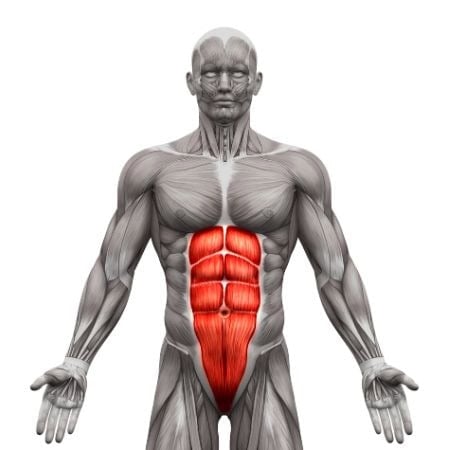
During the Dead Bug, the core muscles are active from the very start to keep the spine in a neutral, stable position while the arms and legs move. As you extend a leg away from your center, the rectus abdominis and transverse abdominis work hard to prevent your lower back from arching, while the obliques help maintain pelvic and rib alignment from side to side. The hip flexors lift and hold the legs in tabletop, the glutes and deep spinal stabilizers assist in keeping your pelvis steady, and the muscles around the shoulders—especially the serratus anterior—help you keep the arms stable and connected to the ribcage.
Primary Muscles
-
Rectus Abdominis – Main front core muscle helping to prevent the spine from extending and maintaining the gentle “back to floor” contact.
-
Transverse Abdominis – Deep corset-like muscle providing 360° core stability and tension.
-
Internal and External Obliques – Help keep the ribs down, pelvis steady, and prevent rotation or side-bending.
Secondary Muscles
-
Hip Flexors (Iliopsoas, Rectus Femoris) – Work to hold the hips and knees in the tabletop position and assist with leg movement.
-
Gluteus Maximus and Medius – Assist in stabilizing the pelvis and preventing unwanted tilting as the legs move.
-
Deep Spinal Stabilizers (Multifidus, Erector Spinae) – Co-contract with the abdominals to maintain a supported, neutral spine.
-
Serratus Anterior and Shoulder Flexors (Deltoids) – Help control arm position and keep the shoulders stable as the arms move overhead.
Primary Muscle(s):
Abdominal
Secondary Muscle(s):
Equipment needed for Dead Bug
Adjust the difficulty of Dead Bug
The Dead Bug is one of the most easily adjustable calisthenics core exercises. By changing how far your limbs travel, how bent or straight your legs are, whether you add external load, or how unstable the contact points are (e.g., using a ball), you can fine-tune the resistance for any fitness level. Beginners can keep the movement tiny and knees very bent, while advanced athletes can add load, tempo, and unstable equipment to turn it into a serious core challenge that supports high-level calisthenics skills.
The beauty of the Dead Bug is that small changes in limb position, range of motion, or added resistance can dramatically transform how the exercise feels. This makes it almost infinitely adjustable: you can tailor it to complete beginners learning to find their core for the first time, or to advanced calisthenics athletes who need rock-solid trunk stability for skills like front levers, handstands, and muscle-ups. By fine-tuning the difficulty, you can always stay in that sweet spot where the exercise is challenging, safe, and productive for your current level.
How to make Dead Bug harder?
How to make Dead Bug easier?
How to make Dead Bug harder?
To make Dead Bug harder:
-
Fully straighten the moving leg – The longer the lever, the more torque your core must resist. This dramatically increases difficulty.
-
Lower the leg closer to the floor – Without touching down, bring the heel just above the ground while keeping the back glued to the mat.
-
Add overhead resistance – Hold a light dumbbell, kettlebell, or resistance band in your hands as you move the arm overhead.
-
Use a stability ball or foam roller – Squeeze a ball between your opposite hand and knee on the non-moving side to create extra tension and coordination demand.
-
Increase time under tension – Add a 2–5 second pause at the end of each rep, then return slowly.
-
Tempo or isometric sets – Perform very slow reps, or hold the extended position for 20–30 seconds per side.
-
Combine with hollow body work – Start from a gentle hollow body position, then perform Dead Bug reps without losing that hollow shape.
How to make Dead Bug easier?
To make Dead Bug easier:
-
Reduce the range of motion – Only move your arm and leg a short distance, stopping well before your back wants to arch.
-
Keep knees more bent – Maintain a tighter bend in the knees instead of full leg extension to reduce leverage and stress on the core.
-
Move only one limb at a time – Start by moving just one leg, or just one arm, instead of opposite arm and leg together.
-
Keep arms vertical – Let both arms stay pointed at the ceiling while you only move the legs initially.
-
Use floor support – Gently rest your non-moving foot on the floor rather than hovering it in the air to reduce overall demand.
-
Take longer rests between reps – Reset your position, breathing, and core tension before each repetition if you tend to lose control over time.