
Cat-Cow - Thoracic Mobilization Exercise
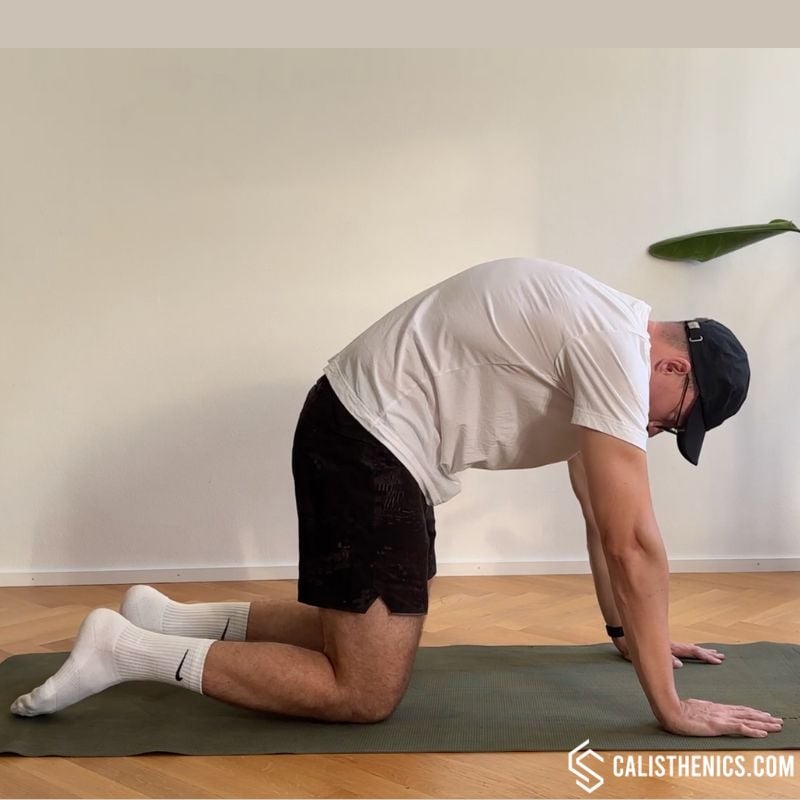
How to do Cat-Cow - Thoracic Mobilization Exercise?
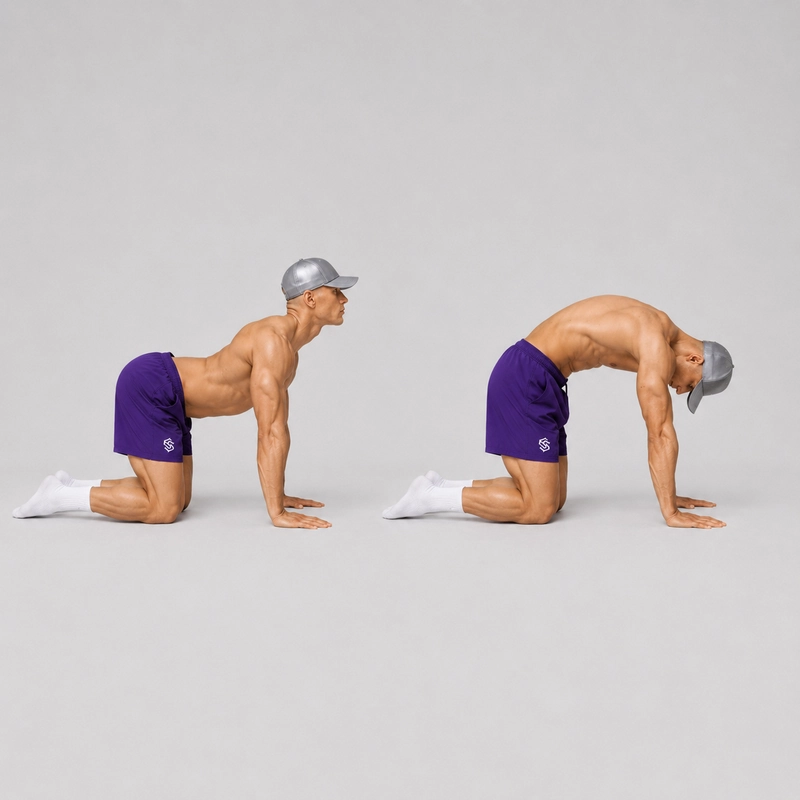
The Cat-Cow is a gentle spinal mobility exercise performed on hands and knees, where you alternate between rounding your back up toward the ceiling (“cat”) and gently arching it (“cow”). It’s a controlled, rhythmic movement that moves your spine through flexion and extension while you coordinate breathing. You’ll see it often in yoga warm-ups, but it’s just as valuable in calisthenics as a way to wake up the spine, shoulders, and hips before harder work.
Before practicing Cat-Cow, it helps to have basic comfort in a quadruped position: hands under shoulders, knees under hips, and the ability to kneel without significant pain. You should be able to move your spine without sharp or radiating pain; if your back is very sensitive or you have a recent injury, start with a smaller range of motion and, if needed, get cleared by a professional. Basic shoulder and hip mobility is enough—Cat-Cow is more about control and awareness than extreme flexibility.
Equipment needs are minimal. All you really need is enough floor space and, ideally, a yoga or exercise mat to cushion your knees and hands. Optional equipment can make it more comfortable and adaptable: folded towels or pads for sensitive knees, yoga blocks under the hands to reduce wrist angle, or even a low bench if you need to elevate your hands. Because it’s so accessible, Cat-Cow is a great movement to include in almost any warm-up, from complete beginner to advanced athlete.
How to Perform Cat-Cow
- Setup (Tabletop Position)
- Place your hands and knees on a mat.
- Position your wrists directly under your shoulders and knees under your hips.
- Fingers spread wide, middle finger roughly pointing forward.
- Keep your spine in a neutral position—neither rounded nor overly arched—and look down at the floor so your neck is in line with the rest of your spine.
- Cat Position (Spinal Flexion)
- Start by exhaling slowly through your mouth or nose.
- As you exhale, press the floor away with your hands, gently tuck your tailbone under, and round your spine toward the ceiling.
- Think of pulling your belly button up toward your spine and gently tucking your chin toward your chest (don’t jam it—just a soft nod).
- This is your Cat position: your back should look like a rounded “C” shape from shoulders to hips.
- Cow Position (Spinal Extension)
- From Cat, begin a slow inhale through your nose.
- As you inhale, let your belly soften down toward the floor, gently lift your chest forward, and tilt your tailbone up behind you.
- Open across the collarbones and let your shoulder blades glide slightly together, keeping some tension away from the lower back.
- Look slightly forward or at the horizon (not straight up) to keep the neck long and comfortable.
- This is your Cow position: a gentle, controlled arch through the spine.
- Flow Between Positions
- Move continuously between Cat and Cow, coordinating movement with your breath:
- Exhale → Cat (round the spine).
- Inhale → Cow (gently arch the spine).
- Aim for slow, smooth transitions—imagine each vertebra moving in sequence.
- Avoid “snapping” into the end positions; think of them as soft endpoints.
- Move continuously between Cat and Cow, coordinating movement with your breath:
- Repetitions and Sets
- For warm-up, perform 1–3 sets of 8–15 slow cycles (Cat + Cow = 1 cycle).
- Move at a pace that lets you feel each phase. A typical rhythm is 3–4 seconds per direction.
- Breathing Pattern
- Inhale: move into Cow, opening the front of the body.
- Exhale: move into Cat, gently closing and rounding the spine.
- Keep the breath smooth and continuous; don’t hold your breath at either end.
Benefits of Cat-Cow
- Improves spinal mobility – Cat-Cow systematically takes the spine through flexion and extension, helping to keep it mobile and reducing stiffness from sitting or static postures.
- Wakes up the core and back muscles – You lightly activate the deep core, spinal erectors, and muscles around the shoulder blades, preparing them for heavier or more demanding calisthenics work.
- Promotes body awareness and control – Learning to move the spine segment by segment builds better proprioception, which carries over into handstands, bridges, and general posture.
- Gentle warm-up for any level – It’s low-impact and accessible, making it a perfect first exercise in a warm-up routine, especially for people with tight backs or hips.
- Supports better posture – By exploring both rounded and extended positions, you learn where “neutral” feels like and can better find it during standing, sitting, and lifting.
- Encourages relaxed, mindful breathing – The breath-synchronized rhythm can help down-regulate tension and support a calmer nervous system before more intense training.
Common Mistakes to Avoid
- Dumping into the lower back in Cow – Over-arching the lower back without engaging the core can create discomfort. Keep some tension in the abs and spread the curve along the entire spine.
- Barely moving the spine – Letting only the head or pelvis move while the mid-back stays stiff reduces the effectiveness. Focus on moving the whole spine, especially between the shoulder blades.
- Locking the elbows – Over-locked elbows and shrugged shoulders can compress the joints. Keep a tiny softness in the elbows and push the floor away gently.
- Rushing the movement – Fast, jerky transitions turn this into a throwaway exercise. Slow down and sync with your breathing.
- Head throwing – Flinging the head back in Cow or jamming the chin into the chest in Cat can strain the neck. Keep the neck long and move it gently with the rest of the spine.
- Hands or knees in the wrong position – Hands too far forward or knees too close together can shift stress into the wrists or lower back. Reset to wrists-under-shoulders, knees-under-hips.
Gym Equivalent Exercises
If you’re training in a gym and want exercises that mimic the spinal mobility and control of Cat-Cow:
- Seated Cat-Cow on a Bench – Sit on a bench, hands on knees, and perform the same flexion/extension pattern through the spine. Great as a warm-up between sets.
- Back Extension Machine (controlled range) – Use light weight and focus on curling the spine down and then slowly extending it up, rather than just hinging at the hips.
- Jefferson Curl (advanced) – A slow, weighted spinal flexion/extension movement performed standing on a box. This is a much more advanced version and should be approached carefully and progressively.
- Stability Ball Back Roll – Lying with your upper back on a Swiss ball, gently roll into flexion and extension to mobilize the thoracic spine.
- Seated Cable Row with Spinal Articulation (very light) – With low weight, round forward slightly, then extend through the upper and mid-back as you row, focusing on control rather than pulling heavy.
Tips for the proper execution of Cat-Cow - Thoracic Mobilization Exercise
Move slowly and deliberately, aiming to feel each segment of your spine move.
Think of starting the movement from the pelvis—tailbone tucks for Cat, tilts up for Cow—then let the rest of the spine follow.
Keep shoulders relaxed and away from the ears; don’t let them creep up as you move.
If your wrists feel uncomfortable, place your hands slightly in front of your shoulders or use yoga blocks to reduce the wrist angle.
Use your breath as your metronome: inhale to open (Cow), exhale to round (Cat).
Don’t chase maximal range at all costs. Work in a comfortable, pain-free range and gradually increase over time.
If your knees are sensitive, add extra padding with a folded mat or towel.
Muscles worked when doing Cat-Cow - Thoracic Mobilization Exercise
During Cat-Cow, the muscles around the spine alternate between active shortening and lengthening as you move from flexion to extension. In the Cat phase, the abdominals and muscles between the shoulder blades help round and spread your back, while the hip flexors and deep neck flexors assist with the tucked position. In the Cow phase, the spinal erectors, glutes, and some hip flexors contribute to the gentle arch, while the chest opens and the shoulder stabilizers guide the shoulder blades. Although Cat-Cow is low-load, it provides a coordinated activation pattern for many postural and stabilizing muscles.
Primary Muscles
-
Erector Spinae – Extend and control the spine in the Cow position and help return from Cat.
-
Rectus Abdominis – Assists with spinal flexion during Cat, helping to round and support the lower back.
-
Obliques (internal and external) – Support spinal flexion and help control ribcage position throughout the movement.
Secondary Muscles
-
Multifidus and Deep Spinal Stabilizers – Fine-tune segmental control of each spinal segment.
-
Gluteus Maximus – Assists with pelvic positioning, especially in the Cow phase when the tailbone tips up.
-
Hip Flexors – Contribute to pelvic tilting and stabilization in both positions.
-
Trapezius and Rhomboids – Help move and stabilize the shoulder blades as the spine flexes and extends.
-
Serratus Anterior – Assists in keeping the shoulders stable and the ribcage connected to the upper body.
-
Deep Neck Flexors and Extensors – Guide gentle flexion and extension of the neck in sync with the rest of the spine.
Primary Muscle(s):
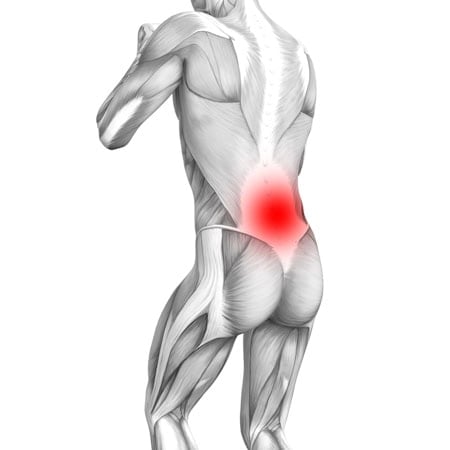
Lower back
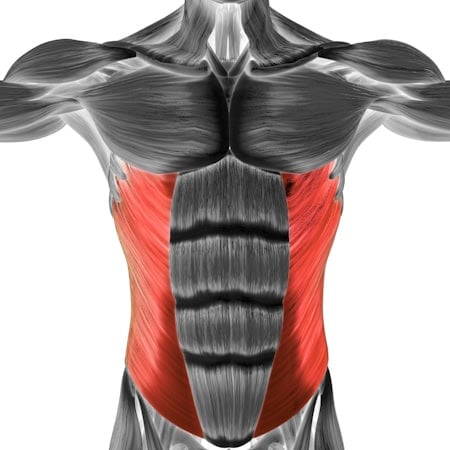
Oblique
Secondary Muscle(s):
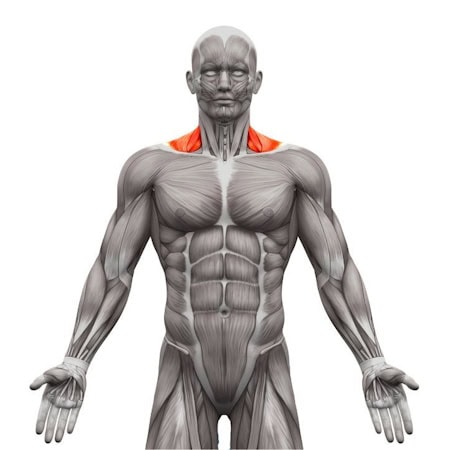
Trapezius
Equipment needed for Cat-Cow - Thoracic Mobilization Exercise
Adjust the difficulty of Cat-Cow - Thoracic Mobilization Exercise
Cat-Cow is a highly adaptable spinal mobility drill. You can dial the difficulty up or down by changing how much bodyweight you load into your hands and knees, how large the range of motion is, and how much control you demand from your core and shoulders. Beginners can keep the movements small, use lots of support, and focus simply on finding the positions. More advanced athletes can add loaded or hovering variations that challenge the core, shoulder stability, and coordination to a surprising degree.
The beauty of Cat-Cow is that its difficulty doesn’t depend on heavy weights or complex equipment, but on how mindfully and precisely you move. By adjusting range of motion, base of support, tempo, and how much bodyweight you load into the position, you can tailor this exercise to almost any level. From someone just learning to gently mobilize a stiff back, to an advanced calisthenics athlete fine-tuning spinal control for bridges, handstands, and levers, Cat-Cow can always be tweaked to feel appropriately challenging, safe, and effective for your current needs.
How to make Cat-Cow - Thoracic Mobilization Exercise harder?
How to make Cat-Cow - Thoracic Mobilization Exercise easier?
How to make Cat-Cow - Thoracic Mobilization Exercise harder?
To make Cat-Cow - Thoracic Mobilization Exercise harder:
-
Hover the knees (“Bear Cat-Cow”) – Lift your knees 2–5 cm off the floor while you perform small Cat-Cow movements. This massively increases core and shoulder demand.
-
Add isometric holds – Pause for 3–5 seconds at the end of Cat and Cow, maintaining strong, active engagement.
-
Slow tempo – Take 4–5 seconds to move into Cat, 4–5 seconds into Cow, focusing on segmental control of the spine.
-
Narrow your base – Bring your knees slightly closer together or hands a bit closer, forcing more stability work.
-
Loaded variations (advanced) – Use a light resistance band around your mid-back pulling you gently into flexion or extension, so you have to actively resist and control the movement.
-
Combine with other drills – Flow from Cat-Cow into more demanding movements like thread-the-needle or bird-dog while maintaining spinal awareness.
How to make Cat-Cow - Thoracic Mobilization Exercise easier?
To make Cat-Cow - Thoracic Mobilization Exercise easier:
-
Reduce the range of motion – Move only a little into flexion and extension, staying well within a pain-free, comfortable range.
-
Elevate your hands – Place your hands on a bench, box, or yoga blocks to unload the wrists and shoulders.
-
Use extra knee padding – Make the position more comfortable so you can relax and focus on the spine.
-
Slow down and pause at neutral – Spend more time in a neutral spine between Cat and Cow to reset your alignment.
-
Perform Seated Cat-Cow – Sit on a chair or bench with hands on knees and practice the same motion with less weight on the spine and limbs.
-
Shorter sets – Start with 5–6 slow cycles instead of long sets, especially if you fatigue or lose focus quickly.