
Broad Jump
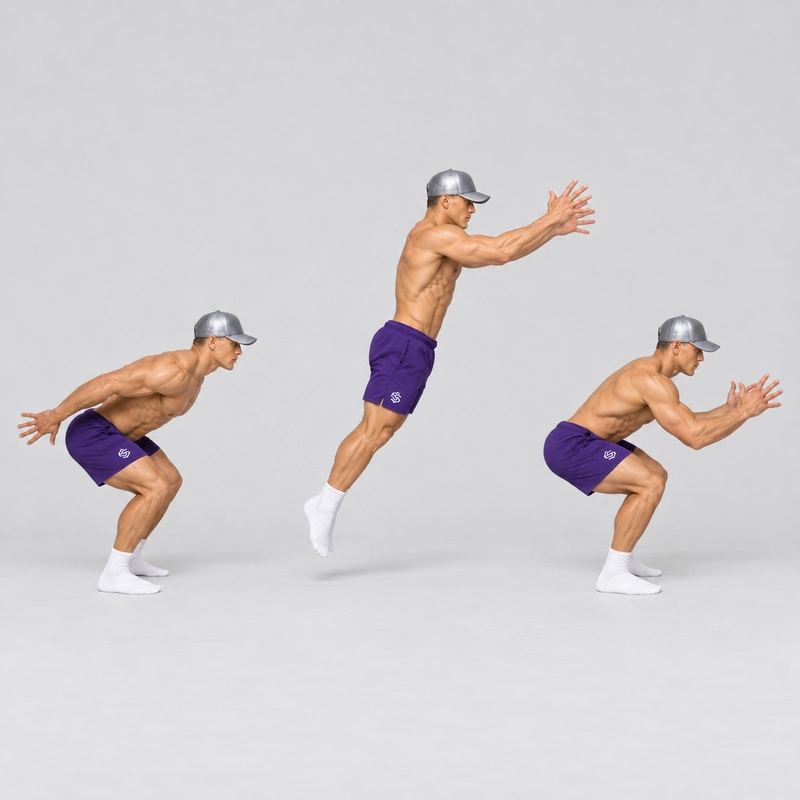
How to do Broad Jump?
The broad jump, also called the standing long jump, is a two-foot jump from a stationary start that aims to cover horizontal distance. You bend at the hips and knees, swing your arms, drive off the floor with both legs, and land on both feet without needing a recovery step. It trains explosive lower-body movement and the ability to control a forward landing.
Unlike jumping squats, which travel mainly upward, a broad jump sends your body forward. Unlike a box jump, it ends on the floor rather than on a raised platform. You need no equipment, but you do need enough clear space to take off and land on a level, nonslip surface.
Your legs produce the takeoff, but your arms are part of the technique rather than an afterthought: a coordinated arm swing can improve standing-long-jump performance, as discussed in this review of standing long jump research. Distance is only useful when you can also control where and how you land. Begin with shorter jumps if your longest attempt ends in a stumble, a hand touching down, or an uncomfortable landing.
Setup and preparation
Choose a clear, level area with firm footing and room beyond your expected landing point. Mark a takeoff line if you want to track distance, and stand behind it without taking a preparatory step. Wear footwear that grips the surface; avoid a loose mat that could slide under either foot.
Warm up with a few minutes of easy movement, comfortable squats, and several small practice jumps before attempting longer distances. The joint warm-up routine can form the mobility portion of your preparation, but follow it with easier versions of the jumps you plan to perform.
Step-by-step broad jump technique
- Set your stance: Stand with your feet roughly hip- to shoulder-width apart, toes pointing forward or slightly outward, and arms relaxed at your sides.
- Load the jump: Swing your arms behind you as you bend your hips and knees into a comfortable partial squat; keep your feet planted and your trunk controlled.
- Drive forward: Rapidly extend your hips, knees, and ankles while swinging your arms forward and upward, pushing the ground away so both feet leave the floor together.
- Travel through the air: Aim forward with enough upward lift to clear the ground, and bring your feet ahead of you as you prepare to land.
- Land on two feet: Contact the ground with both feet at about the same time, then allow your ankles, knees, and hips to bend to absorb the landing.
- Stick and reset: Keep your knees moving generally in the direction of your toes, regain full-foot pressure, hold your position briefly, and walk back for the next attempt.
Breathing and landing cues
Take a breath before you load, brace your trunk comfortably, and exhale during or just after takeoff. Breathe normally while you stabilize and reset. There is no need to hold your breath through a long series of jumps.
Think “jump forward, then land ready to stop.” Let your hips, knees, and ankles bend rather than landing with straight, rigid legs. A controlled landing may include a natural forward lean; forcing your torso perfectly upright can make balancing harder. The goal is a stable landing, not an artificially silent one or a particular foot-contact pattern.
What counts as a complete repetition?
Start from behind your takeoff point without a running step, leave the ground with both feet, land on both feet, and hold your landing without an immediate extra step or a hand touching down. If you cannot stick the landing, shorten the distance on the next attempt. Pause and reset between repetitions when learning the movement.
Common mistakes and fixes
- Jumping almost straight up: Direct your leg drive and arm swing forward as well as upward.
- Skipping the arm swing: Let your arms move behind you during the dip and forward as your legs extend.
- Starting with a run-up or step: Keep both feet set before takeoff if you are practicing or measuring a standing broad jump.
- Landing with stiff legs: Bend through your ankles, knees, and hips as your feet meet the ground.
- Reaching so far that you fall backward: Aim for a distance you can stabilize before trying to extend your feet farther in flight.
- Chasing distance after technique deteriorates: End the set when takeoffs slow down or landings become inconsistent.
How to train and measure it
For power practice, try 2–4 sets of 2–4 deliberate jumps, resting enough between attempts to approach each one with good speed and control. This is a starting example, not a required target; beginners can do fewer jumps and build from short, comfortable distances. Prioritize the quality of each takeoff and landing over accumulating repetitions.
To track distance, mark the takeoff line and measure to the landing mark nearest that line, usually the back of a heel. If a hand or another body part touches down behind the feet, that nearer mark determines the distance for that attempt. Use the same surface, footwear, takeoff rule, and measurement method when comparing sessions; formal tests may have additional rules.
Frequently asked questions
Is a broad jump the same as a standing long jump?
Yes. In this exercise, both names describe a horizontal jump from a stationary, two-foot start; the running long jump is a different event.
How far should a beginner jump?
There is no useful universal starting distance. Begin with a short jump you can land and hold, then increase the distance gradually while keeping the same standard.
Is a broad jump harder than a box jump?
They test different demands. A broad jump emphasizes horizontal travel and stopping on the floor, while a box jump emphasizes reaching and landing on a raised surface; neither is automatically the right next step for everyone.
What if my knees or ankles hurt when I land?
Stop the painful attempts, reduce the jump distance or return to lower-impact preparation, and seek qualified advice if pain persists or you are returning from an injury.
Tips for the proper execution of Broad Jump
Set your feet before every attempt so a small preparatory step does not turn the movement into a running jump.
Swing your arms behind you during the dip and forward as you push off the floor.
Aim forward with enough upward lift to give yourself time to bring your feet into a balanced landing.
Keep your gaze toward the landing area rather than dropping your head toward your feet.
Allow your hips, knees, and ankles to bend when you land instead of locking your legs straight.
Hold each landing briefly before walking back to the start.
Stop the set when you can no longer reproduce a controlled two-foot landing.
Muscles worked when doing Broad Jump
Primary muscles: The quadriceps, glutes, and calves contribute strongly to the explosive takeoff, while the quadriceps and glutes help control the landing.
Secondary muscles: The hamstrings assist at the hips and help control the landing; the abdominal and lower-back muscles help stabilize the trunk during takeoff, flight, and landing.
Primary Muscle(s):
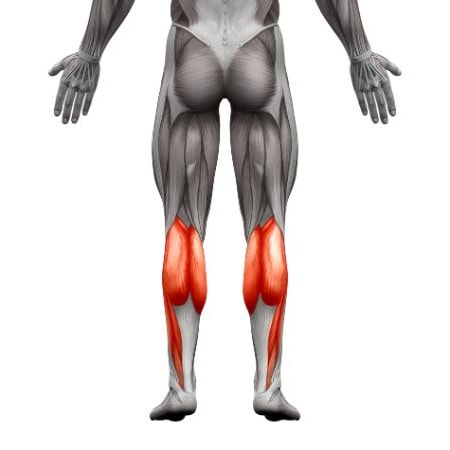
Calf
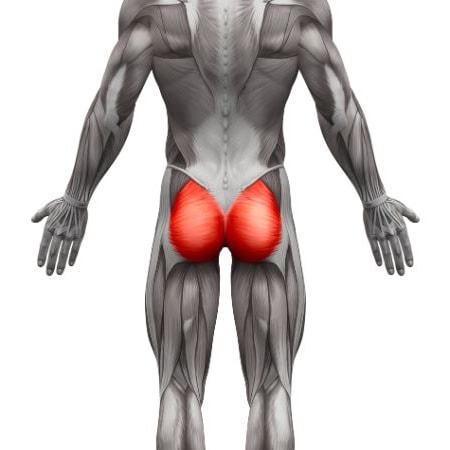
Glutes
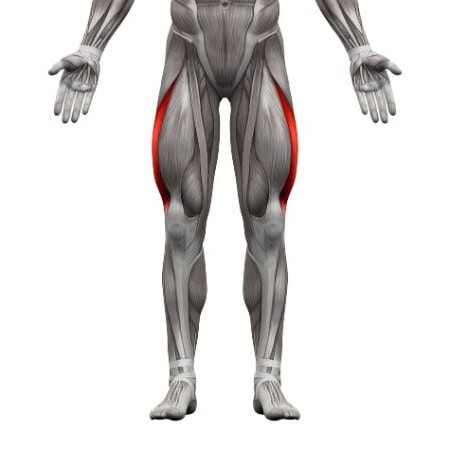
Quads
Secondary Muscle(s):
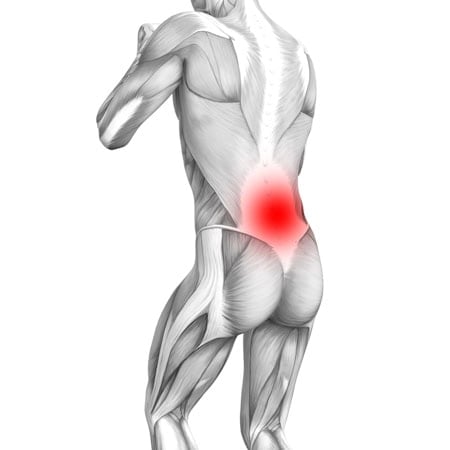
Lower back
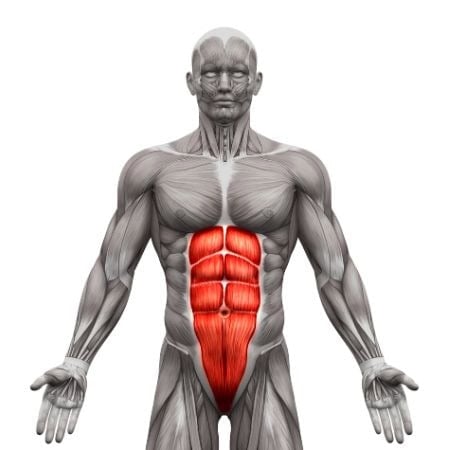
Abdominal
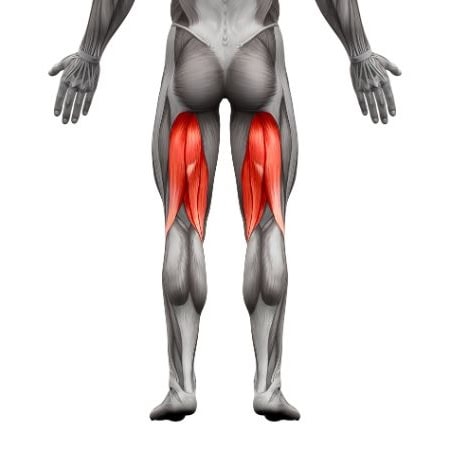
Hamstring
Equipment needed for Broad Jump
No equipment needed for this exercise.
Adjust the difficulty of Broad Jump
How to make Broad Jump harder?
How to make Broad Jump easier?
How to make Broad Jump harder?
To make Broad Jump harder:
-
Increase the target distance in small increments while still holding every landing without an extra step.
-
Begin from a motionless partial squat to reduce help from the quick countermovement.
-
Keep your hands on your hips to make the legs perform the jump without an arm swing.
-
Link two broad jumps together only after you can consistently control the landing of each individual jump.
How to make Broad Jump easier?
To make Broad Jump easier:
-
Practice bodyweight squats to become comfortable bending and extending your hips and knees.
-
Perform a partial squat followed by a strong calf raise and arm swing to rehearse takeoff without leaving the floor.
-
Practice small two-foot jumps in place and hold each landing before adding forward distance.
-
Jump forward only a short, comfortable distance and pause for two seconds after landing.