
High Box Jump
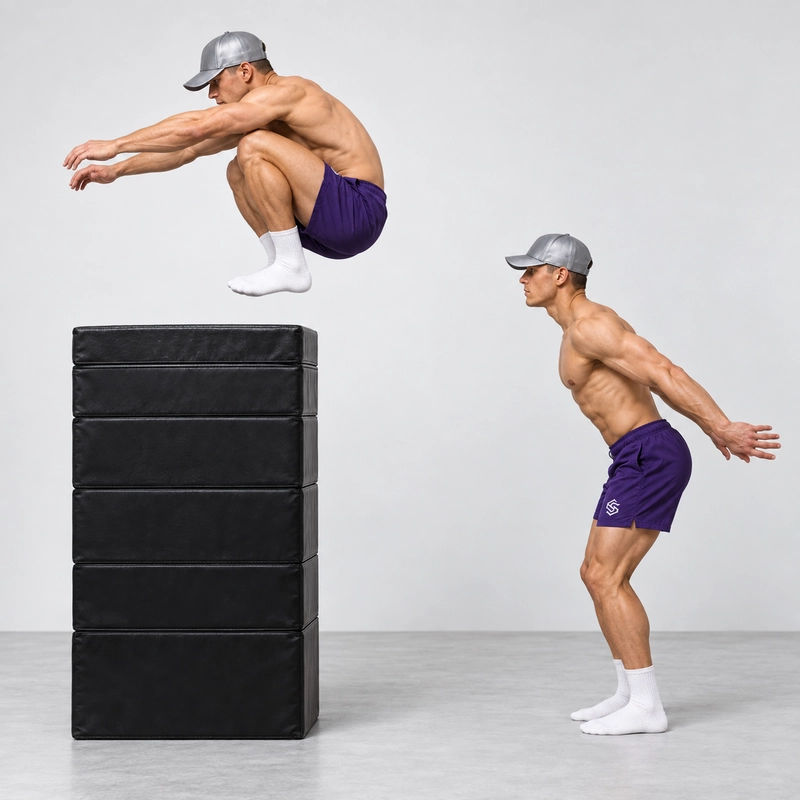
How to do High Box Jump?
The High Box Jump is an advanced plyometric exercise in which you jump from a stationary two-foot stance onto a tall, stable platform. Compared with a standard Box Jump, the higher obstacle requires a more powerful takeoff, faster hip and knee flexion in the air, greater foot clearance and a more compact landing position.
The defining difference is not a universal box measurement. A platform is “high” relative to the athlete when it cannot be cleared with the moderate knee bend and partial-squat landing used for an ordinary Box Jump. You must first extend forcefully from the floor and then deliberately pull your knees and feet upward to clear the edge.
A High Box Jump measures more than explosive power. Box height is influenced by your vertical displacement, body proportions, hip mobility, knee-tuck speed and how deeply you can land. It should therefore be treated as an obstacle-clearance skill rather than an accurate measurement of your vertical jump.
A 2024 study involving 31 recreationally active adults compared jumps at box heights ranging from 0% to 80% of each participant’s maximum box-jump height. Box height generally did not change the measured propulsive performance when the athletes were instructed to jump with maximal intent. This supports an important distinction: a higher box changes the clearance and landing challenge, but it does not automatically produce a more powerful takeoff. See the box-height study on PubMed.
High Box Jump quick facts
| Exercise type | Advanced plyometric and obstacle-clearance skill |
|---|---|
| Primary equipment | Tall, stable plyometric box or fixed platform |
| Difficulty | High |
| Takeoff | Stationary simultaneous two-foot jump |
| Defining feature | Deliberate knee tuck and compact landing required to clear the box |
| Primary training quality | Explosive takeoff combined with rapid lower-body repositioning |
| Standard exit | Stand upright and step down under control |
High Box Jump versus standard Box Jump
| Standard Box Jump | High Box Jump |
|---|---|
| Uses a moderate box selected for repeatable power training. | Uses a substantially taller box selected for advanced obstacle clearance. |
| Requires only enough hip and knee flexion to clear the edge. | Requires a fast and deliberate knee tuck after takeoff. |
| Ends in a controlled partial squat reasonably similar to the countermovement depth. | Normally ends in a deeper and more compact squat position. |
| Can be programmed for several high-quality repetitions. | Is best performed for very low repetitions with complete recovery. |
| Prioritizes repeatable takeoff and landing mechanics. | Prioritizes maximal or near-maximal clearance skill while retaining control. |
If the box can be cleared without a pronounced knee tuck and noticeably deeper landing, the exercise remains a standard Box Jump rather than a separate High Box Jump.
Benefits of the High Box Jump
- Challenges explosive lower-body extension: The glutes, quadriceps and calves must produce a forceful takeoff before the legs can be repositioned for clearance.
- Develops rapid knee-tuck coordination: You must change quickly from extending the lower body to flexing the hips and knees after leaving the floor.
- Improves obstacle-clearance ability: The exercise develops confidence and coordination when moving the feet onto a tall surface.
- Challenges landing control: You must stabilize on an elevated platform while the hips and knees are in a more flexed position than during a standard Box Jump.
- Provides a measurable skill goal: Box height can be tracked when takeoff style, equipment and repetition standards remain consistent.
- Exposes limiting factors: Video can help distinguish insufficient takeoff height from a slow knee tuck, poor foot clearance or unstable landing.
A High Box Jump is not inherently better for developing power than a lower Box Jump. Its additional value comes primarily from the coordination, mobility, confidence and obstacle-clearance demands created by the taller platform.
Are you ready for High Box Jumps?
You should already be comfortable with ordinary Box Jumps before increasing the obstacle height. The following are practical readiness markers rather than compulsory performance tests:
- You can perform repeated standard Box Jumps without catching the edge, hesitating or landing asymmetrically.
- You consistently land with both feet fully supported and can hold the landing without taking a recovery step.
- You can perform controlled Jumping Squats with a balanced two-foot takeoff and landing.
- You can perform a vertical tuck jump and bring both knees upward without leaning excessively backward.
- You can squat deeply enough to assume the intended landing position without the heels lifting or the knees collapsing inward.
- Your ankles, knees, hips and lower back tolerate lower box jumps without sharp pain or instability.
- You can clear the height immediately below your planned box setting with a visible margin for error.
If you regularly clip the edge, land with only the front of your feet supported or need your hands to prevent a fall, return to the standard Box Jump and rebuild your clearance gradually.
Equipment and setup
Use a purpose-built plyometric box or fixed platform with a broad, flat and nonslip landing surface. The equipment must remain stable when you take off nearby, land near its center and stand upright.
- Inspect the box and surrounding floor before every session.
- Do not create height by stacking loose plates, benches or unsecured boxes.
- Make sure a modular or adjustable box is locked into its intended configuration.
- Check that a foam box does not compress, rotate or tip when landed on.
- Keep the takeoff area, landing surface, ceiling and step-down area unobstructed.
- Wear footwear that grips both the floor and the top of the box.
- Use a height-adjustable setup that can be increased in small increments.
A soft foam plyo box can make accidental shin contact less severe, but softness does not compensate for instability or an inappropriate height. Do not stack an ordinary foam box on loose equipment to create a maximal platform.
How to choose the box height
There is no universal number that separates a standard Box Jump from a High Box Jump. The same 76-centimeter or 30-inch box may be an ordinary training height for one athlete and a near-maximal challenge for another.
Begin with a box you can clear consistently, then increase the height by the smallest secure increment available. The next height is appropriate only when you can:
- Commit to the jump without repeated hesitation or aborted attempts.
- Complete your hip, knee and ankle extension before beginning the tuck.
- Lift both feet clearly above the front edge.
- Land with the entire surface of both feet on the box.
- Control the deeper squat position without touching the box with your hands.
- Stand upright without stepping, falling forward or jumping off immediately.
Reduce the height when the landing becomes a collapse rather than a controlled squat, your thighs are forced tightly against your torso, or your feet repeatedly reach only the front edge.
How to warm up for a High Box Jump
- Complete several minutes of easy general movement to raise your body temperature.
- Move the ankles, knees and hips through comfortable ranges using the Joint Warm-Up Routine if helpful.
- Perform controlled squats and several low pogo-style or vertical jumps.
- Practise a few submaximal tuck jumps without a box.
- Complete two or three sets of ordinary Box Jumps at an easy height.
- Increase the box progressively rather than moving directly from the warm-up height to your highest attempt.
- Finish the warm-up before fatigue begins reducing your takeoff speed.
How to do the High Box Jump
- Set the box to a challenging but previously manageable height and confirm that it cannot slide, rotate or tip.
- Stand facing the box approximately one short step away with your feet around hip- to shoulder-width apart.
- Direct your eyes toward the center of the landing surface rather than staring at the front edge.
- Distribute your weight evenly across both feet and allow your arms to hang naturally.
- Take a controlled breath and brace your trunk without becoming rigid.
- Swing your arms behind you while bending your hips and knees into a quick countermovement.
- Reverse the countermovement forcefully and swing your arms forward and upward.
- Drive through both feet and extend your hips, knees and ankles before beginning the knee tuck.
- Once both feet have left the floor, rapidly flex your hips and knees to pull your thighs upward.
- Lift your feet above the front edge while keeping the left and right leg movements symmetrical.
- Place both feet fully on the landing surface at approximately the same time.
- Allow your ankles, knees and hips to bend into a compact squat while keeping the knees aligned with the toes.
- Stabilize your torso and hold the landing without touching the box or taking an additional step.
- Stand fully upright on the platform to demonstrate control.
- Step down one foot at a time and reset completely before the next repetition.
The extension-to-tuck sequence
The most important technical distinction is the order of the takeoff and knee tuck. First create height by extending forcefully through the hips, knees and ankles. Only after leaving the floor should you pull the knees upward to clear the obstacle.
Tucking too early interrupts lower-body extension and may produce the appearance of a dramatic jump without maximizing the height reached by your center of mass. Think “jump tall, then tuck” rather than trying to begin the movement with your knees already travelling toward your chest.
The tuck should lift the feet over the front edge without causing the torso to fall excessively backward. Bring both knees upward together, keep the feet level and prepare to place the entire foot on top of the box.
High Box Jump form standard
A clean repetition meets the following standards:
- You begin from a stationary standing position without a run-up or preparatory step.
- Both feet remain planted until the countermovement begins.
- You leave the floor from both feet at approximately the same time.
- You complete a visible lower-body extension before pulling the knees upward.
- Neither foot, shin nor knee contacts the front of the box.
- Both feet land fully on the upper surface rather than hanging over the edge.
- Your hands do not touch the box or your thighs for assistance.
- Your knees remain controlled instead of collapsing sharply inward.
- You stabilize the landing without an immediate recovery step.
- You stand completely upright before stepping down.
- You step down instead of jumping backward from the platform.
If you are tracking a personal record, use the same takeoff style, footwear and equipment each time. Record the measured platform height and whether the attempt was standing, paused, seated or performed with an approach because these versions are not directly comparable.
High Box Jump versus vertical jump height
Your box-jump result should not be reported as your vertical jump. A vertical-jump test measures how far your center of mass or reaching height moves upward, whereas a High Box Jump also rewards the ability to pull the knees and feet upward and land in a deep squat.
Two athletes with the same vertical takeoff height may clear different boxes because of differences in leg length, hip mobility, knee-tuck speed and landing depth. Track vertical-jump height separately if your objective is to assess improvements in pure vertical propulsion.
Common High Box Jump mistakes
| Mistake | How to correct it |
|---|---|
| Choosing a near-maximal height before mastering ordinary Box Jumps | Return to a lower box and accumulate successful repetitions with full-foot landings. |
| Tucking before completing the takeoff | Think “extend, then tuck” and practise maximal vertical jumps without a box. |
| Standing too far from the platform | Move closer so that the jump travels primarily upward with only the forward motion needed to reach the box. |
| Standing almost against the box | Leave enough space for a natural arm swing and slight forward travel without striking the edge. |
| Looking only at the front edge | Focus on the center of the upper landing surface to guide your feet farther onto the platform. |
| Landing with the heels unsupported | Reduce the box height and aim to place both feet completely beyond the front edge. |
| Landing one foot before the other | Use a lower height and practise symmetrical tuck jumps before rebuilding the progression. |
| Collapsing into the deepest possible squat | Lower the box until you can absorb the landing without losing trunk, knee or foot control. |
| Touching the platform with the hands | Treat the attempt as unsuccessful and reduce the height rather than using the hands to save the landing. |
| Stacking loose plates or boxes | Use a purpose-built adjustable platform with a sufficiently large and stable landing surface. |
| Repeating the jump immediately | Step down, reset and recover so that every repetition begins with full attention and power. |
| Jumping down from the high box | Step down using an intermediate platform when necessary to avoid an unnecessarily large drop. |
| Continuing after a near miss | Reduce the height or end the session because contact with the edge indicates that your clearance margin has disappeared. |
| Treating box height as vertical-jump height | Measure vertical jumping separately and use box height only as an obstacle-clearance result. |
High Box Jump progression
- Controlled squat: Develop the strength and mobility to enter and stabilize the intended landing position.
- Snap-down landing drill: Practise moving rapidly into a balanced partial squat without leaving the floor.
- Jumping Squat: Learn a simultaneous two-foot takeoff and controlled floor landing.
- Vertical jump and stick: Jump upward and stabilize each landing before adding an obstacle.
- Tuck jump: Practise completing the takeoff before pulling both knees upward.
- Low Box Jump: Learn to clear an edge and place both feet fully on an elevated surface.
- Standard Box Jump: Develop repeatable power and landing control on a moderate platform.
- Progressively higher Box Jump: Add height in small increments while preserving symmetrical takeoff and full-foot landings.
- High Box Jump: Clear a platform that requires a deliberate knee tuck and compact landing without losing control.
- Max-height attempt: Test a near-maximal platform only occasionally and stop after the first contact, unstable landing or aborted attempt.
How to program High Box Jumps
Perform High Box Jumps early in a lower-body or power session after warming up and before fatiguing squats, lunges or conditioning work. The following is a conservative coaching framework rather than a universal prescription:
- Perform three to six sets of one to three high-quality repetitions.
- Reset completely between individual jumps.
- Rest approximately two to four minutes between demanding sets.
- Use a height below your absolute maximum for most training sessions.
- Reserve true personal-record attempts for occasional testing rather than every workout.
- Begin with one or two sessions per week depending on your other running, jumping and leg training.
- Stop the set when takeoff height, foot clearance or landing control deteriorates.
- Avoid using High Box Jumps for high-repetition conditioning or training to failure.
Track both box height and landing quality. Progress may mean clearing a slightly higher box, landing more upright on the same box or reproducing the same result with less hesitation and more control.
Safety considerations
A taller box reduces your clearance margin and increases the consequences of catching the front edge. Use conservative height increases and treat every contact, unstable landing or aborted takeoff as a reason to reduce the height or end the session.
- Never use a chair, narrow bench or unsecured stack of weight plates.
- Do not hold dumbbells or other loose external loads during a High Box Jump.
- Use an intermediate step when the platform is too tall to step down comfortably in one movement.
- Avoid maximal attempts when your legs are fatigued or the box surface is wet.
- Do not let another person push or lift you during takeoff.
- Stop if you experience sharp ankle, Achilles tendon, knee, hip or lower-back pain.
- Obtain individualized guidance when returning from a recent lower-body injury or experiencing repeated instability.
Frequently asked questions
What height counts as a High Box Jump?
There is no universal height because the challenge depends on your jumping ability, body proportions and landing mobility. It becomes a High Box Jump when a pronounced knee tuck and substantially more compact landing are required compared with your standard Box Jump.
Is a High Box Jump the same as a max-height Box Jump?
A High Box Jump can be trained below your maximum, while a max-height Box Jump specifically tests the tallest platform you can clear under a defined technique standard.
Does jumping onto a higher box mean I have a higher vertical jump?
No. A higher box can be cleared through a faster or deeper knee tuck even when the height reached by your center of mass does not increase.
Should I pull my knees toward my chest?
Yes, but only after completing the explosive takeoff. Pulling the knees upward too early can interrupt hip and knee extension.
How deeply should I land?
A High Box Jump naturally requires a deeper landing than the standard version, but you should still control the squat without the knees collapsing, the heels lifting or the torso falling onto the thighs.
Should I use a run-up?
The canonical version uses a stationary two-foot start. A run-up or approach step creates a separate variation and should be recorded independently.
Can I stack weight plates on top of a box?
No. Loose plates reduce the usable landing area and may shift during takeoff or landing, so use purpose-built adjustable equipment instead.
Should I jump back down?
No. Stand upright and step down under control, using an intermediate platform when the box is too tall for one comfortable step.
Are High Box Jumps better for power than ordinary Box Jumps?
Not necessarily. A lower box can produce a similarly forceful takeoff while allowing a taller and more repeatable landing, whereas the High Box Jump places greater emphasis on obstacle clearance and knee-tuck coordination.
Why can I jump high but still struggle to clear the box?
Your limiting factor may be the timing or speed of your knee tuck, foot clearance, confidence near the obstacle or ability to stabilize a compact landing rather than takeoff power alone.
Tips for the proper execution of High Box Jump
Master the standard Box Jump before attempting a platform that requires a pronounced knee tuck.
Use a purpose-built box with a broad, nonslip and completely stable landing surface.
Stand close enough to travel mainly upward while leaving room for a natural arm swing.
Direct your eyes toward the center of the landing surface instead of the front edge.
Swing your arms backward during the countermovement and forcefully upward during takeoff.
Extend your hips, knees and ankles before beginning the knee tuck.
Pull both knees upward together after your feet leave the floor.
Lift both feet clearly above the front edge rather than scraping over it.
Aim to place the entire surface of both feet on top of the box.
Keep your knees tracking in approximately the same direction as your toes during landing.
Stabilize the compact squat position before trying to stand.
Stand completely upright to demonstrate control before stepping down.
Reset fully between repetitions instead of rebounding immediately.
Film from the side to distinguish actual takeoff height from knee-tuck height.
Increase the platform in the smallest secure increments available.
End the session after a near miss, edge contact or unstable landing.
Muscles worked when doing High Box Jump
The High Box Jump uses the same primary takeoff muscles as a standard Box Jump, but the taller obstacle places additional emphasis on rapid hip and knee flexion after takeoff.
Primary muscles
- Quadriceps: Extend the knees during takeoff and help control knee flexion during the compact landing.
- Glutes: Produce powerful hip extension and help stabilize the hips and knees when landing.
- Calves: Contribute to ankle plantar flexion during the final portion of takeoff and help control the landing.
Secondary muscles
- Hip flexors: Rapidly lift the thighs after takeoff so the feet can clear the higher front edge.
- Hamstrings: Assist hip extension during propulsion and contribute to knee and hip control during landing.
- Abdominals: Stabilize the trunk and help coordinate the compact aerial tuck.
- Lower back: Helps maintain trunk control during the countermovement, flight and landing.
- Hip abductors and adductors: Help keep the thighs and knees aligned during takeoff and landing.
- Shoulders and upper back: Produce and control the arm swing used to support takeoff momentum.
The muscles producing the takeoff do not necessarily work harder simply because the box is taller. Greater box height can also be achieved through a faster knee tuck and deeper landing, so box height should not be used as a direct measure of muscular power.
Primary Muscle(s):
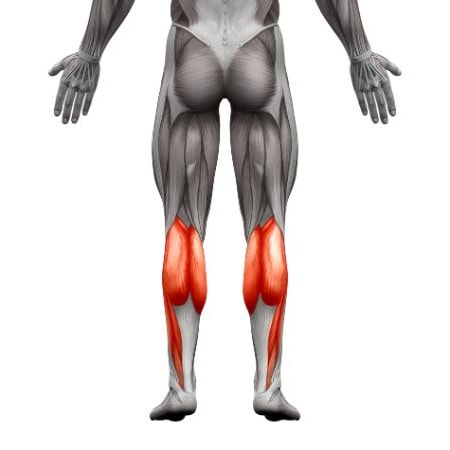
Calf
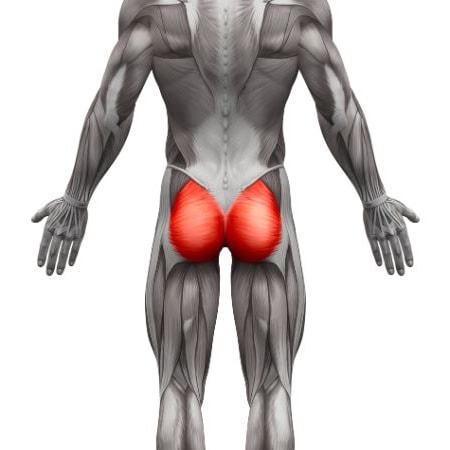
Glutes
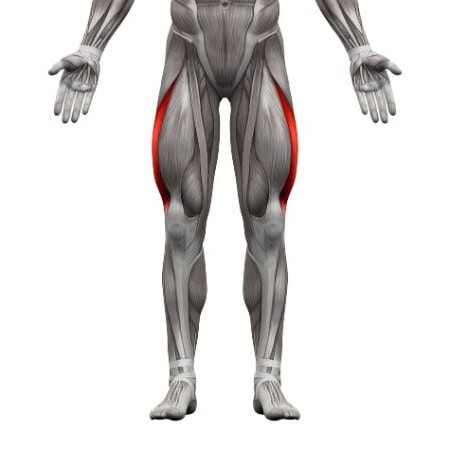
Quads
Secondary Muscle(s):
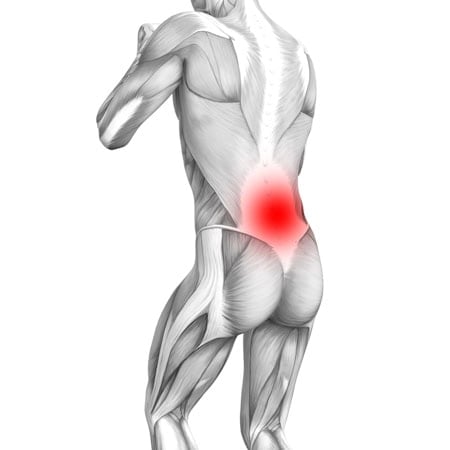
Lower back
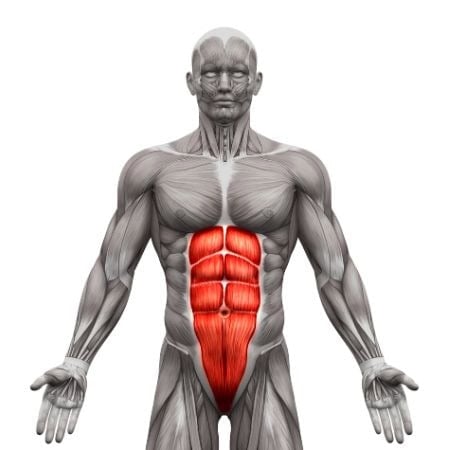
Abdominal
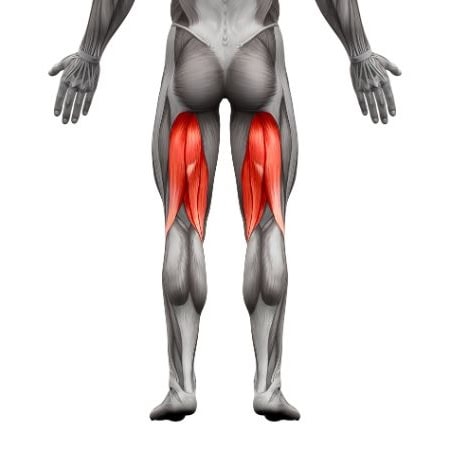
Hamstring
Equipment needed for High Box Jump
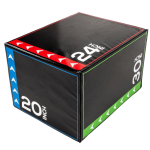
Adjust the difficulty of High Box Jump
How to make High Box Jump harder?
How to make High Box Jump easier?
How to make High Box Jump harder?
To make High Box Jump harder:
-
Increase the box height by the smallest secure increment while preserving the complete repetition standard.
-
Land more upright on the same box to rely less on knee tuck and deeper hip flexion.
-
Keep your hands on your hips to remove assistance from the arm swing.
-
Pause in the countermovement position before jumping to reduce assistance from the rapid stretch-shortening cycle.
-
Begin from a stable seated position to remove the normal countermovement before takeoff.
-
Perform two or three consecutive high-quality repetitions with a complete reset between each jump.
-
Use a smaller countermovement while maintaining the same box height and landing control.
-
Test a true max-height attempt only after completing several successful submaximal heights during the same session.
How to make High Box Jump easier?
To make High Box Jump easier:
-
Return to the standard Box Jump and use a height that allows a controlled partial-squat landing.
-
Reduce the platform by the smallest secure height increment available.
-
Practise vertical jumps without a box to improve the takeoff without an obstacle.
-
Practise tuck jumps to improve the extension-to-tuck sequence before returning to the box.
-
Use a soft foam plyometric box of appropriate stability to reduce fear of accidental shin contact.
-
Perform single repetitions with a complete physical and mental reset between attempts.
-
Practise landing in a deep squat from a low step before combining that position with a high jump.
-
Use a clearly marked target on a lower box to improve foot placement and landing accuracy.
-
Increase the height only after completing several identical full-foot landings at the current level.
-
End the progression below your maximum and retain a visible clearance margin.