
Hanging Windshield Wipers
How to do Hanging Windshield Wipers?
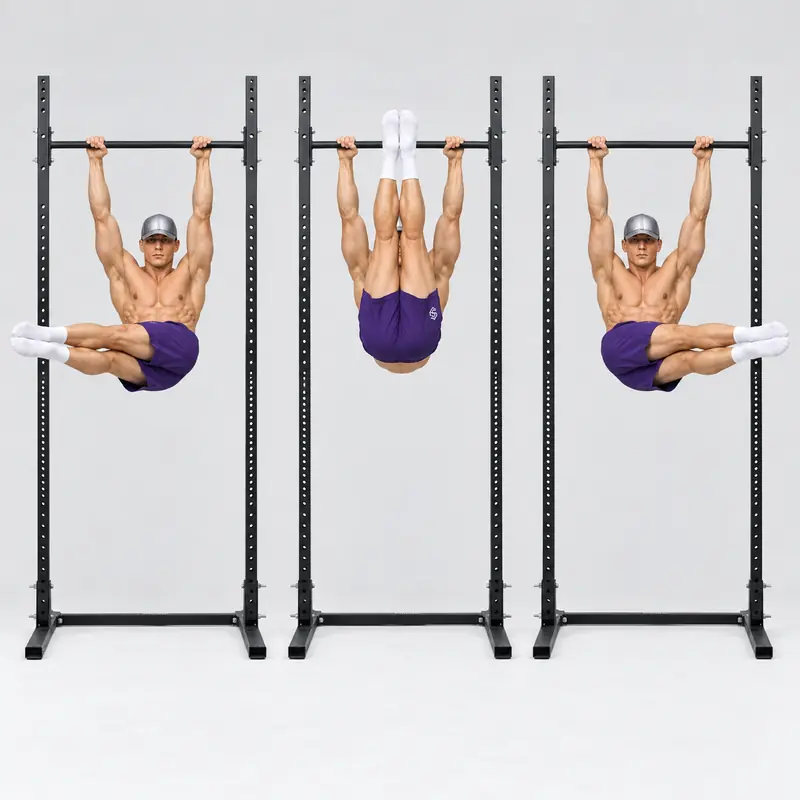
Hanging windshield wipers are an advanced core exercise performed from a pull-up bar. From a high straight-leg position with your feet close to the bar, you sweep both legs toward one side, return through the center and repeat toward the opposite side. The legs move like a car’s windshield wipers while the upper body remains as stable as possible.
The exercise combines the straight-leg compression required for toes to bar with demanding side-to-side trunk control. Before attempting the full movement, build the necessary hanging strength with hanging knee raises, hanging leg raises and controlled toes-to-bar repetitions.
The strict version on this page uses straight elbows, joined legs and a controlled arc without kipping. Other legitimate versions use bent elbows and a more reclined torso, but the chosen standard should remain consistent throughout a set. This hanging windshield wiper demonstration illustrates the straight-arm version and its characteristic side-to-side movement.
A small laboratory study of the hanging straight-leg raise—not windshield wipers specifically—found high activity in the rectus abdominis and external oblique. It also demonstrated that advanced hanging leg movements can create substantial trunk-loading demands, supporting the use of controlled repetitions and appropriate progressions rather than momentum-driven volume. See the hanging leg raise muscle-activity study for the full research context.
How to Correctly Perform Hanging Windshield Wipers
Equipment and setup
Use a stable pull-up bar that can support your full body weight and provides clearance below and to both sides of your body. Avoid bars positioned close to walls, posts or other equipment because your legs need room to travel through a wide lateral arc.
General hanging leg raise safety guidance recommends using a stable bar and wrapping the thumbs around it for a secure grip. Do not perform the exercise from an unsecured doorway ledge or another surface not designed for hanging exercise.
Starting position
- Take a closed overhand grip: Grip the bar approximately shoulder-width apart, wrapping your thumbs around it. Hang with your feet clear of the floor.
- Create an active hang: Keep your elbows straight and gently pull your shoulders away from your ears. Brace your abdomen, bring your ribs down and keep your legs together.
- Remove any swing: Wait until your body is still before beginning. Starting with momentum makes the rotational phase much harder to control.
Step-by-step execution
- Raise your legs: Perform a strict toes-to-bar-style leg raise, lifting both straight legs until your feet approach the bar.
- Establish the center position: Keep your knees straight, legs together and pelvis slightly tucked. Your feet should be close to the bar without requiring a forceful kick.
- Sweep toward the first side: Rotate your pelvis and move both legs together in a controlled arc. Keep your shoulders facing forward and your hands fixed on the bar.
- Reach the side position: Lower the legs toward the side until they approach parallel with the floor, or stop earlier if you cannot maintain straight knees and a stable upper body.
- Return through the center: Use your obliques and abdominal muscles to bring your feet back toward the bar. Avoid dropping into a full hang between sides.
- Sweep toward the opposite side: Repeat the same controlled arc in the other direction, aiming for approximately equal depth on both sides.
- Complete the repetition: Return your feet to the center position. One movement to the left and one to the right counts as one complete cycle.
- Finish under control: After the final cycle, lower your legs gradually into a stable hang instead of letting them fall and create a swing.
The page standard uses straight elbows throughout the movement. A bent-arm version with the torso pulled farther back is also recognized in established windshield wiper coaching guidance, but it should be presented as a variation rather than mixed with the straight-arm completion standard.
Breathing
Take a controlled breath before raising your legs. Exhale during the initial lift and during the hardest portion of each return toward the center. Use short, controlled breaths at the top instead of holding your breath for the entire set.
Completion standard
- Use a secure closed grip and begin without visible swinging.
- Keep both elbows straight throughout the page-standard version.
- Keep the legs together and the knees straight.
- Return the feet close to bar height between sides.
- Move the legs toward a similar depth on the left and right.
- Control both the lowering and returning portions of the movement.
- Do not use a kip, forceful kick or rebound to change direction.
- Count one left-and-right cycle as one complete repetition.
Common Mistakes
- Starting with a swing: Pause in a quiet hang before raising your legs and reset whenever momentum starts controlling the movement.
- Kicking the feet to the bar: Build more strength with strict hanging leg raises before attempting full windshield wipers.
- Allowing the legs to fall below the working position: Reduce the side-to-side range or bend the knees until you can keep the feet elevated.
- Twisting through the shoulders: Keep the chest facing generally forward while the pelvis and legs create the rotational movement.
- Bending the knees unintentionally: Use an intentional bent-knee regression instead of switching between straight and bent legs during a repetition.
- Moving much farther on one side: Match the range to your weaker direction and gradually develop symmetry.
- Rushing through the center: Briefly control the feet near the bar instead of bouncing from one side to the other.
- Continuing after grip or shoulder position fails: End the set before the hands open, elbows bend unexpectedly or shoulders collapse toward the ears.
Benefits of Hanging Windshield Wipers
- Dynamic rotational core strength: The obliques produce and control the side-to-side movement while the rest of the abdominal wall maintains leg height.
- Straight-leg compression: Holding the legs close to the bar challenges the abdominal muscles and hip flexors through a demanding position.
- Hanging body control: The exercise teaches you to move the lower body without relying on uncontrolled swinging.
- Grip endurance: The hands and forearms must support the entire set while the legs create changing rotational forces.
- Shoulder and lat stability: The lats, scapular muscles and shoulders maintain the active hanging position.
- Left-to-right coordination: Alternating directions can reveal differences in range, strength or control between sides.
Readiness and Safety
Hanging windshield wipers are not a beginner abdominal exercise. Useful readiness checks include a comfortable active hang, several strict hanging leg raises, controlled toes-to-bar repetitions and the ability to prevent swinging during an L-hang. These are practical coaching checks rather than universal pass-or-fail requirements.
Begin with bent knees or a partial lateral range if your legs drop uncontrollably. Do not force the feet lower simply to claim a larger range of motion. Stop if you experience sharp pain in the shoulders, elbows, hands, lower back, hips or groin. Anyone with an existing injury or pain during overhead hanging should seek guidance from an appropriately qualified healthcare or training professional.
Progression Path
- Hollow body hold
- Elbow side plank
- Lying bent-knee windshield wipers
- Lying straight-leg windshield wipers
- Hanging knee raises
- Hanging bent-knee windshield wipers
- Hanging leg raises
- Strict toes to bar
- Partial-range hanging windshield wipers
- Full hanging windshield wipers
How to Program Hanging Windshield Wipers
Train the exercise near the beginning of a core or upper-body session, after warming up but before grip and abdominal fatigue become limiting. Quality and symmetry are more important than accumulating high repetition counts.
- Skill practice: Perform 3–4 sets of 1–3 controlled cycles with 2–3 minutes of rest.
- Strength: Perform 3–4 sets of 2–5 cycles, stopping before range or knee position deteriorates.
- Tempo practice: Take approximately 2–4 seconds to move toward each side and return through the center.
- Frequency: One or two sessions per week is a reasonable starting point for most prepared athletes.
Regress the movement when you cannot return the feet to bar height, when one side becomes noticeably shallower or when momentum determines the direction change.
Frequently Asked Questions
Are hanging and lying windshield wipers the same exercise?
No. Both use side-to-side leg movement, but the hanging version adds grip, overhead shoulder stability and the challenge of holding the legs against gravity. The lying version is a useful regression but should have a separate exercise page.
Do my toes need to touch the bar?
Touching the bar provides a clear reference point, but it is not essential if you can bring your feet consistently close to bar height without kicking or bending your knees.
Should my arms remain straight?
For the completion standard on this page, yes. A bent-arm version with a more reclined torso is a legitimate variation, but it changes the upper-body demand and should not be mixed into a set being evaluated against the straight-arm standard.
What counts as one repetition?
Moving from the center to one side, through the center to the other side and returning to the center counts as one complete repetition or cycle.
Why do I feel the exercise in my hip flexors?
The hip flexors help hold the legs close to the torso. This is expected, but the abdomen should remain braced and the pelvis controlled rather than allowing the lower back to arch excessively.
Can hanging windshield wipers be performed on rings?
They can, but independent rings add considerable instability and make it harder to control the shoulders and upper body. Master the pull-up-bar version first. A separate ring page would only be worthwhile if Calisthenics.com produces ring-specific demonstration media and technique guidance.
Tips for the proper execution of Hanging Windshield Wipers
Begin every set from a completely still hang.
Wrap your thumbs around the bar to create a secure closed grip.
Keep your shoulders active and away from your ears.
Move both legs together as one long lever.
Match your range of motion to your weaker side.
Return your feet to bar height before changing direction.
Reduce the range as soon as momentum starts controlling the movement.
Count one left-and-right cycle as one repetition.
Lower your legs gradually after the final repetition.
Muscles worked when doing Hanging Windshield Wipers
Hanging windshield wipers primarily challenge the obliques and the rest of the abdominal wall. The shoulders, lats, forearms and hip flexors support the hanging position and keep the legs elevated.
Primary muscles
- Internal and external obliques: Produce and control the side-to-side rotation while helping return the legs toward the center.
- Rectus abdominis: Helps maintain the tucked pelvic position and prevents the legs from dropping out of the working range.
- Transverse abdominis: Contributes to abdominal bracing and trunk control throughout the arc.
Secondary muscles
- Hip flexors: Maintain hip flexion and help keep the feet close to bar height.
- Latissimus dorsi: Supports the active hang and helps limit unwanted upper-body movement.
- Shoulders and scapular stabilizers: Maintain the overhead position as the legs change direction.
- Forearms and grip muscles: Keep the hands secured to the bar throughout the set.
- Quadriceps: Keep the knees extended.
- Adductors: Help hold the legs together as a single lever.
- Glutes: Contribute to pelvic and leg-position control.
Research on the related hanging straight-leg raise found substantial rectus abdominis and external-oblique activity, although the study did not test hanging windshield wipers directly. The rotational emphasis described here is therefore based on the movement’s biomechanics and established coaching practice rather than direct comparative research on this exact variation.
Primary Muscle(s):
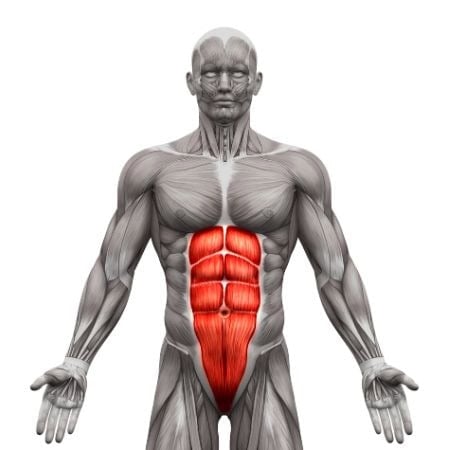
Abdominal
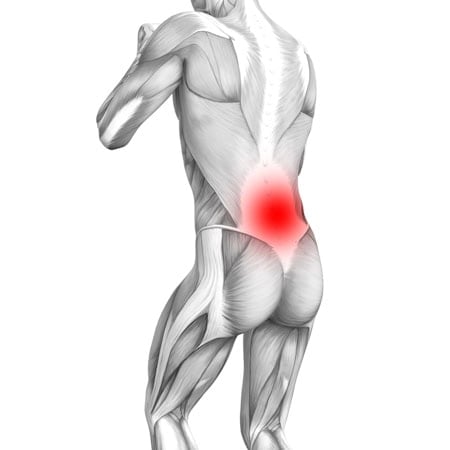
Lower back
Secondary Muscle(s):
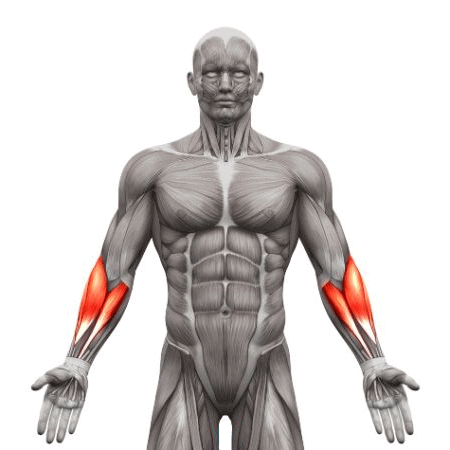
Forearm
Equipment needed for Hanging Windshield Wipers
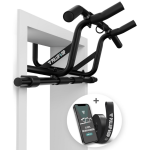
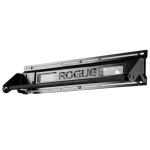
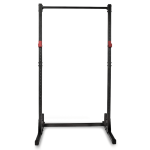
Adjust the difficulty of Hanging Windshield Wipers
How to make Hanging Windshield Wipers harder?
How to make Hanging Windshield Wipers easier?
How to make Hanging Windshield Wipers harder?
To make Hanging Windshield Wipers harder:
-
Pause for two to three seconds at each side position.
-
Take four to five seconds to return from each side to the center.
-
Perform consecutive full-range cycles without resetting in a dead hang.
-
Add very light ankle weights only after mastering symmetrical strict repetitions.
-
Perform the exercise on gymnastics rings for substantially greater instability.
How to make Hanging Windshield Wipers easier?
To make Hanging Windshield Wipers easier:
-
Perform lying bent-knee windshield wipers with your back supported by the floor.
-
Perform lying straight-leg windshield wipers before progressing to the pull-up bar.
-
Use hanging bent-knee windshield wipers to shorten the leg lever.
-
Move through a smaller side-to-side range while keeping your feet elevated.
-
Practice one controlled side at a time and reset between repetitions.
-
Build straight-leg compression with strict hanging leg raises and toes to bar.