
L-Sit on Dip Bars
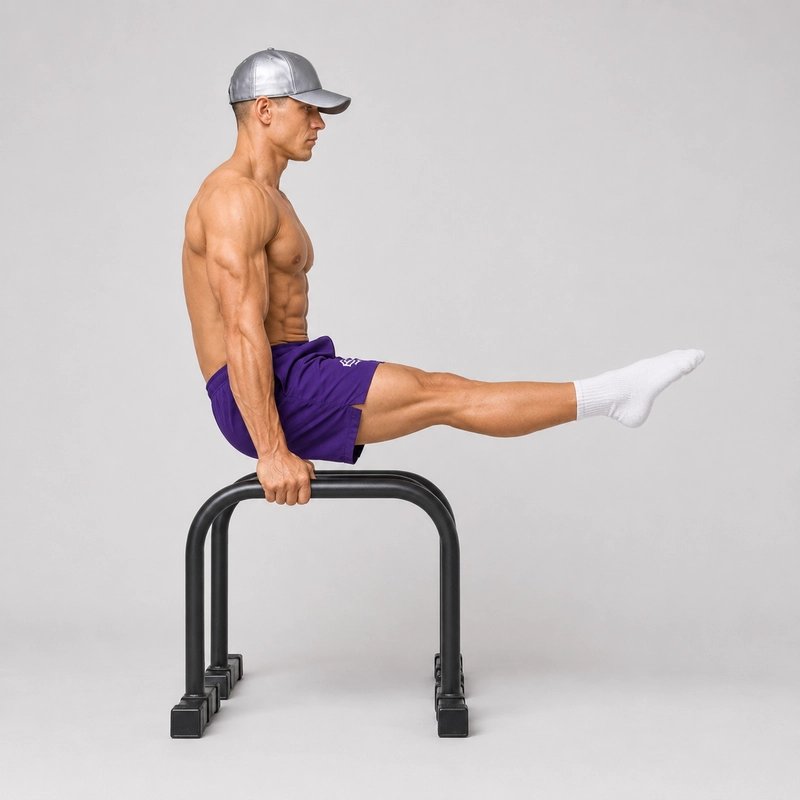
How to do L-Sit on Dip Bars?
The L-Sit on Dip Bars is a static calisthenics exercise in which you support your body on locked arms while holding both legs straight and horizontal in front of you. The position combines straight-arm support strength with intense abdominal and hip-flexor compression.
Performing the L-sit on dip bars provides more ground clearance than the floor variation. This makes it easier to lift the hips and heels without touching the ground, allowing you to concentrate on shoulder stability, straight knees and maintaining the legs at hip height.
The exercise should begin from a stable top support rather than from the bottom of a dip. If you cannot yet hold yourself securely with straight arms, first develop your support position and controlled leg-raising strength. The Hanging Leg Raise develops related abdominal and hip-flexor strength, while the L-Hang provides an equipment alternative for practicing the straight-leg L position.
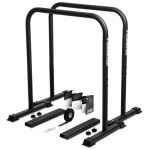
Use stable dip bars with enough clearance for your feet to remain off the ground. If the bars are high, step onto a secure platform to enter the support position instead of jumping into it.
Tips for the proper execution of L-Sit on Dip Bars
Check that the dip bars are stable before lifting your feet.
Use a secure platform to enter high dip bars instead of jumping.
Wrap your thumbs around the bars for a secure grip.
Lock your elbows before beginning to raise your legs.
Press the bars down and keep your shoulders away from your ears.
Keep your torso tall rather than leaning backward to counterbalance the legs.
Raise the legs through active hip compression instead of momentum.
Squeeze your quadriceps to keep both knees completely straight.
Keep your legs together and avoid twisting toward one side.
Take short, controlled breaths without relaxing your core.
End the set when the knees bend or the heels drop substantially below hip height.
Lower the legs slowly and stabilize the support position before stepping down.
Muscles worked when doing L-Sit on Dip Bars
The L-Sit on Dip Bars combines isometric hip flexion with straight-arm upper-body support. The abdominals and hip flexors hold the legs horizontally, while the triceps, shoulders and scapular muscles keep the body elevated between the bars.
Primary Muscles
- Abdominals: Stabilize the torso, control the pelvis and help maintain the compressed L-shaped position.
- Hip flexors: Hold the thighs in front of the body. The iliopsoas and rectus femoris are especially important for maintaining the horizontal leg position.
- Triceps: Maintain complete elbow extension while the arms support your bodyweight.
- Lower trapezius and scapular stabilizers: Maintain shoulder depression and prevent the upper body from collapsing between the bars.
Secondary Muscles
- Quadriceps: Keep the knees locked and the legs straight throughout the hold.
- Anterior deltoids: Stabilize the shoulders during straight-arm support.
- Obliques and deep core muscles: Prevent rotation and keep the torso centered between the bars.
- Forearms and grip muscles: Maintain a stable grip on the dip bars.
- Adductors: Keep the legs squeezed together.
- Upper chest: Assists with stability in the top support position.
The stable parallel bars make this variation less balance-dependent than an L-sit on gymnastics rings. Compared with the L-Hang, it adds significant straight-arm pushing and shoulder-support demands while removing the need for overhead grip strength.
Primary Muscle(s):
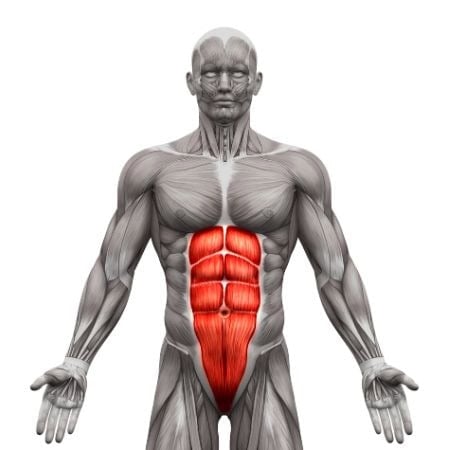
Abdominal
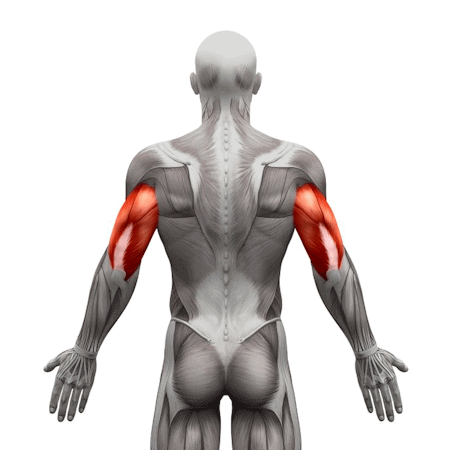
Triceps
Secondary Muscle(s):
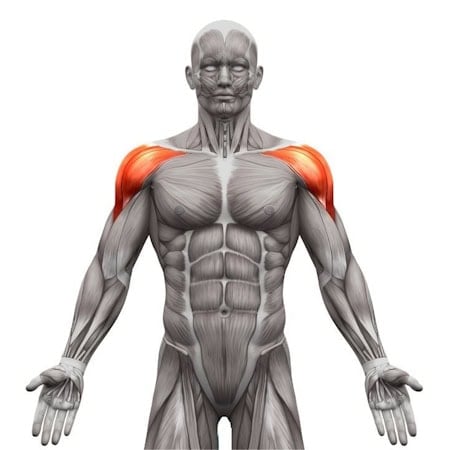
Anterior delt
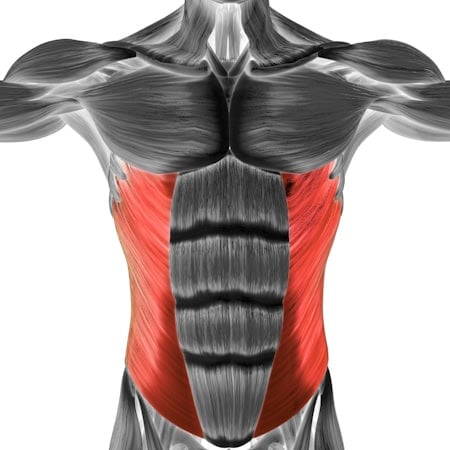
Oblique
Equipment needed for L-Sit on Dip Bars
Adjust the difficulty of L-Sit on Dip Bars
How to make L-Sit on Dip Bars harder?
How to make L-Sit on Dip Bars easier?
How to make L-Sit on Dip Bars harder?
To make L-Sit on Dip Bars harder:
-
Longer L-Sit Hold: Gradually extend the hold while maintaining locked elbows, active shoulders and straight knees.
-
High L-Sit: Raise the feet above hip height while keeping the torso upright and the knees straight.
-
L-Sit Leg Lifts: Lower the straight legs slightly and raise them back to horizontal without losing the support position.
-
L-Sit Flutter Kicks: Perform small alternating leg movements while keeping both knees straight.
-
L-Sit Dips: Maintain the horizontal leg position while performing controlled parallel-bar dips.
-
Weighted L-Sit: Add light ankle weights only after a strict bodyweight hold is well controlled.
-
V-Sit Progression: Compress the legs higher toward the torso while maintaining straight knees.
-
L-Sit to Tuck Planche: Draw the legs backward into a tuck planche and return to the L-sit without touching down.
-
L-Sit Press to Handstand: Press from the L-sit into a handstand using controlled shoulder and compression strength.
-
L-Sit on Gymnastics Rings: Perform the same position on freely moving rings for a greater stability challenge.
How to make L-Sit on Dip Bars easier?
To make L-Sit on Dip Bars easier:
-
Dip Bar Support Hold: Maintain the top position with straight arms while allowing the legs to hang naturally.
-
Support Hold Knee Raises: From the top support, raise and lower the bent knees without attempting a static L-sit.
-
Tuck L-Sit on Dip Bars: Pull both knees toward the chest and hold them above hip level.
-
Open Tuck L-Sit: Move the knees slightly farther from the chest while keeping them bent.
-
Single-Leg L-Sit: Keep one leg straight at hip height while the other knee remains tucked.
-
Alternating Single-Leg L-Sit: Switch the extended leg during each short hold.
-
Band-Assisted L-Sit: Secure a resistance band between the bars and place it beneath the feet or calves for assistance.
-
Feet-Supported L-Sit: Rest the heels lightly on a box positioned in front of the bars while maintaining straight-arm support.
-
Short-Range L-Sit: Raise the straight legs as high as possible, even if they initially remain below horizontal.