
 Andy Toth
When most people say they can do a one-arm push-up, I usually have one question first.
What kind?
That may sound picky, but it matters. There is a huge difference between a one-arm push-up done with a wide stance, a shortened range of motion, and a truly strict rep where the chest touches the ground and the feet stay together.
That is exactly why I wanted to interview Miguel A. Fernandez, the Guinness World Record holder for the most consecutive chest-to-ground one-arm push-ups with legs together. After going through his record documentation, the biomechanics explanation, and his detailed answers to my questions, one thing became obvious to me. This movement is not just about pressing strength.
It is a test of balance, body control, tension, patience, and technique.
In this article, I want to break down what actually makes a strict one-arm push-up so difficult, why many reps you see online would not count under a stricter standard, what I learned from Miguel’s training approach, and how I would think about progressing toward this skill at home or in a calisthenics park.
If you are still working on your foundation, I would start with a beginner push-up workout plan before worrying about advanced one-arm work. Clean basics still matter.
What Is a Strict One-Arm Push-Up?
When people picture a one-arm push-up, they often imagine a cool-looking feat where someone spreads their feet wide, lowers halfway, and grinds out a rep. That can still be hard, but it is not the same thing as a strict chest-to-ground one-arm push-up with the feet together.
That distinction is the whole point here.
Miguel told me that the strict standard matters because it removes the usual loopholes.
“The chest-to-ground and legs-together standards matter so much because they remove ambiguity. In many one-arm push-up variations, athletes can reduce the difficulty by not lowering enough or by widening the feet too much.”
That is one of the reasons I like this story. The standard is clear. The rep either counts or it does not.
What counts as a rep?
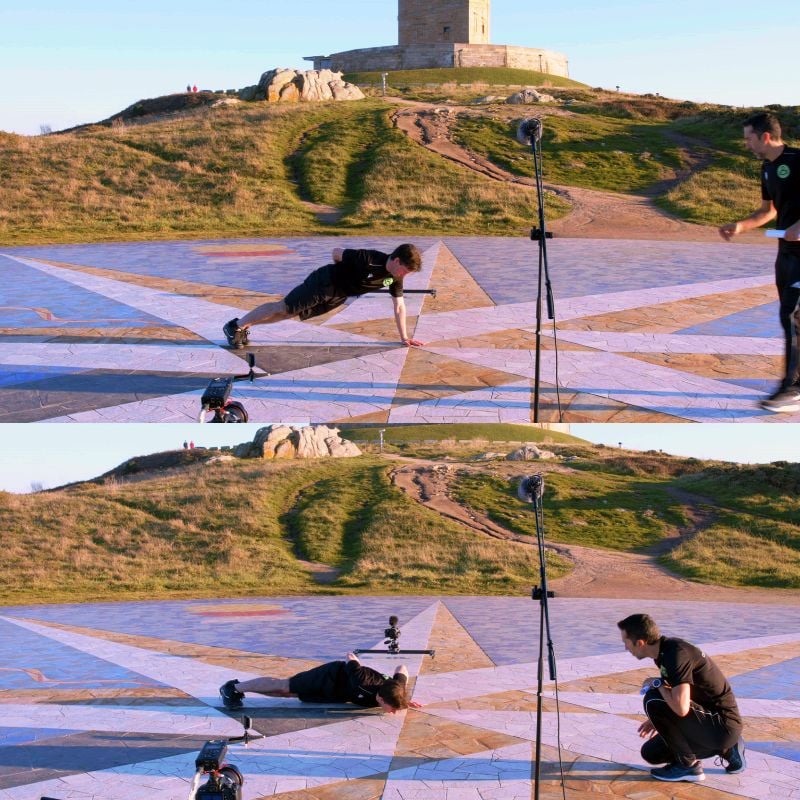
For a rep to count in Miguel’s record category, the setup has to be strict from the start. One hand on the floor. The other arm behind the back. Legs together. Toes on the ground. Whole body lifted off the floor. Then the athlete lowers until the chest touches the ground, keeps the knees off the floor the whole time, and returns to the top without turning the set into a stop-and-go grind.
Miguel explained it simply:
“For each rep to count, the chest must touch the ground, the knees must remain off the floor at all times, and the repetitions must be consecutive. No more than two seconds can pass between one rep ending and the next one beginning.”
You cannot fake range of motion. You cannot hide behind a wide base. You cannot take a long rest between reps and still call it a clean set.
Why chest-to-ground and feet-together standards matter
Miguel put it like this:
“In my variation, those two requirements are non-negotiable. They make the movement clear, measurable, and difficult to fake.”
That is refreshing. A lot of online fitness content lives in the gray zone. Half reps count if they look cool on camera. Wide stances magically become strict form. People invent new variations, give them impressive names, and hope nobody looks too closely.
This standard does the opposite. It asks a blunt question. Can you control your body through a narrow and demanding position, or not?
Why the Strict One-Arm Push-Up Is So Much Harder Than It Looks
A lot of people assume the reason this variation is so hard is simple. One arm means one arm is doing almost all the work, so it must just be a brutal strength exercise.
That is only part of the story.
Miguel made a distinction I think more athletes need to understand.
“The real difficulty is qualitative. The movement places the body in a constant state of unstable balance. Controlling that instability requires full-body coordination and athletes respond very differently to that instability.”
It is not just a strength exercise
If a movement is only hard because of load, the solution is usually straightforward. Get stronger in the relevant muscles. If a movement is hard because your body is fighting instability, the solution is different. You are not just building strength. You are teaching your body how to organize strength.
That is why this skill fascinates me.
Miguel summed it up in a way that stuck with me:
“What makes my variation so difficult is that it demands far more than raw pressing strength. It is a test of full-body synergy.”
That word synergy keeps coming up for a reason. Plenty of athletes have a strong chest, strong triceps, or a big bench press. That still does not mean they can control their whole body through a strict one-arm push-up.
Why unstable balance changes everything
With the feet together, there is very little room for error. Tiny shifts in body position matter. The chest, shoulder, elbow, trunk, hips, legs, breathing, and concentration all have to line up.
Miguel said it better than I could:
“The chest, shoulder, elbow, core, hips, legs, breathing, concentration, and nervous system all have to work together in one precise action.”
That is why I would never describe this as only a chest and triceps exercise. It is a whole-body problem.
The Biomechanics Most People Miss
This was my favorite part of the interview because it clears up one of the biggest misunderstandings around the one-arm push-up.
A lot of athletes assume that a strict one-arm push-up should look perfectly straight and square to the floor from start to finish. On the surface that sounds logical. Straight body equals strict rep.
But that is not how this variation works.
Why a perfectly square body position is not realistic here
Miguel pushed back on that idea hard.
“Nobody in the world can hold that position. Not because they are not strong enough, but because it is mechanically impossible.”
His explanation is simple once you strip away the jargon.
With the feet together, you effectively have two points of contact with the ground. Your working hand and your feet. That creates a very narrow line of support. If your bodyweight drifts too far away from that line, rotational force builds and you tip over.
Why a slight lean or hip shift is not cheating
This was one of the most useful insights in the whole interview.
Miguel told me:
“The lean and hip shift are necessary because otherwise the center of gravity would move outside the vertical plane defined by the supporting hand and the feet.”
Then he made the key point:
“So this shift is not a flaw. It is the technical adjustment that allows the movement to exist at all.”
I think that is worth repeating. Sometimes what looks strict is not actually correct. Sometimes what looks slightly unusual is exactly what real mechanics require.
That is true in the one-arm push-up. It is also true in many calisthenics skills. People love frozen textbook shapes, but the body is not a geometry diagram. It is a live system trying to solve a balance problem under load.
Where good form ends and form breakdown begins
I asked Miguel where the line is between necessary movement and bad form.
His answer was practical.
“The line between necessary body shift and bad form appears when the athlete can no longer maintain that control. One of the clearest signs of breakdown is when the lower back begins to sag near the top of the rep.”
That is coachable. That is visible. And that is a much better standard than vague internet arguments about whether the rep looked “clean enough.”
How Miguel A. Fernandez Built World-Record-Level Strength
One reason I enjoyed this interview is that Miguel did not try to sell the record as the result of some magical six-week routine. He gave a much more honest answer.
When he realized this movement was special
Before this push-up record, Miguel had already been thinking in terms of strict standards. In 2018, he considered applying for the Guinness World Record in most consecutive muscle-ups. He believed he had the rep capacity, but he could not fully eliminate a slight kip from his legs.
That experience taught him something.
“The muscle-up, in that context, depended heavily on upper-body strength, and I discovered that my lower-body constitution actually worked against me there.”
Then the opposite happened with the one-arm push-up.
“In 2019, I discovered the opposite effect in the one-arm push-up with legs together. My legs were no longer a disadvantage.”
He told me his background in sprint cycling, soccer, and full-contact started working in his favor. That year he hit 4 strict chest-to-ground reps in this variation.
The part I found most interesting was what came next.
“I also discovered that elite strength athletes could not perform even one strict rep. At that point, I realized that 4 reps already represented something exceptional and was worth attempting to make it official.”
The sports and skills that carried over the most
Miguel’s background is broader than most people would guess from a push-up record. He has spent years training across soccer, cycling, full-contact, muscle-ups, and calisthenics.
That matters because it helps explain why he keeps coming back to the idea of integrated strength instead of isolated strength.
Why muscle-ups helped more than most people would expect
I expected Miguel to name a one-arm push-up progression as the exercise that carried over the most. He did not.
He said muscle-ups gave him the biggest carryover.
“They became a laboratory for understanding how strength, power, endurance, VO2 max, technique, and biomechanics interact in real practice.”
I liked that answer because advanced calisthenics skills often talk to each other. Sometimes you do not build a movement only by copying the movement. Sometimes you build it by learning how your body handles tension, fatigue, rhythm, joint stress, and technique in another demanding skill.
What Usually Stops People From Getting Their First Strict Rep
This was another part of the interview that I think readers will find useful.
I asked Miguel what usually fails first when someone attempts this movement. Pressing strength? Balance? Core tension? Confidence?
His answer was not what many gym-focused athletes would expect.
“From what I have seen, the main limit is usually not isolated strength but whole-body synergy.”
Why isolated strength is not enough
Miguel said:
“Many athletes have strong chest, shoulders, core, or triceps, but that does not automatically mean they can organize the entire body under this kind of unstable load.”
That lines up with what I have seen in calisthenics too. You can meet athletes who are strong on paper and still move poorly in advanced skills. Then you meet someone else who is not overwhelmingly muscular, but they have timing, tension, body awareness, and patience. Suddenly they can do things that look almost unfair.
The role of tension, coordination, and patience
Miguel has his own theory about what kinds of training backgrounds carry over well.
“Interestingly, the athletes I have seen come closest to performing one strict rep are often boxers, kick-boxers and arm-wrestlers.”
That makes sense to me. Those sports teach force production, coordination, tension, and control under pressure.
He also pointed out that some modern training methods can work against this if they build local strength without enough integration.
The mistake strong athletes make most often
Miguel was honest about his own mistakes too.
“My main mistake, especially when I started training beyond 4 strict reps in 2019, was letting enthusiasm compromise form. I would become too explosive, too plyometric, and too eager to push the rep count.”
That is a serious lesson in self-improvement. Sometimes less really is more. Not because low ambition is good, but because quality multiplies progress over time.
How I’d Approach a One-Arm Push-Up Progression
Most people reading this should not start with Miguel’s exact variation tomorrow. That would be like deciding to learn a strict ring muscle-up by jumping straight onto the rings and hoping for the best.
The better approach is to treat the strict one-arm push-up as a long-term skill and build the qualities it actually needs.
Step 1: Build a stronger regular push-up base
If your regular push-ups are shaky, your shoulders collapse, your core goes soft, or your range of motion is inconsistent, you have no business rushing into advanced one-arm work.
If that sounds like you, start by owning the basics with a beginner push-up workout plan and by improving your general horizontal pushing strength.
Step 2: Use uneven and staggered push-up variations
This is where I would spend serious time. Uneven push-ups and the staggered push-up are practical bridges between standard push-ups and harder unilateral work.
They let you load one side more while keeping the movement honest and repeatable.
Step 3: Add negative reps and controlled unilateral work
I am a big believer in slow eccentrics for skills like this. Negative push-ups can help you own the lowering phase, feel where the position starts to break, and build confidence without pretending you already have a full rep.
Step 4: Build full-body tension and balance
This was a major theme in my interview with Miguel.
“Think of the body as one chain running from your toes to your fingertips.”
That is a great cue.
A strict one-arm push-up is not just an arm exercise. The feet matter. The glutes matter. The trunk matters. Your ability to create tension through the whole body matters.
Exercises like pseudo planche push-ups can help here because they force you to connect your pressing strength with body position and tension.
Step 5: Practice strict attempts without rushing them
Miguel’s warning about anxiety was one of the most interesting things he said.
“The most common mistake is anxiety. People want to improve too quickly.”
That sounds philosophical, but it is also practical. Rushing changes movement quality. It makes people chase reps before they own positions. It turns training into a test of ego instead of a process of skill-building.
Miguel also said something I agree with:
“The balance required in this movement is not something you manage by conscious calculation in the middle of the rep. It works more like riding a bike.”
That means occasional careful exposure to the real movement can be useful, even before you feel fully ready. Not max-effort flailing. Not painful grinders. Just enough honest practice for your nervous system to start learning the pattern.
Best Exercises That Carry Over to the One-Arm Push-Up
If I were coaching an athlete toward this skill, these are the exercises I would care about most.
Uneven push-ups
I would use uneven push-ups to shift more work onto one arm without losing all structure.
Staggered push-ups
The staggered push-up is another logical bridge because it starts teaching asymmetrical loading in a more forgiving setup.
Pseudo planche push-ups
Pseudo planche push-ups are useful for advanced pushing strength, shoulder loading, and body tension. They are not the same skill, but they can build qualities that carry over.
Negative push-ups
Negative push-ups teach control and honesty. If you cannot own the eccentric, you probably do not own the movement.
Explosive push-ups and clapping push-ups
For athletes who already have a strong base, explosive push-ups and clapping push-ups can help build more aggressive pressing intent. I would still treat them as secondary tools, not the foundation.
Common Mistakes When Learning the One-Arm Push-Up Alone
I asked Miguel what mistakes people make when trying to learn this sort of movement on their own. His answer was bigger than just exercise technique.
Rushing progress
“The most common mistake is anxiety. People want to improve too quickly.”
That is true for one-arm push-ups, muscle-ups, handstands, front levers, and almost every other skill worth having.
Chasing reps before owning the position
Miguel told me that even when he suspected he could do 10 regular reps, he spent months consolidating around 4 reps with perfect form.
That is the kind of discipline that separates real progress from noisy progress.
Confusing ugly reps with real progress
The internet rewards impressive-looking struggle. Real training rewards clean positions, repeatable mechanics, and joint-friendly progression.
Those are not always the same thing.
What I Took Away From Miguel’s Record Attempt
The setting itself gives the whole story more texture. Miguel performed the attempt at the Tower of Hercules in La Coruña, on a horizontal surface known as the Compass Rose. Multiple cameras were set up to verify the attempt from different angles. Witnesses were present. Reporters from Spanish and regional television were there too.
I like details like that because they remind you this was not filmed in a perfect indoor studio with ideal lighting and endless retakes. It was a real event, outside, by the sea, under scrutiny.
Why honest standards matter
One small detail from the attempt says a lot about the integrity of the whole thing. Miguel was very close to completing rep 18, but his left foot slipped on the sea-salty ceramic surface. Because he did not return properly to the official starting position, the rep was not counted.
That is frustrating, but I actually think it strengthens the story. The standard won.
That is how it should be.
Why calisthenics is really about connected strength
Miguel remembers the moment less as a chase for numbers and more as a state of concentration.
“As the attempt began, everything related to preparation, expectation, or even the idea of a ‘record’ disappeared.”
Then he said this:
“The only thing that remained was the execution of each repetition, one at a time.”
That is one of my favorite lines from the whole interview.
When you are pursuing something difficult, whether it is your first pull-up, a muscle-up, a handstand, or a strict one-arm push-up, the outcome matters less in the moment than the next clean rep, the next good set, the next honest session.
Miguel also described the feeling of everything aligning.
“When technique, balance, and breathing are properly aligned, the body no longer feels like a set of separate parts. It acts as a single system converging into one point.”
That captures what the best bodyweight training feels like. Not random suffering. Not chaos. Coordination.
FAQ About the Strict One-Arm Push-Up
Is a one-arm push-up with feet apart still good?
Yes. It is still a strong movement. It is just easier to balance than a strict legs-together version, so it is not the same test.
How strong should I be before I train this skill?
I would not rush into it until regular push-ups feel easy and controlled with full range of motion and strong body tension. If you are still building your base, start with a push-up progression for beginners or the zero to 10 push-ups plan.
Can I learn this at home without weights?
Yes. That is one of the great things about calisthenics. You can build a lot of the required strength and coordination with bodyweight alone, especially if you train patiently and use smart progressions.
Are push-up bars useful for one-arm push-up training?
They can be, especially if they help your wrists feel better or let you train with cleaner range of motion. If flat-floor push-ups bother your wrists, here is my guide to the best push-up bars.
Final Thoughts
After interviewing Miguel and going through the material, I do not think the main lesson here is that everyone should now start obsessing over one-arm push-up records.
The real lesson is better than that.
The strict one-arm push-up is a reminder that advanced calisthenics is not only about force. It is about precision, honesty, body awareness, patience, and the willingness to train in a way that makes your whole body more intelligent.
Miguel said something near the end of our conversation that stayed with me.
“Our physique should not become an end in itself. It should be one expression of the challenges we are learning to overcome in life.”
That is not the usual fitness soundbite, which is probably why I liked it so much.
For me, that line gets to the heart of why bodyweight training matters.
Done well, calisthenics is not just a way to build muscle and strength at home or in a park. It is a way to build character through honest standards, patient repetition, and the pursuit of beautiful movement.
Miguel summed it up with a Spanish saying:
“Más vale maña que fuerza.”
Technique is worth more than strength.
For the strict one-arm push-up, I would say that is exactly right.