
Strict Parallel Bar Dip
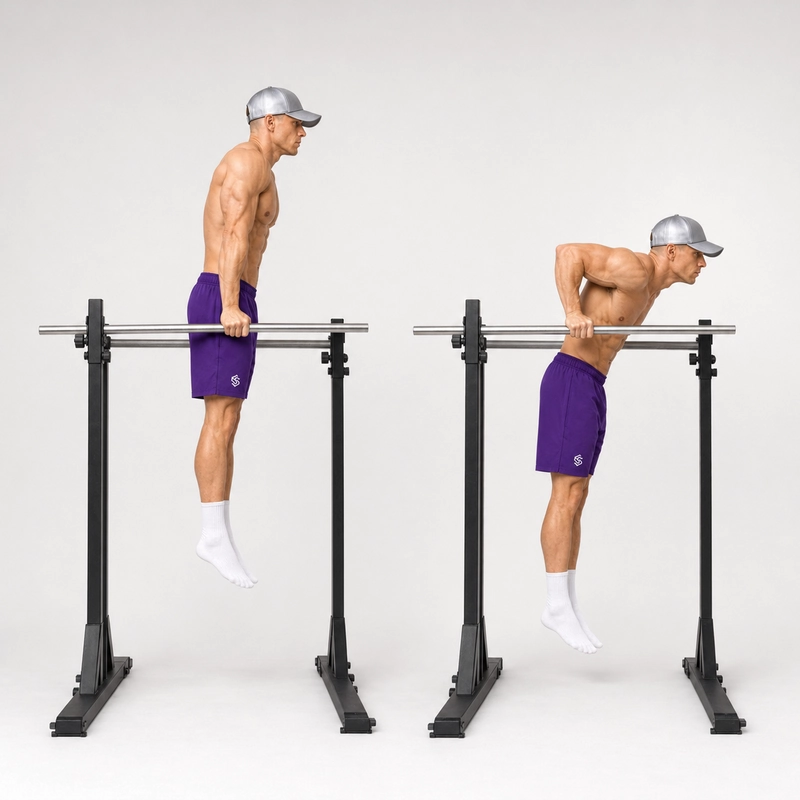
How to do Strict Parallel Bar Dip?
The strict parallel bar dip is a bodyweight pushing exercise performed between two fixed bars. Each repetition starts in a stable support with the elbows locked, lowers until the shoulders reach at least elbow height, and finishes at the same controlled lockout—without swinging, kicking or bouncing.
If you are still building your first clean repetitions, follow our 6-week plan to go from zero to five dips. Athletes who need more assistance can also practise feet-assisted dips while developing the strength and control required for the full movement.
Parallel bars provide a stable base, making this the standard dip variation to learn before moving to the greater instability of strict ring dips. The exercise primarily trains the chest and triceps, with the anterior deltoids and upper-body stabilizers supporting the movement.
How to do a strict parallel bar dip
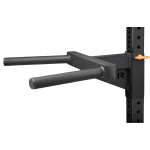
- Set up the bars. Use fixed, stable parallel bars with enough clearance for your feet. If the bars are high, place a secure plyo box or step beside them so you can enter the support position without jumping.
- Establish the top position. Wrap your hands fully around the bars with a neutral grip. Straighten your elbows, press your shoulders down away from your ears and keep your wrists stacked under your forearms.
- Brace your body. Keep your ribs controlled, abs and glutes engaged, and legs together. Your knees may be straight or slightly bent for clearance, but the lower-body position should remain unchanged throughout the repetition.
- Lower under control. Inhale and bend your elbows, allowing your shoulders and torso to travel slightly forward. Keep the elbows tracking mostly behind you instead of flaring sharply out to the sides.
- Reach the full-rep depth. Descend until the tops of your shoulders are level with or slightly below your elbows. Do not force a deeper bottom position if it causes pain or makes you lose shoulder control.
- Press to lockout. Push the bars down, extend your elbows fully and return to a stable support. Exhale during the press, pause briefly at the top and reset before the next repetition.
Strict dip repetition standard
Count a repetition when it meets all of the following standards:
- The repetition begins with both elbows fully extended and the shoulders actively pressed away from the ears.
- The body descends under control; there is no drop or bounce into the bottom.
- The tops of the shoulders reach at least the height of the elbows.
- The feet and knees remain quiet, with no kick, kip or deliberate leg swing.
- The repetition finishes with both elbows fully extended and the body stable between the bars.
Depth note: More depth is not automatically better. Shoulder-to-elbow height provides a clear, repeatable minimum for this exercise page. Going lower is optional and should only be used when it remains comfortable and controlled. If you cannot yet reach the standard depth, use assistance or a reduced range temporarily and build it over time.
Benefits of strict parallel bar dips
- Builds bodyweight pressing strength in the chest, triceps and front shoulders.
- Develops control in both the bottom position and the top support lockout.
- Uses a stable setup that makes technique and progression easy to measure.
- Can be progressed with pauses, slower tempos or additional weight.
- Creates a useful strength base for ring dips and more advanced dip variations.
Common strict dip mistakes
Stopping above full depth
Short repetitions may be useful as a temporary progression, but they do not meet the full-rep standard. Use foot or band assistance if you need help reaching shoulder-to-elbow depth with control.
Bouncing out of the bottom
Dropping quickly and reversing with a bounce removes control from the hardest part of the exercise. Slow the descent, pause briefly if needed and press from a stable bottom position.
Shrugging the shoulders
Do not let the shoulders collapse toward the ears at the top. Push the bars down and establish an active, stable support before beginning each repetition.
Flaring the elbows excessively
Let the elbows travel back naturally. A small amount of outward movement is normal, but aggressive flaring can make the position less controlled.
Swinging or kicking the legs
Brace the trunk and keep the lower body still. If your feet touch the floor, use higher bars or bend the knees slightly before the set instead of changing leg position during each rep.
Skipping the top lockout
Finish every repetition with straight elbows and a stable support. Rushing into the next descent makes the reps harder to judge and often leads to shoulder shrugging.
Forcing excessive depth
Do not chase the deepest possible position. Stop at the page standard, or earlier if you feel pain or lose control, and develop additional comfortable range gradually.
How to make parallel bar dips easier
- Use foot assistance: Set the bars low enough to keep the toes lightly on the floor or on a secure box. Use only as much leg assistance as needed.
- Use a resistance band: Secure a suitable band to the bars and support the knees or feet according to the equipment manufacturer's instructions.
- Perform controlled negatives: Step into the top position, lower for three to five seconds and use the box to return to the start.
- Reduce the range temporarily: Lower only as far as you can control, then increase the depth over time.
- Build support strength: Hold the locked top position for several short, high-quality sets.
A bench dip can add beginner-friendly triceps volume, but its hand position and shoulder path differ from a parallel bar dip. Treat it as a related accessory rather than an exact substitute.
How to make parallel bar dips harder
- Lower for three to five seconds on every repetition.
- Pause for one to two seconds at the bottom without relaxing or bouncing.
- Add repetitions or sets while preserving the same depth and lockout standard.
- Add external load with a dip belt and weight plate once bodyweight reps are consistent.
- Progress to ring dips, where each arm must stabilize an independently moving ring.
How to program strict parallel bar dips
Train dips early in an upper-body or push session while your technique is fresh. Choose a version that lets you complete every planned repetition to the same standard.
- Learning the movement: 3–5 sets of 2–5 assisted or controlled full-range repetitions.
- Building strength: 3–5 sets of 3–8 strict repetitions with 2–3 minutes of rest.
- Building muscle: 3–4 sets of 6–12 strict repetitions, stopping before depth, lockout or body control deteriorates.
- Eccentric practice: 3–4 sets of 2–5 negatives, each with a controlled 3–5-second descent.
These ranges are practical starting points, not universal rules. Adjust the volume to your training experience, recovery and current pushing workload.
Strict parallel bar dip form checklist
- Full grip around two stable parallel bars
- Locked elbows and active shoulders at the top
- Braced trunk with quiet legs
- Controlled descent to shoulder-to-elbow depth
- No bounce, kip or kick
- Full elbow extension at the finish
Build your first five strict dips
Use a structured progression instead of testing your maximum every session. Our beginner plan combines technique practice, assistance and progressive strength work over six weeks.
Tips for the proper execution of Strict Parallel Bar Dip
Begin and finish every repetition with locked elbows and the shoulders pressed away from the ears.
Keep the legs together and quiet; bend the knees before the set only if extra floor clearance is needed.
Let the torso incline slightly forward as you lower, but do not turn the rep into a swing.
Use shoulder-to-elbow height as the minimum depth for a full repetition.
Stop the set when you can no longer control the bottom position or complete the top lockout.
Use a secure step or plyo box to mount high bars instead of jumping into support.
Muscles worked when doing Strict Parallel Bar Dip
The strict parallel bar dip is a compound vertical pushing exercise. Several muscles work together during both the lowering and pressing phases.
- Pectoralis major: Helps move the upper arms toward the torso and contributes strongly as you press out of the bottom.
- Triceps brachii: Extends the elbows and completes the press to lockout.
- Anterior deltoids: Assist the pressing action and control the shoulder as the body lowers between the bars.
- Scapular and shoulder stabilizers: Help keep the shoulders organized instead of allowing them to collapse toward the ears.
- Abdominals and glutes: Maintain a quiet, controlled body position and reduce unwanted swinging.
Primary Muscle(s):
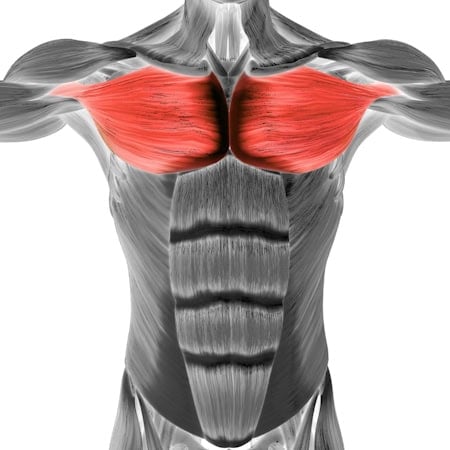
Lower chest
Secondary Muscle(s):
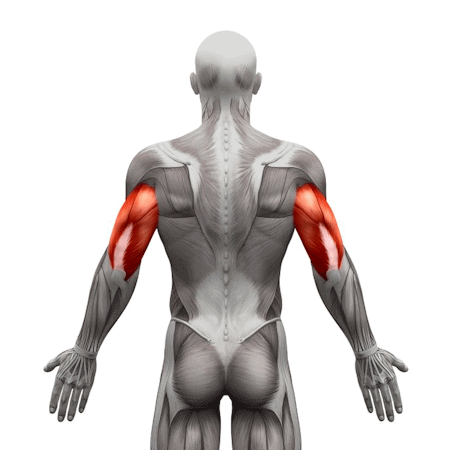
Triceps
Equipment needed for Strict Parallel Bar Dip
Adjust the difficulty of Strict Parallel Bar Dip
How to make Strict Parallel Bar Dip harder?
How to make Strict Parallel Bar Dip easier?
How to make Strict Parallel Bar Dip harder?
To make Strict Parallel Bar Dip harder:
-
Slow-eccentric parallel bar dip
-
Paused parallel bar dip
-
Weighted parallel bar dip with dip belt and plate
-
Ring dip
-
L-sit dip
How to make Strict Parallel Bar Dip easier?
To make Strict Parallel Bar Dip easier:
-
Feet-assisted parallel bar dip
-
Resistance-band-assisted parallel bar dip
-
Three-to-five-second dip negative
-
Reduced-range dip
-
Parallel bar support hold