
Sliding Hamstring Curl
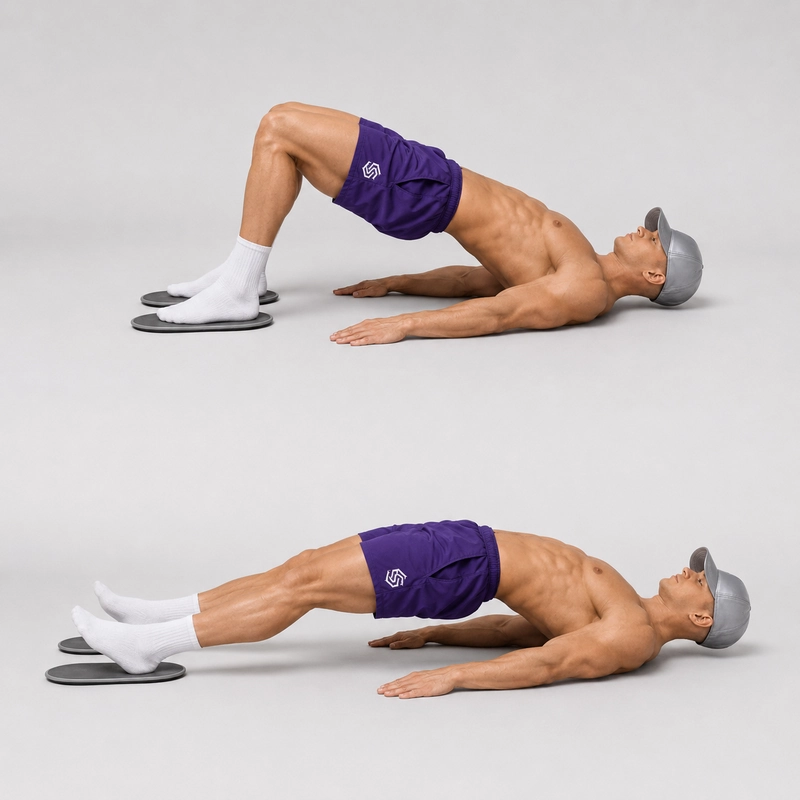
How to do Sliding Hamstring Curl?
The Sliding Hamstring Curl is a bodyweight posterior-chain exercise performed while lying on your back with your heels supported by exercise sliders, towels or another low-friction surface. You lift your hips into a bridge, slowly extend your legs by sliding your heels away and then use your hamstrings to pull the heels back toward your body.
Unlike a standard Glute Bridge, the knees move through a substantial range while the hips remain elevated. This means the hamstrings must both control knee extension during the outward slide and produce knee flexion as the heels return.
The movement also differs from the Nordic Hamstring Curl. During a Nordic curl, the ankles remain anchored while the body moves forward from the knees. During a Sliding Hamstring Curl, the shoulders remain on the floor while the heels move freely across the surface.
Sliding Hamstring Curls require little specialist equipment and can be adapted to different floors. Use exercise sliders or folded towels on a smooth floor, or suitable sliding discs on carpet. The surface must be predictable and free from objects that could stop a slider suddenly.
A study classifying common hamstring exercises found high hamstring activation during the slide-leg exercise, including during both the lengthening and shortening phases. However, the study involved elite female track-and-field athletes, so its results should not be treated as a universal measurement for every athlete. See the published hamstring exercise comparison.
How to Perform a Sliding Hamstring Curl
1. Choose a Suitable Surface
Use a clear, level surface that allows both heels to slide smoothly. Exercise sliders, furniture sliders, folded towels or socks may work depending on the flooring.
Test the setup before lying down. Both heels should move with similar resistance, and the sliders should not catch on gaps, edges or nearby objects.
2. Establish the Starting Position
Lie on your back with your knees bent and your heels resting on the sliders. Position your feet approximately hip-width apart and begin with your heels relatively close to your glutes.
Keep your toes raised or lightly relaxed so most of the pressure travels through the heels. Place your arms beside your body with your palms on the floor for balance.
3. Lift Into a Bridge
Brace your abdominals and squeeze your glutes as you lift your hips. At the top, your shoulders, hips and knees should form an approximately straight line without excessive arching through the lower back.
If you cannot hold this position comfortably, practise the Glute Bridge before adding the sliding movement.
4. Slide the Heels Away
Slowly extend your knees by allowing both heels to travel away from your body. Keep your hips elevated and control the outward movement with your hamstrings.
Only extend as far as you can without dropping your hips, arching your lower back or losing control of the sliders. The exercise becomes progressively harder as the legs approach a straight position.
5. Reach the Extended Position
Stop before the knees forcefully lock or the hips touch the floor. Your body should form a long controlled line from the shoulders toward the heels, with the abdominals and glutes remaining active.
A slight bend in the knees is acceptable, especially while learning. Full extension should be earned gradually rather than reached by letting the hips collapse.
6. Curl the Heels Back In
Press the heels into the sliders and bend your knees to pull your feet back toward your hips. Continue squeezing the glutes so the pelvis remains elevated during the return.
Finish with the heels under or close to the knees and the hips in a stable bridge position. Do not thrust the lower back upward to create artificial hip height.
7. Repeat With Control
Begin the next outward slide without lowering your hips. If you cannot maintain the bridge continuously, lower your hips between repetitions and reset until your hamstring strength improves.
What Counts as a Complete Sliding Hamstring Curl?
- The repetition begins in a stable bridge with both hips elevated.
- Both heels slide away from the body at approximately the same speed.
- The knees extend through a consistent, controlled range.
- The hips remain elevated without excessive lower-back arching.
- The heels return toward the body through active knee flexion.
- The repetition finishes with the hips still elevated and the pelvis level.
- No momentum, sudden floor contact or assistance from the hands is used.
Common Sliding Hamstring Curl Mistakes
Allowing the Hips to Drop
The most common mistake is letting the pelvis descend as the legs extend. Reduce the range or perform eccentric-only repetitions until you can maintain active hip extension.
Arching the Lower Back
Lifting the hips by extending the lumbar spine shifts the position away from the intended bridge. Keep your ribs controlled and use the glutes rather than the lower back to maintain hip extension.
Sliding Too Far Too Soon
The resistance increases substantially as the legs straighten. Stop the outward movement before you lose control and increase the range gradually.
Dropping Through the Eccentric Phase
Do not let the heels shoot away from the body. Aim for a smooth two-to-four-second outward slide so the hamstrings actively control knee extension.
Pushing Through the Toes
Keep most of the pressure through the heels. Driving through the forefoot can make the sliders harder to control and may increase calf involvement.
Using Unequal Leg Pressure
Both sliders should travel together during the bilateral version. If one leg moves faster, shorten the range and concentrate on applying equal heel pressure.
Letting the Knees Separate or Collapse Inward
Keep the knees and feet approximately hip-width apart. Avoid allowing the legs to rotate or drift sideways as they extend.
Pulling With the Arms
The hands can provide light balance, but they should not press forcefully into the floor to compensate for insufficient hamstring strength. Cross your arms over your chest only as a later progression.
Using an Inconsistent Surface
Carpet seams, floor gaps or towels that bunch up can stop the heels unexpectedly. Test the full sliding path before beginning a demanding set.
Continuing Through a Cramp or Sharp Pain
Hamstring or calf cramping can occur when fatigue increases. Stop, reset and reduce the range or volume rather than forcing the repetition.
Benefits of Sliding Hamstring Curls
- Train knee flexion: The hamstrings actively pull the heels toward the hips during the inward phase.
- Develop eccentric control: The hamstrings lengthen under tension as the knees extend during the outward slide.
- Combine knee flexion and hip extension: The hamstrings work dynamically at the knees while the glutes help maintain the bridge.
- Require little equipment: Sliders can often be replaced by towels or socks on an appropriate floor.
- Offer measurable progressions: Range, tempo, hip position and unilateral loading can all be adjusted.
- Provide a Nordic Curl preparation exercise: Sliding curls can develop hamstring strength before the more demanding anchored-knee pattern.
- Reveal side-to-side differences: The single-leg variation makes differences in strength and control easier to identify.
Research has reported high hamstring activation during the slide-leg exercise, but muscle activation is not the same as proven injury prevention or superior long-term muscle growth. The exercise is best used as one component of a broader lower-body program rather than as a replacement for every hip-hinge or hamstring exercise. See the full exercise-classification study.
Readiness and Safety
Before attempting full Sliding Hamstring Curls, you should be able to hold a stable bridge without hamstring cramping or lower-back discomfort. Elevated Glute Bridges and Lying Hamstring Curls with a Resistance Band are useful alternatives when the complete sliding movement is too demanding.
Begin with a short range and a controlled outward phase. Sliding Hamstring Curls can create substantial eccentric loading and soreness, particularly when performed with nearly straight legs or one leg at a time.
Do not use this page as a rehabilitation prescription for an acute hamstring injury. Stop if you experience sharp posterior-thigh pain, a sudden pulling sensation, bruising, weakness or pain that changes your normal movement, and seek an appropriate medical or physiotherapy assessment.
How to Program Sliding Hamstring Curls
For general strength and muscle development, begin with 3 to 4 sets of 6 to 12 controlled repetitions. Rest for approximately 90 seconds to three minutes between demanding sets.
When learning the exercise, use a two-to-four-second outward slide and a controlled inward curl. End the set when your hips begin dropping or the range becomes uneven.
For eccentric-only training, perform 3 to 5 repetitions with a three-to-six-second outward slide. Lower your hips after each repetition, bring the heels back toward you and reset rather than attempting an uncontrolled concentric return.
Frequently Asked Questions
Are Sliding Hamstring Curls the same as Sliding Leg Curls?
Yes. Sliding leg curl, slider hamstring curl and towel hamstring curl commonly describe the same basic exercise. They should be consolidated on this canonical page rather than published as separate exercise entities.
What can I use instead of exercise sliders?
Use folded towels or socks on a smooth floor, or suitable furniture sliders or sliding discs on carpet. Test the setup first because materials behave differently on different surfaces.
Should the hips stay elevated throughout the exercise?
Yes, during the standard variation the hips remain elevated through both phases. Lowering the hips between repetitions is an acceptable regression while developing strength.
Should the knees straighten completely?
Extend the knees only as far as you can control without dropping the hips or forcefully locking the joints. A slightly bent-knee endpoint is appropriate while learning.
Should I keep my toes raised?
Keeping the toes raised can help maintain pressure through the heels and improve control of the sliders. A relaxed ankle position is also acceptable if the sliders remain stable.
Why do my hamstrings cramp?
Cramping can occur when the exercise exceeds your current hamstring endurance or when the glutes are not helping maintain hip extension. Stop the set, reduce the range and build capacity with bridges or shorter repetitions.
Are Sliding Hamstring Curls easier than Nordic Curls?
The bilateral sliding variation is usually easier to scale because you can shorten the range and lower the hips between repetitions. A full single-leg Sliding Hamstring Curl can nevertheless be extremely demanding.
Can Sliding Hamstring Curls help me achieve a Nordic Curl?
They can build knee-flexion strength and eccentric control without requiring an ankle anchor. Progress next to the Band-Assisted Nordic Hamstring Curl before attempting an unassisted Nordic Curl.
What is the difference between a Sliding Hamstring Curl and a Glute Bridge?
A Glute Bridge primarily raises and lowers the hips while the feet remain stationary. A Sliding Hamstring Curl keeps the hips elevated while the heels travel away from and back toward the body.
Is the single-leg variation necessary?
No. Bilateral curls can remain challenging when performed through a long range with slow tempo and elevated hips. Use the single-leg version only when bilateral repetitions are consistently controlled.
How often should I perform Sliding Hamstring Curls?
One to three weekly sessions may be appropriate depending on training volume, difficulty and recovery. Introduce them conservatively because long-range eccentric repetitions can produce noticeable soreness.
Tips for the proper execution of Sliding Hamstring Curl
Test the sliders across the complete movement path before beginning your set.
Place both heels on surfaces that provide approximately equal sliding resistance.
Begin with your feet hip-width apart and your heels relatively close to your glutes.
Brace your abdominals and squeeze your glutes before lifting your hips.
Maintain pressure through your heels rather than pushing primarily through your toes.
Keep your pelvis level as both legs extend.
Slide the heels away slowly instead of allowing them to shoot forward.
Stop the outward slide before your hips drop or your lower back arches.
Pull both heels back toward your body at approximately the same speed.
Keep the knees and feet hip-width apart throughout the repetition.
Use your arms only for balance rather than pushing forcefully into the floor.
Increase the range of motion before progressing to the single-leg variation.
End the set when you can no longer maintain hip height or control the eccentric phase.
Muscles worked when doing Sliding Hamstring Curl
The Sliding Hamstring Curl primarily trains the hamstring group through dynamic knee flexion and extension. The glutes and trunk muscles work mainly to maintain the elevated bridge position.
Primary Muscles
- Biceps femoris: Both heads assist knee flexion, while the long head also contributes to maintaining hip extension.
- Semitendinosus: Helps control the outward knee-extension phase and pulls the heels back toward the hips.
- Semimembranosus: Contributes to knee flexion and controls the medial side of the posterior thigh throughout the repetition.
Secondary Muscles
- Gluteus maximus: Contracts to keep the hips extended while the knees bend and straighten.
- Gastrocnemius: The calf crosses the knee joint and assists the hamstrings during knee flexion.
- Rectus abdominis and obliques: Brace the trunk and help prevent excessive lower-back extension or pelvic rotation.
- Erector spinae: Help maintain a stable torso while the hips remain elevated.
- Hip adductors and abductors: Help keep the knees aligned and prevent the legs from separating or collapsing inward.
The outward slide lengthens the hamstrings while they control knee extension, whereas the inward curl shortens them as they flex the knees. The glutes remain active to preserve hip extension during both phases. Research comparing hamstring exercises classified the slide-leg exercise as highly demanding in the tested athletes, but the result should be interpreted within the study's population and protocol. See the original hamstring activation study.
Primary Muscle(s):
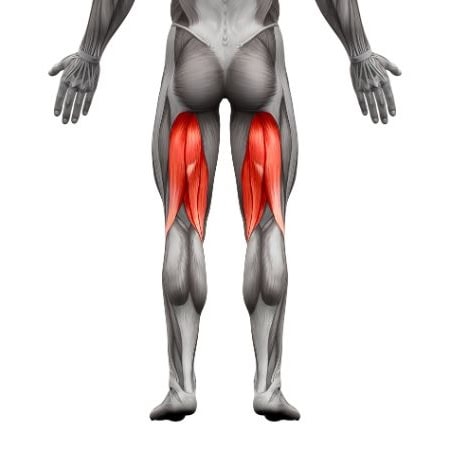
Hamstring
Secondary Muscle(s):
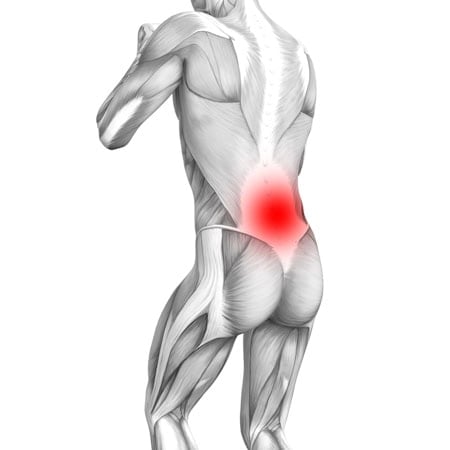
Lower back
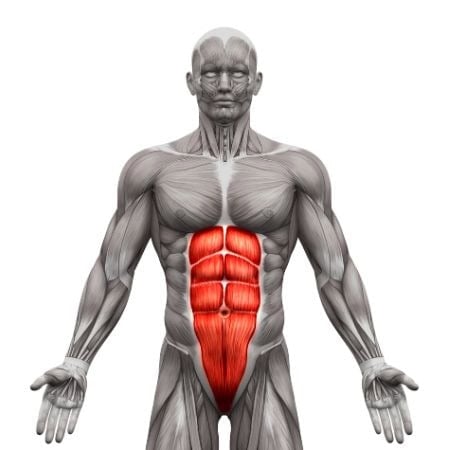
Abdominal
Equipment needed for Sliding Hamstring Curl
No equipment needed for this exercise.
Adjust the difficulty of Sliding Hamstring Curl
How to make Sliding Hamstring Curl harder?
How to make Sliding Hamstring Curl easier?
How to make Sliding Hamstring Curl harder?
To make Sliding Hamstring Curl harder:
-
Extend the legs farther while maintaining the same hip height.
-
Take four to six seconds to complete the outward sliding phase.
-
Pause for two to three seconds with the legs nearly straight before curling back in.
-
Keep the hips elevated continuously without resting between repetitions.
-
Cross your arms over your chest to reduce assistance from the upper body.
-
Wear a weighted vest to increase resistance without placing a loose object across your pelvis.
-
Perform one-and-a-half repetitions by sliding halfway in, extending again and then completing the curl.
-
Perform alternating Sliding Hamstring Curls while keeping the pelvis level.
-
Slide outward with both legs and return using one leg.
-
Progress to full Single-Leg Sliding Hamstring Curls.
-
Progress to Band-Assisted Nordic Hamstring Curls after mastering long-range sliding repetitions.
How to make Sliding Hamstring Curl easier?
To make Sliding Hamstring Curl easier:
-
Perform a standard Glute Bridge without sliding the heels to build foundational hip-extension strength.
-
Use a shorter sliding range and extend the knees only partway.
-
Lower your hips between repetitions and reset before beginning the next curl.
-
Perform eccentric-only repetitions by sliding the heels outward slowly, lowering the hips and resetting.
-
Keep the hips slightly lower to reduce the hamstring demand while learning the movement.
-
Use both hands firmly on the floor to provide additional balance.
-
Perform Hamstring Walkouts by taking several small heel steps instead of using a continuous slide.
-
Practise Lying Hamstring Curls with a Resistance Band before returning to the sliding variation.
-
Use a surface with slightly more friction so the heels move more slowly, provided the material still slides smoothly.