
Hand-Assisted Pistol Squat
How to do Hand-Assisted Pistol Squat?
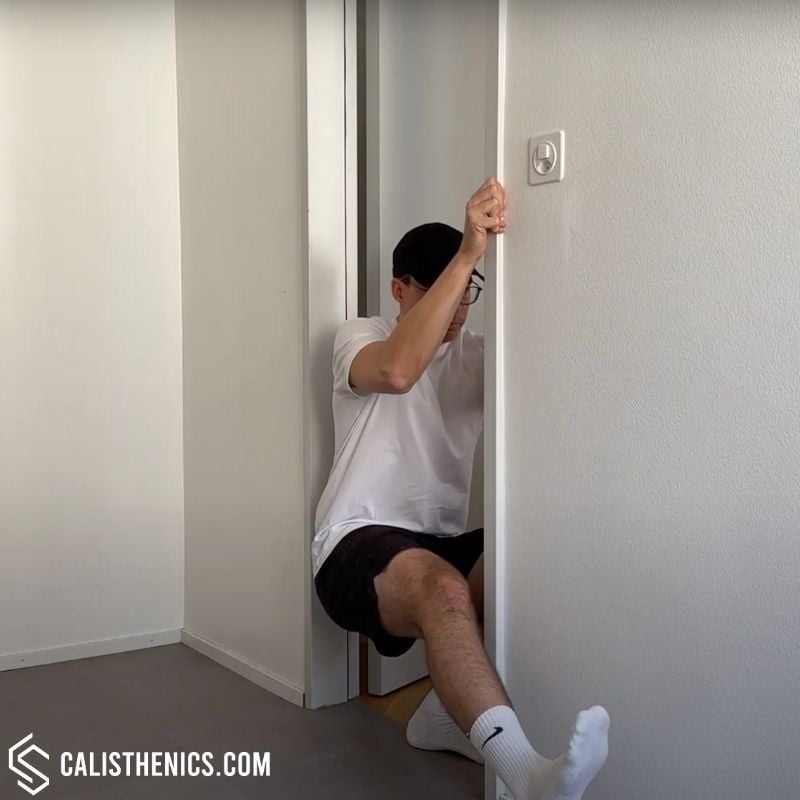
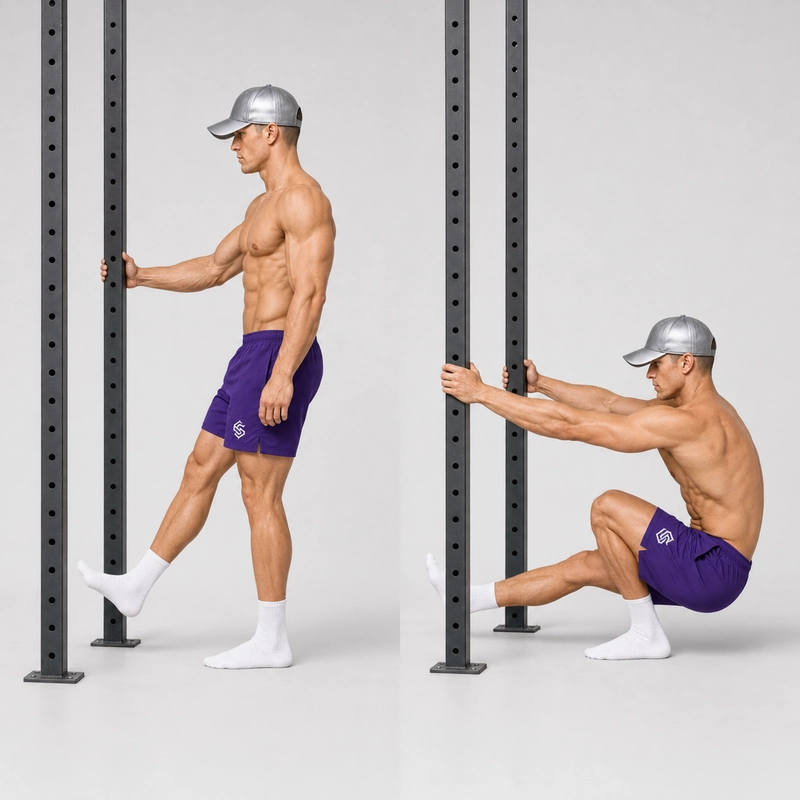
The hand-assisted pistol squat is a single-leg squat performed while holding a stable vertical support. It is also known as a supported pistol squat, pole-assisted pistol squat or doorframe one-leg squat. The hand provides adjustable assistance, allowing you to practise the depth and movement pattern of a pistol squat before you can complete it without support.
You can hold the upright of a securely anchored pull-up station, a structural post, a sturdy railing or another surface that cannot move under load. Holding with one hand is recommended because it leaves the other arm available as a counterbalance and makes it easier to monitor how much assistance you are using. Holding with both hands is completely acceptable when you need more stability or help standing from the bottom position.
Unlike bench-assisted pistol squats, the support does not restrict your depth. You can gradually descend into a full single-leg squat while using your arm only as much as necessary. Compared with single-leg squat negatives, this variation also lets you practise the upward phase rather than ending the repetition at the bottom.
The exercise is best used after you can perform a controlled, comfortable narrow-stance squat with both heels on the floor. Your working leg supplies most of the force, while the hand helps with balance and can remove part of your body weight from the most difficult portion of the repetition.
Tips for the proper execution of Hand-Assisted Pistol Squat
Test the support firmly before placing your weight on it.
Use one hand when possible and two hands when additional security is needed.
Keep pressure through the heel and both sides of the forefoot.
Guide the working knee in the same direction as the toes.
Use only as much pulling assistance as necessary.
Control the descent rather than dropping into the bottom.
Allow a natural forward torso lean instead of forcing the chest completely upright.
Reduce assistance gradually as strength and balance improve.
Muscles worked when doing Hand-Assisted Pistol Squat
The hand-assisted pistol squat primarily trains the muscles extending the knee and hip of the working leg. The support reduces the balance demand and can remove some load, but the lower-body muscle pattern remains similar to an unassisted pistol squat.
Primary Muscles
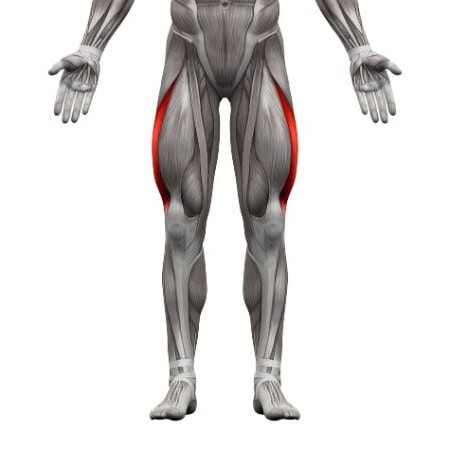
- Quadriceps: The quadriceps control knee flexion during the descent and extend the knee as you return to standing. The group consists of the vastus lateralis, vastus medialis, vastus intermedius and rectus femoris. Their shared role in knee extension is described in the NCBI overview of the thigh muscles.
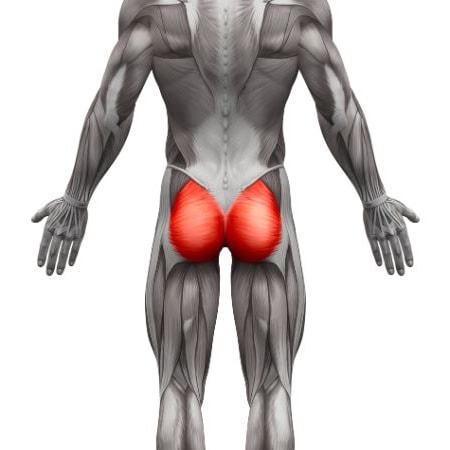
- Gluteus maximus: The gluteus maximus helps control the hip during the lowering phase and contributes strongly to hip extension as you rise from the bottom. It is particularly important when standing from a deeply flexed hip position. See the NCBI anatomy overview of the gluteus maximus.
Secondary and Stabilizing Muscles
- Gluteus medius and minimus: Help stabilize the pelvis and keep the working thigh controlled during the single-leg stance.
- Hamstrings: Assist with hip extension and contribute to stability around the knee and hip.
- Adductors: Help control the position of the thigh and contribute to hip extension from a deep squat.
- Calves: The soleus and gastrocnemius help control the ankle as the knee moves forward and the body descends.
- Abdominals and spinal stabilizers: Maintain trunk control while the body balances over one leg.
- Hip flexors and quadriceps of the free leg: Work isometrically to keep the non-working leg lifted in front of the body.
- Forearms, biceps and upper back: Provide assistance and stabilize the hand against the vertical support.
How Much Work Should the Arms Do?
There is no single required amount of assistance. The appropriate level is the smallest amount that lets you complete the intended range with consistent control. Using more assistance makes the exercise a regression; gradually reducing the pull from the hand turns it into a progression toward the unassisted pistol squat.
Primary Muscle(s):
Glutes
Quads
Secondary Muscle(s):
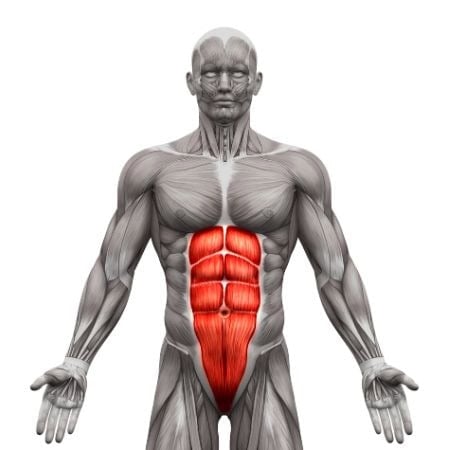
Abdominal
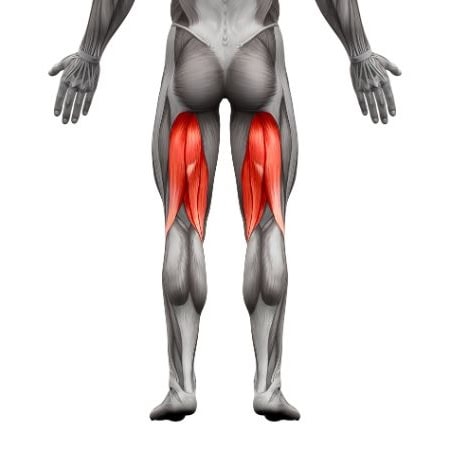
Hamstring
Equipment needed for Hand-Assisted Pistol Squat
No equipment needed for this exercise.
Adjust the difficulty of Hand-Assisted Pistol Squat
The hand-assisted pistol squat can be scaled through support, depth and tempo. Holding with both hands and pulling more strongly makes the exercise easier. Reduce assistance, increase depth and slow the lowering phase as your control improves. The final progression is completing the same movement without touching the support.
How to make Hand-Assisted Pistol Squat harder?
How to make Hand-Assisted Pistol Squat easier?
How to make Hand-Assisted Pistol Squat harder?
To make Hand-Assisted Pistol Squat harder:
-
Use only one hand on the support.
-
Progress from a full grip to a light fingertip touch.
-
Take three to five seconds to lower into the squat.
-
Pause for two to three seconds in the bottom position.
-
Use the hand only during the most difficult portion of the ascent.
-
Perform unassisted single-leg squat negatives.
-
Progress to a complete unassisted pistol squat.
How to make Hand-Assisted Pistol Squat easier?
To make Hand-Assisted Pistol Squat easier:
-
Hold the support with both hands.
-
Use more arm assistance during the descent and ascent.
-
Perform a partial-range hand-assisted pistol squat.
-
Lower toward a high bench or box as a depth target.
-
Keep the free knee slightly bent instead of forcing the leg completely straight.
-
Place a small wedge under the working heel if ankle mobility is limiting, while continuing to train the non-elevated version separately.