
Dragon Flag
How to do Dragon Flag?
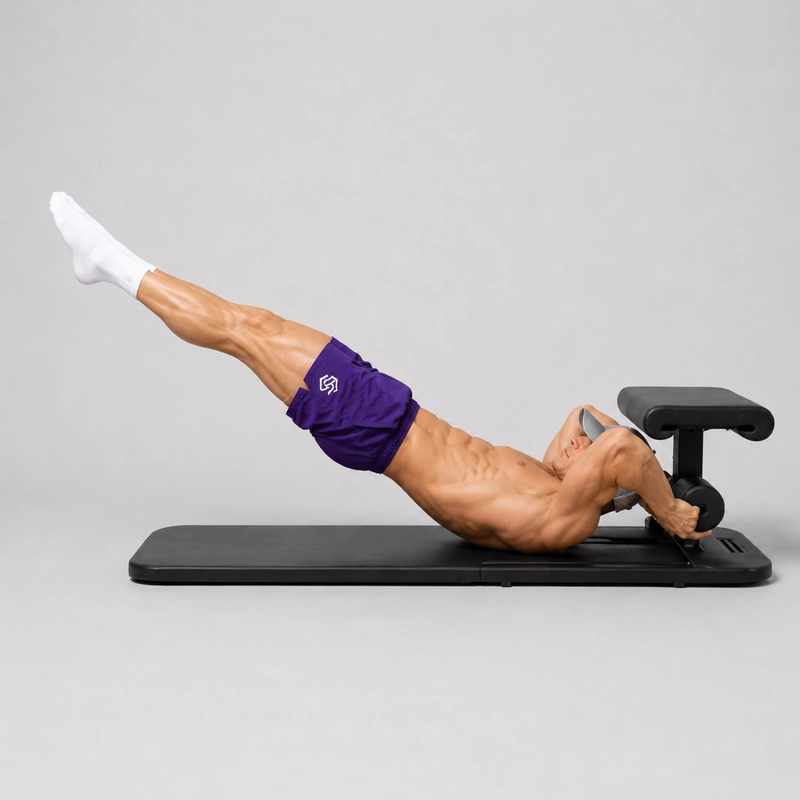
The dragon flag is an advanced bodyweight core exercise performed on a sturdy bench or firm surface with a secure object to hold behind your head. From a shoulder-supported position, you lower and raise your torso and legs as one rigid unit without allowing your hips to fold or your lower back to arch.
Unlike a conventional leg raise, the dragon flag requires you to control the position of your pelvis, spine and legs together. It is primarily an anti-extension exercise: your abdominal muscles must prevent gravity from pulling your body into excessive lumbar extension as you approach the horizontal position. The NCBI overview of the abdominal wall describes how the abdominal muscles contribute to trunk movement, pressure generation and stabilization under load.
Before attempting the full movement, develop a strong hollow body hold, controlled hanging leg raises and the ability to lift your pelvis without relying on momentum. The tuck hollow body hold and bent-knee dragon flag variations provide more appropriate starting points for athletes who cannot yet maintain a straight body.
The dragon flag should not be confused with the tuck dragon press hold. A dragon flag uses an overhead grip to anchor the upper body and is normally performed as a controlled raising and lowering exercise. A dragon press uses the hands or fingertips beside the body to press into the floor and support a static position.
The exercise creates substantial leverage as the body approaches horizontal, so progress through shorter levers and controlled negatives before attempting full repetitions. Use a stable bench that cannot tip or slide, keep the load on your shoulders and upper back rather than your neck, and stop if you experience sharp pain, tingling or persistent discomfort in your neck, shoulders or lower back.
- Choose a secure setup: Lie on a sturdy flat bench or padded surface with a fixed support behind your head that you can grip firmly.
- Establish your grip: Hold the sides or upright of the bench with both hands and keep your elbows in a stable, comfortable position.
- Enter a tucked position: Bend your knees toward your chest and use your abdominal muscles to curl your pelvis away from the bench.
- Move onto your upper back: Raise your hips until your weight is supported across your shoulders and upper back rather than your neck or head.
- Extend into the starting position: Straighten your hips and knees toward the ceiling while tightening your abdominals, glutes and quadriceps.
- Begin the descent: Lower your body slowly as one unit while maintaining a straight line from your shoulders through your hips to your feet.
- Control the pelvis: Keep your ribs drawn down and your pelvis slightly tucked so your lower back does not arch as the leverage increases.
- Reach your controlled depth: Stop before your hips or lower back touch the bench or before you lose the rigid body position.
- Return upward: Reverse the movement while keeping your hips extended, or bend your knees and reset if you are performing a negative-only repetition.
- Finish safely: Tuck your knees toward your chest and lower your spine gradually onto the bench instead of dropping out of the position.
Common Mistakes to Avoid
- Supporting the body on the neck: Distribute the load across your shoulders and upper back rather than balancing on the cervical spine.
- Using an unstable bench: Test the bench and gripping point before beginning so the setup cannot tip, slide or detach.
- Arching the lower back: End the repetition or use an easier variation when you can no longer maintain abdominal tension and pelvic control.
- Bending at the hips: Keep your shoulders, hips, knees and ankles aligned instead of turning the exercise into a straight-leg raise.
- Dropping through the lowering phase: Control the descent and stop at a higher angle if you cannot resist gravity smoothly.
- Using momentum from the legs: Initiate the movement through your trunk and pelvis instead of swinging the legs toward the ceiling.
- Pulling excessively with the arms: Use your grip to anchor the upper body while allowing the core to control the position of the torso and legs.
- Attempting the full lever too early: Master tuck, one-leg and negative variations before repeatedly training failed full repetitions.
- Holding your breath for the entire set: Use short, controlled breaths while preserving abdominal pressure and body tension.
Benefits of the Dragon Flag
- Develops advanced anti-extension strength: The abdominal muscles resist lumbar extension while the body is exposed to a long lever.
- Builds full-body tension: The abdominals, glutes, legs and upper body must coordinate to preserve a rigid position.
- Trains eccentric control: Slow dragon flag negatives teach you to resist a progressively increasing load as your body approaches horizontal.
- Improves pelvic control: The exercise requires you to maintain the relationship between your rib cage, spine and pelvis under substantial resistance.
- Provides scalable bodyweight resistance: Tuck, one-leg, straddle and straight-leg variations allow the lever to be adjusted without adding external weight.
- Creates a measurable advanced core standard: Depth, body alignment and lowering speed provide clear criteria for evaluating technical progress.
Core training can improve trunk strength, but it should not be presented as a guaranteed shortcut to unrelated athletic skills. A systematic review and meta-analysis of trunk-muscle training found substantial improvements in trunk strength but more limited transfer to general physical-performance measures.
Frequently Asked Questions
Which parts of the body should remain on the bench?
Your shoulders and upper back should provide the primary support while the rest of your torso and legs remain elevated. Your head may rest lightly against the bench, but you should not push through your head or balance your weight on your neck.
Should the lower back remain on the bench?
No, the lower back lifts away from the bench during a dragon flag. The goal is to prevent it from arching excessively while the body remains supported from the shoulders and upper back.
Is the dragon flag a lower-ab exercise?
The dragon flag trains the abdominal wall as a coordinated unit rather than isolating a separate “lower abdominal” muscle. The rectus abdominis, obliques and deeper abdominal muscles work together with the hip and upper-body stabilizers.
What is the difference between a dragon flag and a leg raise?
During a leg raise, the legs move primarily relative to a comparatively stable torso. During a dragon flag, the pelvis, torso and legs move together as a rigid lever while the shoulders remain anchored.
Can I perform dragon flags on the floor?
Yes, provided you have a secure, immovable object behind your head to hold and enough padding for your shoulders. A bench often makes the grip and range of motion easier to manage.
Should I start with full dragon flag repetitions?
No, most athletes should begin with tucked repetitions or controlled negatives. Progress by gradually extending the legs and lowering closer to horizontal without losing pelvic control.
How many dragon flags should I perform?
Use a small number of technically consistent repetitions, often three to six, and stop the set when your hips begin to fold, your lower back arches or the descent becomes uncontrolled.
Why do I feel the exercise in my lats?
The latissimus dorsi and other upper-body muscles help anchor your shoulders through the overhead grip, so substantial lat involvement is normal even though the abdominal wall controls the body position.
What should I do if my lower back hurts?
Stop the exercise and return to a shorter-lever variation such as a tuck dragon flag or hollow body hold. Seek advice from a qualified healthcare professional if pain persists, recurs or affects normal activity.
Tips for the proper execution of Dragon Flag
Use a sturdy bench or fixed support that cannot tip, slide or detach while you are holding it.
Maintain support across your shoulders and upper back instead of placing your body weight on your neck.
Tighten your abdominals and glutes before beginning the lowering phase.
Keep your shoulders, hips, knees and ankles aligned as one rigid unit.
Draw your ribs down and maintain a slight posterior pelvic tilt to resist lower-back extension.
Lower only as far as you can maintain a straight body without arching or folding at the hips.
Perform the descent slowly and avoid allowing gravity to pull your body toward the bench.
Use your hands and lats to anchor your upper body without trying to curl yourself upward using only your arms.
Point your toes and tighten your quadriceps to make changes in body alignment easier to see.
End the set when your hips begin to sag, your knees bend unintentionally or the movement becomes uncontrolled.
Muscles worked when doing Dragon Flag
The dragon flag is a full-body tension exercise, but its primary demand is placed on the muscles that stabilize the trunk and prevent the lumbar spine from extending as the body approaches horizontal.
Primary Muscles
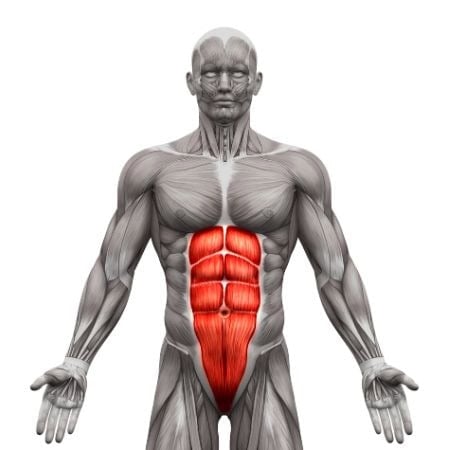
- Rectus abdominis: The rectus abdominis maintains trunk stiffness and helps control the relationship between the rib cage and pelvis.
- Transversus abdominis: This deep abdominal muscle contributes to abdominal compression and trunk stability during the movement.
- Internal and external obliques: The obliques assist with trunk stabilization and prevent unwanted rotation or lateral movement.
The abdominal wall contains several muscles with overlapping roles in trunk movement, compression and stabilization. These relationships are described in the NCBI abdominal-wall anatomy reference.
Secondary and Stabilizing Muscles
- Hip flexors: The iliopsoas and rectus femoris help control the position of the legs relative to the pelvis.
- Gluteus maximus: The glutes help maintain hip extension and prevent the body from folding at the hips.
- Quadriceps: The quadriceps keep the knees extended and contribute to the rigid straight-leg position.
- Latissimus dorsi and teres major: These muscles help anchor the upper body through the overhead grip.
- Serratus anterior, trapezius and rhomboids: These muscles stabilize the shoulder blades against the supporting surface.
- Spinal erectors: The back extensors co-contract with the abdominal muscles to maintain a stable trunk while the body moves.
- Forearms and upper arms: The grip and arm muscles secure your connection to the bench or fixed support.
The hollow body hold trains a related anti-extension position with a shorter and more manageable lever. The hanging leg raise develops hip-flexion and abdominal control from a hanging position, while the dragon flag combines those qualities with a shoulder-supported full-body lever.
Primary Muscle(s):
Abdominal
Secondary Muscle(s):
Equipment needed for Dragon Flag
No equipment found.
Adjust the difficulty of Dragon Flag
How to make Dragon Flag harder?
How to make Dragon Flag easier?
How to make Dragon Flag harder?
To make Dragon Flag harder:
-
Gradually extend both knees until you can maintain a completely straight body throughout the repetition.
-
Increase the lowering range until your straight body approaches the bench without touching it.
-
Take five or more seconds to complete each controlled lowering phase.
-
Pause at the most difficult point just above horizontal without allowing your hips to sag.
-
Perform complete straight-leg repetitions that include both the lowering and raising phases.
-
Perform one-and-a-half repetitions by lowering near horizontal, rising halfway, lowering again and then returning to vertical.
-
Add very light ankle weights only after you can perform strict full-range dragon flags without losing alignment.
How to make Dragon Flag easier?
To make Dragon Flag easier:
-
Practise the tuck hollow body hold before attempting shoulder-supported dragon flag variations.
-
Keep both knees tightly bent toward your chest during the raising and lowering phases.
-
Perform tuck dragon flag negatives by lowering slowly and resetting after your back reaches the bench.
-
Extend one leg while keeping the other knee tucked toward your chest.
-
Use a straddle position to shorten the effective lever compared with keeping the legs together.
-
Lower through a partial range and stop well before your body reaches horizontal.
-
Begin each repetition from the elevated position and perform only the controlled lowering phase.