
Split Squat
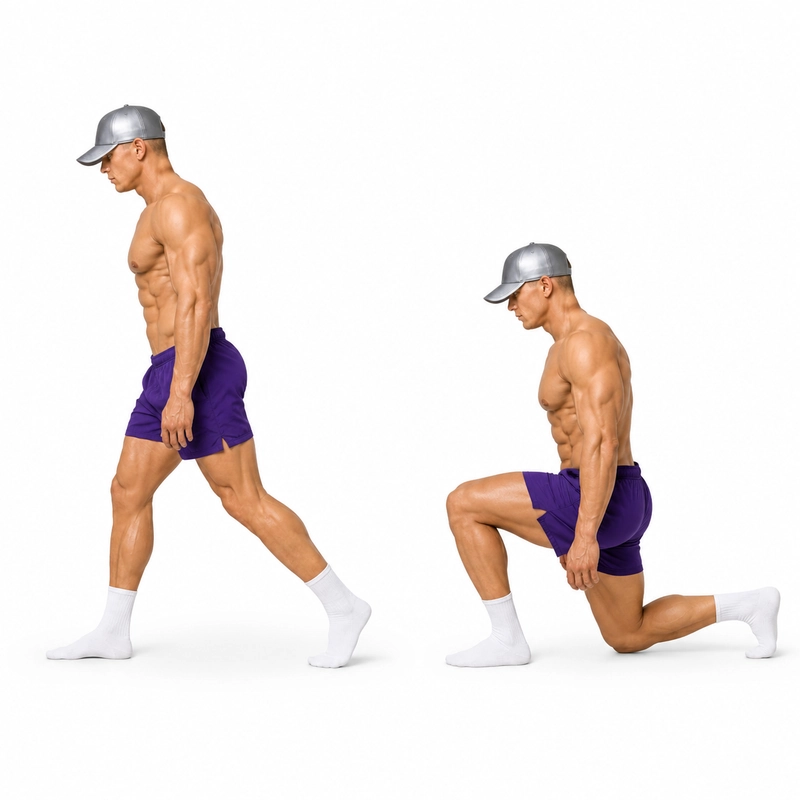
How to do Split Squat?
The split squat is a lower-body exercise performed from a staggered stance with one foot in front of the other. Unlike a forward lunge or reverse lunge, both feet remain planted while the body travels primarily up and down. This is why the movement is also called a stationary lunge or static lunge.
The fixed foot position makes the split squat a useful exercise for learning unilateral leg training before adding the stepping and balance demands of dynamic lunges. Once you can perform controlled bodyweight split squats, you can progress to the more demanding Bulgarian split squat, in which the rear foot is elevated.
The exercise primarily develops the quadriceps and glutes while also training the hamstrings, calves, hip stabilizers and core. It requires no equipment and can be used for lower-body strength, muscular endurance or hypertrophy. For more exercise options, see our guide to building strong legs with calisthenics.
Your stance length affects how the exercise feels and where much of the muscular demand occurs. Research examining different split-squat step lengths found that increasing the distance between the feet increased hip-extensor involvement while having a smaller effect on the knee extensors. Start with a comfortable stance that permits balance and controlled depth before deliberately adjusting it for a particular training emphasis.
Tips for the proper execution of Split Squat
Keep approximately hip-width lateral distance between your feet instead of standing on one narrow line.
Choose a stance long enough to lower the rear knee comfortably without losing balance.
Keep the heel, base of the big toe and base of the little toe of the front foot connected to the floor.
Allow the front knee to travel forward while keeping it aligned with the direction of the toes.
Lower the rear knee primarily downward instead of moving the entire body forward.
Keep the front leg as the main working leg while allowing the rear leg to assist with balance and force production.
Use a small, natural forward torso lean rather than forcing the upper body completely vertical.
Lower under control and stop the rear knee just above the floor.
Start with your weaker leg and perform the same number of controlled repetitions on both sides.
Muscles worked when doing Split Squat
The split squat primarily trains the quadriceps and gluteus maximus. The quadriceps extend the front knee as you stand, while the gluteus maximus produces hip extension and helps control the descent.
Although the front leg usually performs most of the work, the split squat is not a true single-leg exercise. The rear leg remains active and contributes to force production, stability and balance. The relative contribution of each leg changes with stance length, body position and how the athlete distributes pressure between the feet.
The hamstrings and adductors assist with hip control, while the gluteus medius and other lateral hip muscles help stabilize the pelvis and front knee. The calves and muscles of both feet maintain balance, and the abdominal muscles, obliques and spinal erectors stabilize the torso.
Primary muscles
- Quadriceps: Control front-knee flexion during the descent and extend the knee during the ascent.
- Gluteus maximus: Controls the front hip as you lower and produces hip extension as you stand.
Secondary muscles
- Hamstrings: Assist with hip extension and stabilization of the front leg.
- Adductors: Help stabilize the thigh and contribute to hip extension at deeper ranges.
- Gluteus medius and minimus: Stabilize the pelvis and help control the alignment of the front knee.
- Calves and foot muscles: Stabilize the ankles and maintain pressure through both feet.
- Hip flexors of the rear leg: Work around the rear hip while moving through an extended position at the bottom.
- Abdominals, obliques and spinal erectors: Keep the torso stable throughout the exercise.
Primary Muscle(s):
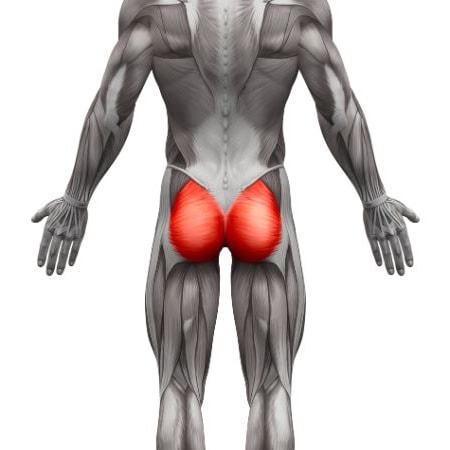
Glutes
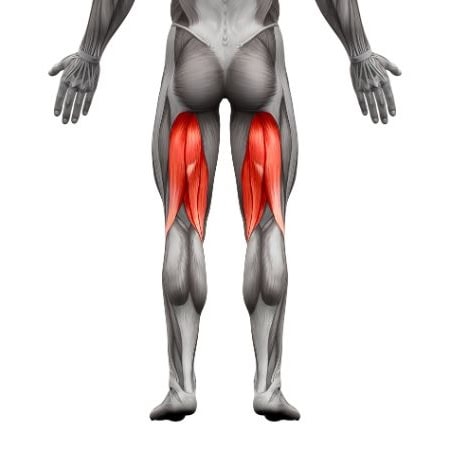
Hamstring
Secondary Muscle(s):
Hamstring
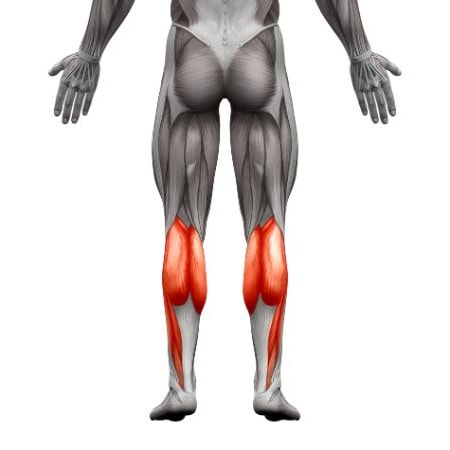
Calf
Equipment needed for Split Squat
No equipment needed for this exercise.
Adjust the difficulty of Split Squat
How to make Split Squat harder?
How to make Split Squat easier?
How to make Split Squat harder?
To make Split Squat harder:
-
Hold dumbbells, kettlebells or other weights at your sides to add external resistance.
-
Wear a weighted vest or loaded backpack to increase resistance while keeping your hands free.
-
Take 3–5 seconds to lower into each repetition.
-
Pause with the rear knee just above the floor for 2–3 seconds before standing.
-
Perform split squat pulses in the lower half of the movement.
-
Elevate the front foot on a stable platform to increase the available range of motion.
-
Elevate the rear foot on a bench or plyo box to progress to Bulgarian Split Squats.
-
Progress to jumping split squats only after developing consistent strength, balance and landing control.
How to make Split Squat easier?
To make Split Squat easier:
-
Hold a wall, railing or other stable support to reduce the balance requirement.
-
Reduce the range of motion and descend only as far as you can control.
-
Place a cushion or stacked exercise mats beneath the rear knee to provide a higher depth target.
-
Use only bodyweight and keep your hands on your hips or extended to the sides for balance.
-
Increase the lateral distance between your feet if the current stance feels like balancing on a tightrope.
-
Adjust the front-to-back distance between your feet until both knees can bend comfortably.
-
Perform fewer repetitions per set and stop before balance or technique deteriorates.
-
Begin from a half-kneeling position to establish a comfortable stance before rising into the starting position.