
Box Step-Up
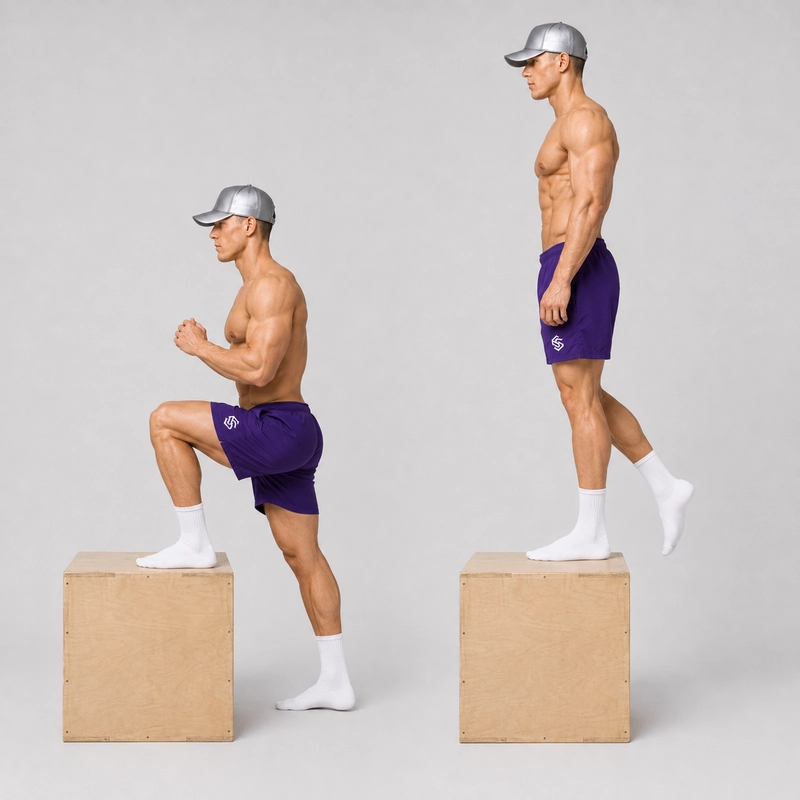
How to do Box Step-Up?
The box step-up is a unilateral lower-body exercise in which you place one foot on a stable plyometric box and use that leg to lift your body onto the platform. It strengthens the quadriceps and glutes while challenging balance, hip stability and control on each side independently.
The defining feature of a well-executed box step-up is that the leg on the box produces the movement. The foot on the floor should provide minimal assistance, and the athlete should reach full hip and knee extension at the top before lowering under control. The trailing leg may remain lifted beside the box or move into a knee-drive position, but it should not be planted to help complete the repetition.
Box step-ups are a practical bridge between bilateral exercises and more demanding single-leg movements. They can follow basic split squats or reverse lunges and help build strength for exercises such as Bulgarian split squats and single-leg squat negatives.
The height of the box determines much of the difficulty. Begin with a platform low enough that you can place the entire foot on top, keep the knee aligned with the toes and stand without jumping or forcefully pushing from the trailing foot. Increase the height only after you can control both the ascent and descent.
Tips for the proper execution of Box Step-Up
Place your entire working foot on the box, including the heel.
Stand close enough to the box that you do not need to reach forward with the working foot.
Shift your bodyweight over the foot on the box before beginning the ascent.
Drive through the whole working foot rather than pushing only through the toes.
Minimize assistance from the trailing foot; avoid jumping from the floor.
Keep the working knee tracking in the same general direction as the toes.
Allow a slight forward torso lean while keeping your spine neutral.
Finish each ascent with the working hip and knee fully extended.
Keep your pelvis level instead of shifting your weight dramatically to one side.
Lower under control and let the trailing foot touch the floor lightly.
Use the same box height and movement standard on both legs.
Let the weaker leg determine the number of repetitions performed.
Muscles worked when doing Box Step-Up
The box step-up is a compound unilateral leg exercise. The quadriceps and gluteus maximus produce most of the force required to raise the body, while the hamstrings, calves, hip stabilizers and core help maintain alignment and control.
Primary muscles
- Quadriceps: Extend the working knee during the ascent and control knee flexion while stepping back down.
- Gluteus maximus: Extends the working hip as the body rises onto the box and reaches a fully upright position.
Secondary muscles
- Hamstrings: Assist hip extension and contribute to knee and hip stability throughout the repetition.
- Gluteus medius and other hip stabilizers: Help keep the pelvis level and control the position of the working knee.
- Calves: Stabilize the ankle and assist force transfer through the working foot.
- Abdominals and obliques: Stabilize the torso and resist excessive leaning or rotation.
- Spinal stabilizers: Help maintain a controlled trunk position during the ascent and descent.
A higher box generally requires greater hip and knee flexion, but height should never come at the expense of foot contact, knee control or a smooth ascent. The most productive height is the highest one you can use without jumping from the floor or losing alignment.
Primary Muscle(s):
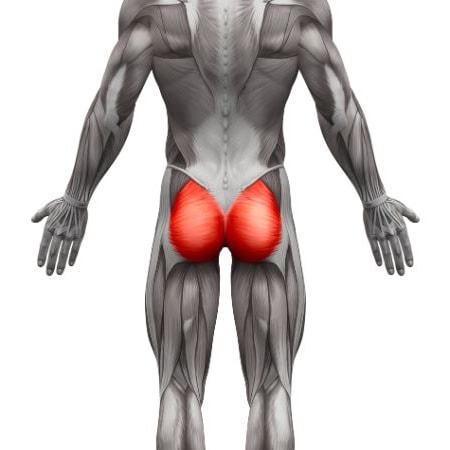
Glutes
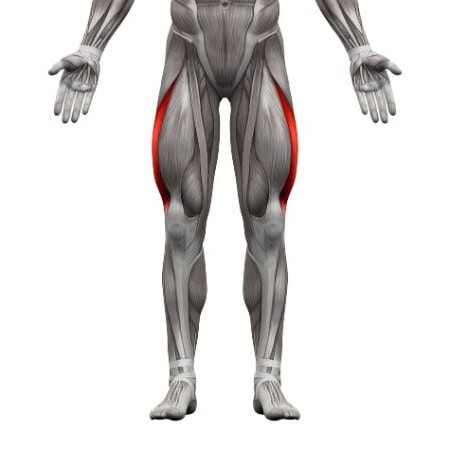
Quads
Secondary Muscle(s):
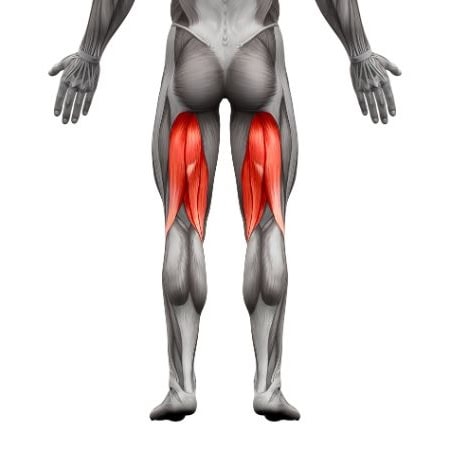
Hamstring
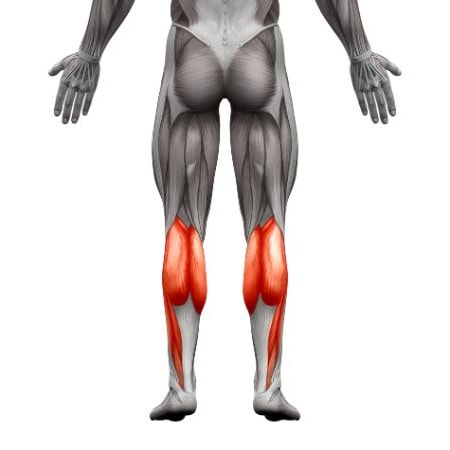
Calf
Equipment needed for Box Step-Up

Adjust the difficulty of Box Step-Up
How to make Box Step-Up harder?
How to make Box Step-Up easier?
How to make Box Step-Up harder?
To make Box Step-Up harder:
-
Increase the Box Height: Use a slightly higher platform while preserving complete foot contact and controlled knee alignment.
-
Add a Knee Drive: Bring the trailing knee toward hip height and pause briefly after reaching full extension.
-
Use a Slow Descent: Take three to five seconds to lower the trailing foot back to the floor.
-
Pause at the Top: Balance on the working leg for two to three seconds without resting the trailing foot on the box.
-
Perform Continuous Single-Leg Repetitions: Complete the entire set on one leg without placing the trailing foot on the box.
-
Add External Resistance: Hold dumbbells, wear a weighted vest or use a securely fitted backpack.
-
Use a Deficit Step-Down: Stand on the box and lower the free foot toward a surface below the normal floor level, provided the box remains stable.
How to make Box Step-Up easier?
To make Box Step-Up easier:
-
Use a Lower Box: Reduce the amount of hip and knee flexion required at the starting position.
-
Use Hand Support: Hold a stable railing, rack or wall lightly for balance.
-
Bring Both Feet onto the Box: Step up with the working leg and place the trailing foot beside it before stepping down.
-
Reduce the Range of Motion: Use a low aerobic step or the bottom stair until you can control the complete movement.
-
Alternate Legs: Alternating sides provides more recovery between repetitions on each working leg.
-
Practise Controlled Step-Downs: Begin on top of a low box and focus only on lowering one foot to the floor before returning with both legs.