
Overhead Shoulder External Rotation
How to do Overhead Shoulder External Rotation?
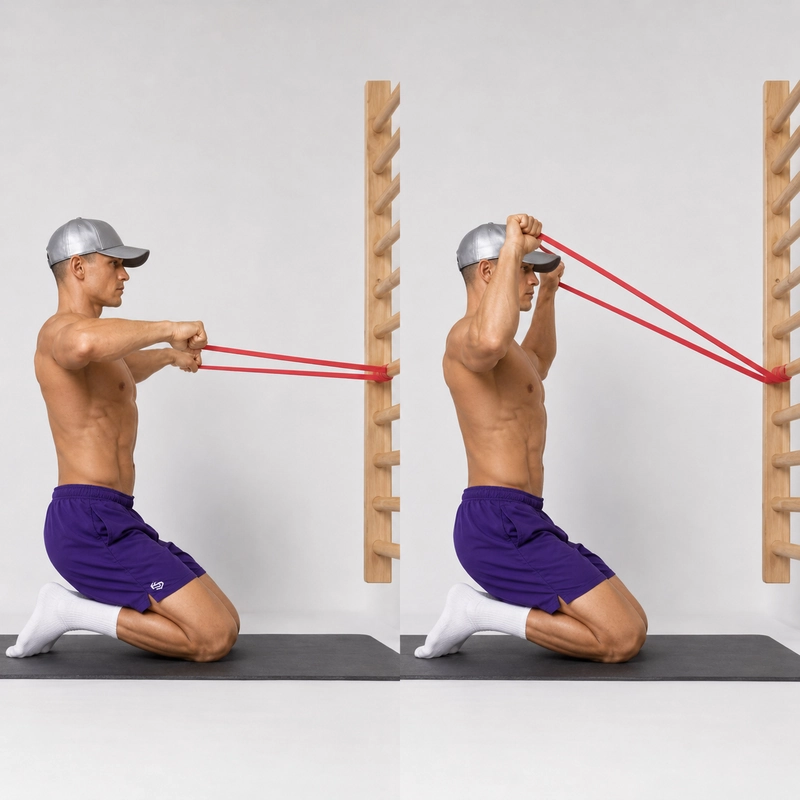
The kneeling overhead shoulder external rotation is a resistance-band exercise performed in a tall-kneeling position with the upper arm raised approximately to shoulder height. With the elbow bent to 90 degrees, you rotate the forearm upward until it approaches a vertical position while keeping the elbow and upper arm controlled.
This movement is also called a tall-kneeling 90/90 external rotation. The “90/90” description refers to approximately 90 degrees of shoulder abduction and 90 degrees of elbow flexion. Although the exercise is often described as overhead, it is not an overhead press: the upper arm remains around shoulder height while the forearm rotates upward.
The exercise primarily trains the infraspinatus and teres minor, which externally rotate the upper arm. Holding the arm at shoulder height also increases the demand on the supraspinatus, serratus anterior, trapezius and other muscles responsible for coordinating the shoulder blade and upper arm.
This arm-raised position distinguishes the exercise from the standard rotator cuff external rotation, during which the elbow remains beside the torso. Research comparing shoulder-abduction angles found that performing band external rotation at 90 degrees changes the shoulder-muscle recruitment pattern and increases the involvement of several scapular stabilizers. See the published resistance-band external-rotation study.
The tall-kneeling position removes assistance from the legs and requires the glutes and abdominal muscles to prevent the ribs from lifting, the lower back from arching and the torso from rotating. However, kneeling does not automatically increase rotator-cuff activation compared with standing; its main purpose is to provide a controlled position for coordinating the shoulder and trunk.
You should be able to raise your arm to approximately shoulder height without pain before attempting this variation. Begin with a light band because the arm-raised position can make compensations difficult to control. Stop if you experience sharp pain, instability, numbness or a catching sensation inside the shoulder.
- Secure the resistance band: Attach the band to a stable anchor in front of you at approximately shoulder height.
- Face the anchor: Kneel far enough from the attachment point to create light tension when your arm is in the starting position.
- Establish the tall-kneeling stance: Place both knees on a mat approximately hip-width apart and extend your hips so your torso is upright.
- Set your trunk: Lightly contract your glutes and abdominals while keeping your rib cage stacked over your pelvis.
- Raise the working arm: Lift your upper arm approximately to shoulder height and position it slightly in front of the side of your torso if that feels more comfortable.
- Bend the elbow: Maintain approximately 90 degrees of elbow flexion, with your forearm pointing toward the anchor in the starting position.
- Set the shoulder blade: Keep the shoulder blade controlled against your rib cage without forcefully pinching it down or back.
- Rotate the shoulder: Keeping the elbow in approximately the same place, rotate your forearm upward and backward against the band.
- Reach your controlled end position: Stop when your forearm approaches vertical or before your elbow moves, your shoulder shrugs or your lower back arches.
- Return slowly: Rotate the forearm forward toward the anchor while resisting the pull of the band.
- Complete both sides: Finish the set with one arm before changing hands and repeating the exercise on the opposite side.
Common Mistakes to Avoid
- Dropping the elbow: Keep the upper arm approximately at shoulder height instead of allowing the elbow to fall as the band becomes harder to move.
- Pulling the elbow backward: Rotate at the shoulder without turning the movement into a row or horizontal pull.
- Shrugging toward the ear: Avoid using excessive upper-trapezius elevation to create the appearance of more rotation.
- Arching the lower back: Maintain abdominal and glute tension instead of lifting the ribs and leaning backward.
- Sitting the hips toward the heels: Keep the hips extended and the torso upright throughout the set.
- Rotating the torso: Keep your chest facing the anchor instead of turning your entire upper body with the working arm.
- Straightening the elbow: Maintain approximately 90 degrees of elbow flexion while the upper arm rotates.
- Bending the wrist: Keep the wrist aligned with the forearm rather than extending the wrist to move the hand farther upward.
- Forcing the forearm completely vertical: Use the range available at your shoulder without changing the position of the ribs, shoulder blade or elbow.
- Using too much resistance: Select a lighter band if the posterior deltoid, torso or upper trapezius begins to dominate the movement.
- Using the wrong anchor height: An anchor that is too low or too high changes the line of resistance and may pull the elbow away from its intended position.
- Allowing the band to snap forward: Control the returning phase instead of letting the resistance pull your hand suddenly toward the anchor.
Benefits of the Kneeling Overhead Shoulder External Rotation
- Strengthens the external rotators: The exercise trains the infraspinatus and teres minor with the arm raised approximately to shoulder height.
- Develops strength in the 90/90 position: It trains external rotation from an arm position used during many throwing, hanging and overhead activities.
- Challenges shoulder-blade coordination: The rotator cuff, serratus anterior and trapezius must coordinate to control the raised upper arm.
- Improves positional control: The elbow must remain stable while the forearm moves independently through external and internal rotation.
- Trains trunk stability: The tall-kneeling stance requires the abdominals and glutes to prevent extension and rotation through the torso.
- Makes compensations easier to identify: Dropping the elbow, arching the back or rotating the torso becomes visually apparent in the kneeling position.
- Provides adjustable resistance: Band thickness and distance from the anchor can be modified without changing the basic movement.
- Requires minimal equipment: The exercise needs only a resistance band, secure anchor and optional knee padding.
Frequently Asked Questions
Why is this called an overhead external rotation?
The forearm rotates upward toward an overhead position while the upper arm remains approximately parallel to the floor. It is not an overhead press because the elbow does not travel from shoulder height to above the head.
Is this a 90/90 shoulder external rotation?
Yes. The upper arm is positioned at approximately 90 degrees relative to the torso, and the elbow remains bent approximately 90 degrees. Individual anatomy may make a slightly lower or more forward upper-arm position more comfortable.
How is it different from a standard band external rotation?
During a standard rotator cuff external rotation, the upper arm remains beside the torso. In this variation, the upper arm is raised to shoulder height, which changes the leverage and recruitment of the rotator cuff and shoulder-blade muscles.
Where should the resistance band be anchored?
Anchor the band in front of you at approximately shoulder height. The band should pull the hand forward while allowing you to rotate the forearm upward without pulling the elbow substantially upward or downward.
Should my forearm become completely vertical?
A nearly vertical forearm provides a useful visual standard, but it should not be forced. Stop at the point where you can maintain the elbow, shoulder blade, rib cage and pelvis positions without pain.
Should I squeeze my shoulder blade down and back?
No. Keep the shoulder blade controlled, but do not force it into maximal depression or retraction. The scapula should remain coordinated with the raised upper arm rather than being rigidly pinned in place.
Where should I feel the exercise?
You will commonly feel muscular effort around the back of the shoulder. The shoulder-blade muscles, abdominals and glutes may also work to maintain the arm and kneeling positions. Sharp pain, catching or instability is not a normal training sensation.
How much resistance should I use?
Use a light or moderate band that allows you to maintain the elbow at shoulder height without shrugging, leaning or pulling the elbow backward. Recent research found that increasing band resistance increased the activity of several shoulder muscles, but heavier resistance also makes compensatory movement more likely.
How many repetitions should I perform?
Begin with two or three sets of 8–15 technically consistent repetitions per side. End the set when the elbow begins to drop, the torso arches or the returning phase becomes difficult to control.
Is this exercise suitable for beginners?
It is more technically demanding than external rotation with the elbow beside the torso. Beginners should first practise the standard variation or use a lower upper-arm angle before progressing to the full 90/90 position.
Can this exercise prevent or rehabilitate shoulder injuries?
Arm-raised external rotations are used in some shoulder-conditioning programs, but no single exercise guarantees injury prevention. If you have shoulder pain, a history of instability or are recovering from surgery, use a variation and training prescription selected by a qualified healthcare professional.
Tips for the proper execution of Overhead Shoulder External Rotation
Anchor the resistance band securely in front of you at approximately shoulder height.
Kneel tall with both knees approximately hip-width apart and your hips fully extended.
Contract your glutes and abdominals to keep your ribs stacked over your pelvis.
Hold your upper arm approximately at shoulder height and slightly in front of your torso if needed for comfort.
Maintain approximately 90 degrees of elbow flexion throughout the exercise.
Keep the elbow in the same position while the forearm rotates upward and downward.
Allow the shoulder blade to remain naturally coordinated instead of forcing it aggressively down and back.
Keep your wrist straight and move the hand and forearm as one unit.
Stop the upward rotation before your elbow drops, your shoulder shrugs or your lower back arches.
Keep your chest facing the anchor instead of rotating your torso with the working arm.
Control the forward return and never allow the resistance band to pull your arm suddenly.
Use a light enough band to maintain the 90/90 arm position throughout every repetition.
Muscles worked when doing Overhead Shoulder External Rotation
The kneeling overhead shoulder external rotation primarily trains the muscles that rotate and stabilize the shoulder with the upper arm raised to approximately 90 degrees. The tall-kneeling position also recruits the abdominals and glutes to control the torso and pelvis.
Primary Muscles
- Infraspinatus: The infraspinatus externally rotates the upper arm and helps control the humeral head throughout the exercise.
- Teres minor: Teres minor assists external rotation and becomes particularly important when the arm is raised to approximately shoulder height.
Research comparing external rotation at different arm positions found that both the infraspinatus and teres minor are strongly involved, but their relative contributions can change with shoulder angle. One study found relatively greater teres-minor involvement at 90 degrees of shoulder abduction than with the arm beside the body. See the published shoulder external-rotator study.
Secondary and Stabilizing Muscles
- Posterior deltoid: The rear shoulder assists external rotation but can become a compensating prime mover if the elbow travels backward.
- Supraspinatus: The supraspinatus contributes to controlling and supporting the upper arm in the shoulder-height position.
- Subscapularis: Although it produces internal rotation, the subscapularis can co-contract with the posterior cuff to help control the shoulder joint.
- Serratus anterior: The serratus helps control the shoulder blade against the rib cage while the arm remains elevated.
- Upper, middle and lower trapezius: The different regions of the trapezius coordinate the position and upward rotation of the shoulder blade.
- Rhomboids: The rhomboids assist with scapular control and resist excessive forward movement of the shoulder blade.
- Biceps, triceps and forearm muscles: These muscles stabilize the elbow and wrist while maintaining the connection to the band.
- Abdominals and obliques: The trunk muscles resist lower-back extension and rotation as the arm moves.
- Gluteus maximus: The glutes maintain hip extension and prevent the body from sitting backward toward the heels.
A recent band-exercise study found greater upper-trapezius, serratus-anterior and supraspinatus activity during external rotation at 90 degrees of shoulder abduction than with the arm beside the body. This supports treating the overhead variation as a distinct exercise rather than merely a kneeling copy of the standard external rotation. See the full external-rotation study.
Primary Muscle(s):
Secondary Muscle(s):
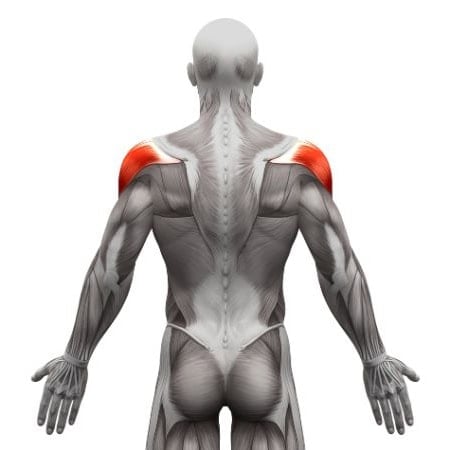
Rear delt
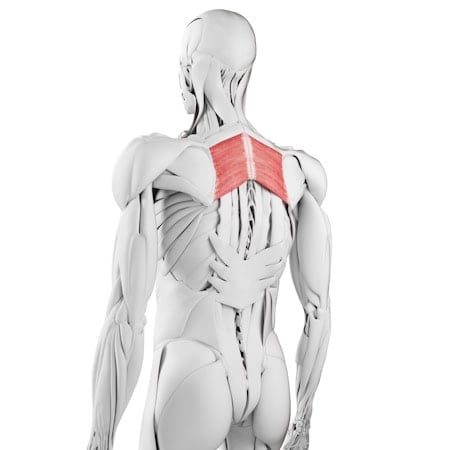
Rhomboid
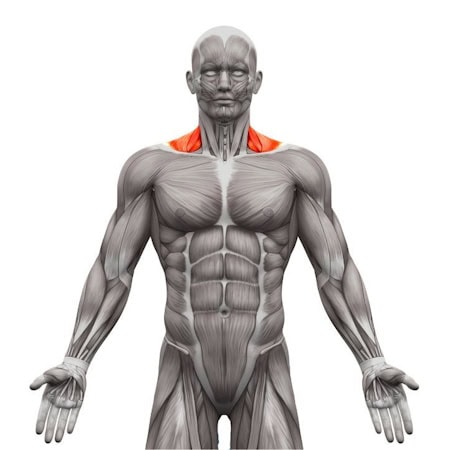
Trapezius
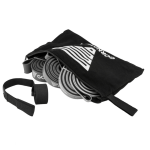
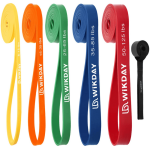
Equipment needed for Overhead Shoulder External Rotation
Adjust the difficulty of Overhead Shoulder External Rotation
How to make Overhead Shoulder External Rotation harder?
How to make Overhead Shoulder External Rotation easier?
How to make Overhead Shoulder External Rotation harder?
To make Overhead Shoulder External Rotation harder:
-
Move slightly farther from the anchor while maintaining the same elbow, shoulder-blade and torso positions.
-
Use a stronger resistance band only when your elbow remains at shoulder height throughout the complete set.
-
Take three to five seconds to complete the forward returning phase of each repetition.
-
Pause for two or three seconds with the forearm near vertical without arching your back.
-
Perform one-and-a-half repetitions by rotating upward, returning halfway, rotating upward again and then completing the return.
-
Bring your knees slightly closer together to increase the tall-kneeling balance and trunk-stability demand.
-
Increase the number of technically consistent repetitions or sets before making a large increase in band resistance.
-
Combine the external rotation with a controlled single-arm overhead press only as a separate advanced exercise after mastering the isolated rotation.
How to make Overhead Shoulder External Rotation easier?
To make Overhead Shoulder External Rotation easier:
-
Use a thinner resistance band that creates less tension throughout the rotation.
-
Kneel closer to the anchor point to reduce the band’s starting resistance.
-
Lower the upper arm slightly below shoulder height to make the position easier to control.
-
Perform external rotation with the elbow beside your torso before progressing to the 90/90 position.
-
Rotate through a shorter comfortable range and increase it only when the elbow remains stable.
-
Perform the exercise standing in a split stance if the tall-kneeling position makes trunk control difficult.
-
Support the upper arm on a stable padded surface at approximately shoulder height while learning the rotation.
-
Practise a gentle isometric hold with the forearm partway toward vertical before performing full repetitions.