
Weighted Pull-Up w/ Dip Belt
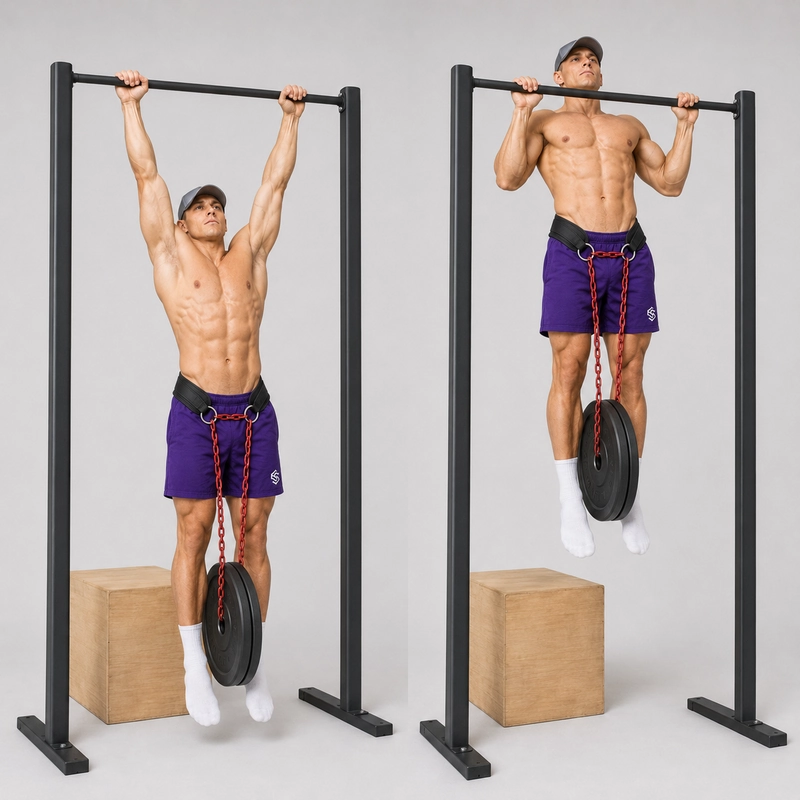
How to do Weighted Pull-Up w/ Dip Belt?
The weighted pull-up is a strength-focused progression of the strict pull-up. A dip belt suspends one or more weight plates from your hips, increasing the total load you must pull while preserving the same full range of motion: straight elbows at the bottom and the chin clearly above the bar at the top.
This page covers weighted pull-ups performed on a pull-up bar with a dip belt, weight plates and a stable elevated surface such as a plyo box. The box lets you attach the load, reach the bar and finish the set without jumping while carrying weight. If you do not have a dip belt, the dumbbell weighted pull-up is a practical alternative for lighter loads.
Equipment and Setup
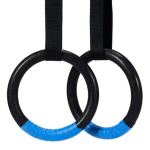
- Stable pull-up bar: Use a securely fixed bar with enough height for your arms to straighten and the plates to hang without touching the floor.
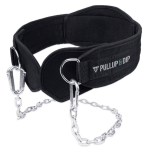
- Dip belt: Check the belt, chain, carabiner and attachment points before loading them.
- Weight plates: The chain must pass securely through the center hole. Begin with a small plate you can control.
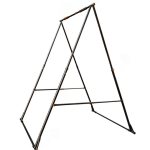
- Plyo box or stable platform: Use a non-slip surface high enough to reach the bar and regain support after the final rep. Position it so the plate can hang freely without hitting the box.
How to Do a Weighted Pull-Up
- Stand securely on the box. Place the box beneath the pull-up station where you can grip the bar without jumping. Stand near the edge that gives the hanging plate clear space.
- Put on the dip belt. Position the padded section around your lower back and hips, with the chain hanging in front of you.
- Attach the weight. Pass the chain through the center of the plate and clip it to the opposite attachment point on the belt. Close the carabiner fully. Keep the plate supported by the box until you are ready to hang.
- Take your pull-up grip. Hold the bar overhand at approximately shoulder-width or slightly wider, with your thumbs wrapped around it.
- Step off under control. Brace your abs and glutes, then carefully move your feet off the box. Let the plate settle directly below your hips between your legs. Wait until your body and the plate are still.
- Begin from a full hang. Straighten your elbows and keep your shoulders controlled rather than collapsing completely into them.
- Pull to the bar. Drive your elbows down, lift your chest and pull until your chin clearly passes above the bar. Keep your legs and the plate quiet.
- Lower with control. Extend your elbows until you return to the same full-hang position. Do not drop into the bottom or allow the plate to swing.
- Finish safely. After the last rep, wait for the plate to settle and place both feet securely back on the box before releasing the bar. Support the plate on the box before unclipping the chain.
Exhale as you pull and inhale as you lower. With heavier loads, take a breath and brace before each repetition rather than rushing through the set.
What Counts as a Full Weighted Pull-Up?
A valid repetition uses the same range-of-motion standard as a strict bodyweight pull-up. Added weight does not justify shorter repetitions.
- Begin with straight elbows and a stable body.
- Pull until the chin clearly passes above the bar without reaching the neck forward.
- Use no kip, knee drive or intentional leg swing.
- Keep the weight plate suspended and clear of the floor, box and surrounding equipment.
- Lower under control until the elbows are fully extended again.
If the plate touches the box during the repetition, the chin does not clear the bar or momentum completes the pull, do not count it as a full strict rep.
Weighted Pull-Up Benefits
- Builds maximal pulling strength: External resistance increases the force required from the lats, upper back and elbow flexors.
- Makes progressive overload measurable: Weight plates let you increase resistance in small, trackable steps.
- Supports back and arm development: The exercise loads the main pull-up muscles without replacing the pull-up movement pattern.
- Strengthens grip and whole-body control: You must hold the bar and stabilize a freely suspended load throughout every rep.
- Can improve bodyweight pull-ups: Building strength with additional load can make your bodyweight feel relatively lighter when you return to unweighted repetitions.
When Are You Ready to Add Weight?
You should first be able to perform approximately 8 controlled strict pull-ups with consistent full range of motion and no kipping. This is a practical coaching guideline, not a universal rule. Your last bodyweight reps should still begin from straight elbows and finish with the chin above the bar.
For your first weighted session, use the smallest practical plate—often 2.5–5 kg (5–10 lb). The correct starting load is one that does not change your grip, body position, range of motion or control. If shoulder, elbow or wrist discomfort appears, stop the set and return to a comfortable variation or lighter load.
Common Weighted Pull-Up Mistakes
Jumping to the Bar With Weight Attached
Jumping while a plate hangs from your waist creates unnecessary swing and makes the start difficult to control. Use the plyo box to reach the bar and step into the hang smoothly.
Using an Unstable Box
A box that slides, tilts or sits too far from the bar makes both mounting and dismounting unsafe. Check its position before attaching the weight and make sure you can place both feet back on it after the set.
Attaching the Belt Incorrectly
The chain should pass completely through the plate and connect to the opposite side of the belt with a fully closed carabiner. The plate should hang centrally rather than pulling the belt to one side.
Starting Too Heavy
A load is too heavy if it reduces your range, forces you to kip or makes the descent uncontrolled. Lower the weight and rebuild with repeatable reps.
Swinging the Plate
Starting the next rep while the plate is still moving turns the set into a pendulum. Pause in the hang until the load settles, brace your trunk and keep your legs quiet.
Cutting the Bottom or Top Range
Heavy partial reps are not equivalent to full weighted pull-ups. Straighten your elbows at the bottom and bring your chin clearly above the bar on every counted rep.
Dropping Through the Descent
Do not relax as soon as your chin clears the bar. Lower smoothly to the full hang so you remain in control of both your body and the suspended plate.
Releasing the Bar Before Reaching the Box
Complete the dismount in reverse: settle the plate, place both feet securely on the box, support the load and only then let go of the bar.
Weighted Pull-Up Sets and Reps
Train weighted pull-ups near the beginning of your session, after an appropriate warm-up and before fatigue reduces your grip or technique.
- For strength: Perform 3–5 sets of 3–5 reps, leaving approximately 1–3 clean reps in reserve. Rest 2–4 minutes between sets.
- For muscle development: Perform 3–4 sets of 5–8 controlled reps with a load that preserves the full range. Rest 2–3 minutes.
- For a first weighted session: Perform 3 sets of 3–5 reps with the smallest plate available and evaluate your technique before adding more.
Heavier resistance is particularly useful for maximal-strength development, while muscle growth can occur across a wider range of loads when sets are sufficiently challenging. This is consistent with the findings of a systematic review of resistance-training loads.
How to Progress Your Weighted Pull-Up
Use a simple double-progression method. Choose a rep range—for example, 3–5 reps—and keep the same load until you can complete every planned set at the top of that range with full, repeatable form. Then add the smallest available plate and return to the lower end of the range.
Record the external load separately from your bodyweight. For example, write “weighted pull-up: +10 kg (22 lb), 4 sets of 5” rather than treating the added plate as your total load. For formal testing or comparisons over time, record your bodyweight as well.
Easier Weighted Pull-Up Progressions
- Strict bodyweight pull-up: Establish consistent full-range reps before adding external weight.
- Paused strict pull-up: Hold briefly above the bar to strengthen control without adding load.
- Slow-motion pull-up: Use a controlled tempo to expose weak points. See the slow-motion pull-up.
- Light weighted pull-up: Begin with 2.5–5 kg (5–10 lb) and low-repetition sets.
- Dumbbell weighted pull-up: Hold a light dumbbell between the feet if a dip belt is unavailable.
Harder Weighted Pull-Up Variations
- Heavier weighted pull-up: Increase the external load in the smallest practical increments.
- Paused weighted pull-up: Hold above the bar for one to three seconds without losing height.
- Slow-eccentric weighted pull-up: Lower for three to five seconds while keeping the plate still.
- Weighted chest-to-bar pull-up: Pull until the upper chest touches the bar while preserving strict control.
- Weighted L-sit pull-up: Hold the legs extended in front while completing each loaded rep.
Weighted Pull-Up FAQ
How much weight should I use for weighted pull-ups?
Start with the smallest load that lets you reproduce your strict bodyweight technique, often 2.5–5 kg (5–10 lb). Increase only after you can complete all planned sets with straight elbows at the bottom, the chin above the bar and no swing.
Is a dip belt or weighted vest better for pull-ups?
A dip belt is convenient for plate loading and makes small weight changes easy. A weighted vest keeps the load closer to the torso but may limit loading options or feel restrictive. This page uses a dip belt because it is practical for progressively heavier pull-ups.
Where should the plate hang?
The plate should hang centrally below the hips, usually between the legs, with the chain taut. It must remain clear of the floor, box and your knees throughout the repetition.
Why use a plyo box for weighted pull-ups?
The box removes the need to jump to the bar with a suspended load. It also gives you a controlled way to support the plate and regain your footing before releasing the bar at the end of the set.
Do I include my bodyweight when recording weighted pull-ups?
Most training logs record only the external load, written with a plus sign—for example, +20 kg. Record your bodyweight separately when comparing performances across longer periods or calculating total system load.
Can weighted pull-ups help me do more bodyweight pull-ups?
They can improve maximal pulling strength, which may help bodyweight repetitions feel easier. You should still practice unweighted pull-ups if increasing your maximum bodyweight-rep count is the specific goal.
Tips for the proper execution of Weighted Pull-Up w/ Dip Belt
Use a stable plyo box to reach the bar and return safely after the set; do not jump with weight attached.
Check the dip belt, chain, carabiner and bar before loading the exercise.
Pass the chain completely through the plate and close the carabiner fully.
Keep the weight plate centered below your hips and clear of the box and floor.
Wait for your body and the plate to stop swinging before beginning each rep.
Start every repetition with straight elbows and controlled shoulders.
Pull until your chin clearly passes above the bar without craning your neck.
Keep your abs and glutes braced; do not use a kip, knee drive or leg swing.
Lower under control to the same full-hang position.
Place both feet securely on the box and support the plate before releasing the bar.
Muscles worked when doing Weighted Pull-Up w/ Dip Belt
The weighted pull-up trains the same main muscles as a strict pull-up, but each repetition requires them to move your bodyweight plus the external load attached to the dip belt.
Primary Muscles
- Latissimus dorsi: Pulls the upper arms down and helps raise your body toward the bar.
- Biceps brachii and brachialis: Flex the elbows as you pull through the middle and top of the movement.
- Middle and lower trapezius: Help control the shoulder blades throughout the pull.
- Rhomboids: Assist with scapular retraction and upper-back control.
Secondary Muscles
- Forearms and grip muscles: Maintain a secure hold on the bar under the increased load.
- Rear deltoids: Assist the upper arms as the elbows travel down and back.
- Abdominals and spinal stabilizers: Keep the trunk controlled and limit swinging.
- Glutes: Help maintain a stable lower-body position while the plate hangs from the belt.
The dip belt transfers the plate load through the hips, but the exercise remains an upper-body vertical pull. The legs should stabilize the hanging plate rather than help generate upward momentum.
Primary Muscle(s):
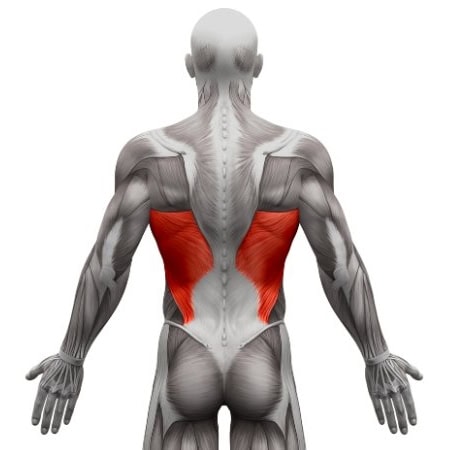
Lats
Secondary Muscle(s):
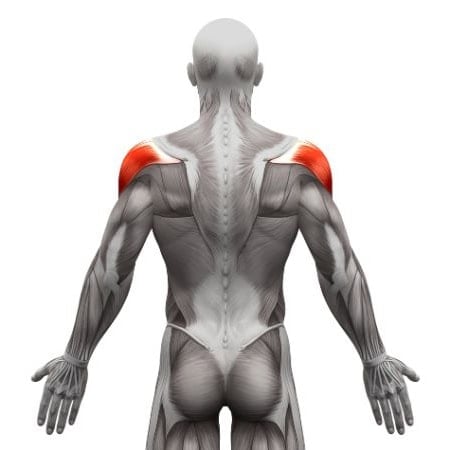
Rear delt
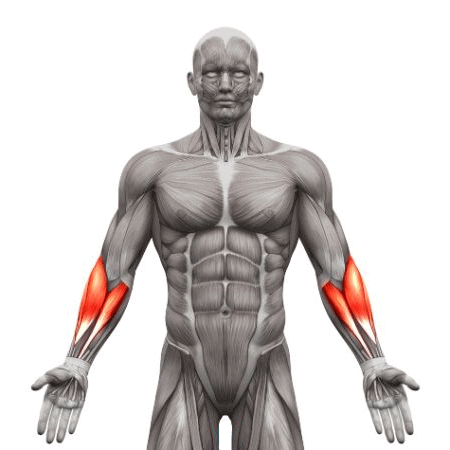
Forearm
Equipment needed for Weighted Pull-Up w/ Dip Belt
Adjust the difficulty of Weighted Pull-Up w/ Dip Belt
How to make Weighted Pull-Up w/ Dip Belt harder?
How to make Weighted Pull-Up w/ Dip Belt easier?
How to make Weighted Pull-Up w/ Dip Belt harder?
To make Weighted Pull-Up w/ Dip Belt harder:
-
Increase the external load in the smallest available increment while keeping the same full range.
-
Pause above the bar for one to three seconds on every repetition.
-
Lower for three to five seconds while preventing the plate from swinging.
-
Pull higher until the upper chest touches the bar.
-
Maintain an L-sit position throughout the loaded pull-up.
How to make Weighted Pull-Up w/ Dip Belt easier?
To make Weighted Pull-Up w/ Dip Belt easier:
-
Remove the weight and perform full-range strict pull-ups.
-
Use the smallest available plate, typically 2.5–5 kg (5–10 lb).
-
Reduce the target to three controlled repetitions per set.
-
Practise paused bodyweight pull-ups before reintroducing external load.
-
Use a light dumbbell between the feet if a dip belt is unavailable.