
Ring Muscle-Up

How to do Ring Muscle-Up?
The ring muscle-up is an advanced gymnastics-rings exercise that moves you from a straight-arm hang below the rings to a stable support position above them. A complete repetition combines a powerful vertical pull, a coordinated transition and a deep ring dip.
Unlike a bar muscle-up, the independent rings can move around the body during the transition. This allows a more direct path above the hands, but it also creates greater instability and requires considerably more control from the shoulders, wrists and core.
The strict variation begins with a false grip. The rings rest across the heel of the palms and wrist creases, allowing the wrists to remain above the rings as the movement changes from pulling to pressing. Building a strong ring false grip pull-up is therefore one of the most useful preparations for this exercise.
To perform the ring muscle-up efficiently, you must pull the rings much higher than during a standard ring pull-up. The rings should travel toward the lower chest or armpits before the chest moves forward over the hands. Both elbows then pass through the transition together before you press into a locked-out ring support hold.
The ring muscle-up develops pulling and pressing strength, false-grip endurance, upper-body coordination and control on an unstable apparatus. It is best learned after developing controlled high pulls, deep ring dips, a stable support hold and confidence practising the transition on low rings. For a broader overview of muscle-up training, see our guide on how to do a muscle-up.
A peer-reviewed comparison of ring and bar muscle-ups also demonstrates that the choice of apparatus affects the movement's muscular and stabilization demands.
How to Perform a Ring Muscle-Up
- Set up the rings. Adjust both rings to the same height and check that the straps and anchor point are secure. Make sure there is enough space above, below and around the rings to complete the movement safely.
- Establish the false grip. Place each ring diagonally across the heel of your palm and into the crease of your wrist. Flex your wrists over the rings and wrap your fingers and thumbs securely around them.
- Begin in a controlled hang. Extend your arms beneath the rings while maintaining the false grip. Keep the rings close together, brace your core and adopt a slightly hollow body position without swinging.
- Initiate the high pull. Depress your shoulder blades and drive your elbows down and behind you. Pull the rings upward while keeping them close to your torso.
- Pull the rings to the lower chest. Continue pulling past ordinary pull-up height. Bring the rings toward your lower chest or armpits rather than stopping when your chin reaches hand height.
- Move through the transition. As the rings reach your chest, keep pulling while bringing your chest and shoulders forward over your hands. Rotate the rings around your torso and sweep both elbows from below the rings to a position behind and above your wrists.
- Catch the deep dip position. Finish the transition with your shoulders above your hands, the rings close to your ribs and your elbows controlled behind you. Avoid dropping suddenly into the bottom of the dip.
- Press into support. Drive down through the rings until your elbows are completely straight. Stabilize the rings beside your hips and hold the top position briefly.
- Descend under control. Reverse the transition gradually, keeping the rings close as you lower from the dip into the pull and return to the straight-arm hang.
Ring Muscle-Up Completion Standard
- Begin below the rings with straight arms and a secure false grip.
- Do not use swinging, kipping, knee drive or an explosive hip extension.
- Pull the rings toward the lower chest or armpits.
- Keep the rings close to the torso throughout the pull and transition.
- Move both shoulders and elbows through the transition together.
- Do not use an asymmetrical one-arm or “chicken-wing” transition.
- Finish above the rings with both elbows fully extended.
- Demonstrate a stable support position before beginning the descent.
- If returning to the hang, lower through the transition under control.
Benefits of the Ring Muscle-Up
- Combines pulling and pressing strength: Each repetition includes a high vertical pull, a demanding transition and a deep ring dip.
- Develops the false grip: Maintaining the wrist position under load strengthens the hands, wrists and forearms for advanced ring skills.
- Improves upper-body coordination: The exercise teaches you to connect several movement phases without losing tension or momentum.
- Challenges shoulder stability: Each arm must independently control its ring throughout the pull, transition and support position.
- Builds body tension: The abdominals, spinal stabilizers and lower body work together to limit unwanted swinging.
- Develops transition-specific strength: The most difficult part of the movement strengthens the upper body through the change from pulling to pressing.
- Prepares you for advanced ring training: A controlled ring muscle-up provides a foundation for harder transitions, weighted repetitions and ring-combination routines.
Common Ring Muscle-Up Mistakes
- Using a regular grip: Starting with the wrists beneath the rings makes the strict transition substantially harder.
- Losing the false grip: Allowing the rings to slide into the fingers places the wrists below the rings before the transition.
- Pulling only to chin height: A standard pull-up does not create enough height to move smoothly over the rings.
- Letting the rings drift away: The farther the rings move from the torso, the longer and less efficient the transition becomes.
- Transitioning too late: Waiting until the pull has completely stopped often leaves you hanging beneath the rings.
- Separating the phases excessively: The pull and transition should connect smoothly rather than becoming two disconnected movements.
- Using a chicken-wing transition: Bringing one shoulder over the rings first creates an asymmetrical repetition and can place uneven stress on the shoulders.
- Allowing the elbows and rings to flare: Keeping the rings close makes the transition more controlled and efficient.
- Using a kip unintentionally: Swinging the legs or driving the knees changes the exercise from a strict muscle-up into a kipping variation.
- Collapsing into the dip: Dropping through the transition without control places unnecessary stress on the shoulders.
- Failing to lock out: A repetition is not complete until both elbows are straight and the support position is stable.
- Training repeated failed attempts: Fatigue quickly degrades the false grip and transition, so stop the set when technique becomes unreliable.
Frequently Asked Questions
What is a ring muscle-up?
A ring muscle-up is a compound rings exercise in which you pull from below the rings, transition your shoulders above your hands and press into a straight-arm support position.
What is the difference between a strict and kipping ring muscle-up?
A strict ring muscle-up is performed without swinging, leg drive or an explosive hip action. A kipping ring muscle-up deliberately uses momentum from the body to assist the pull and transition.
Do you need a false grip for ring muscle-ups?
A false grip is strongly recommended for learning and performing the strict ring muscle-up because it keeps the wrists above the rings during the transition. Advanced athletes can perform no-false-grip variations, but these are considerably harder and are not the variation described on this page.
Are ring muscle-ups harder than bar muscle-ups?
The answer depends on the athlete. The rings can move around the torso, which provides a more direct transition than a fixed bar. However, their instability, the false-grip requirement and the deep dip position introduce additional strength and control demands.
What should I be able to do before training ring muscle-ups?
There is no universal prerequisite number. Practical readiness includes a secure false-grip hang, several controlled false-grip high pulls, deep ring dips, a stable ring support hold and the ability to practise a smooth transition on low rings.
How high should you pull during a ring muscle-up?
Aim to bring the rings toward your lower chest or armpits. Merely pulling your chin above the hands usually leaves your shoulders too low to complete a strict transition.
Why is the ring muscle-up transition so difficult?
The transition changes the movement from a pull into a press while the shoulders pass through the bottom of a deep dip. This creates a mechanically demanding position that requires height, coordination and strength across several joint angles.
Can beginners train for a ring muscle-up?
Beginners can train its components using false-grip hangs, false-grip pull-ups, assisted low-ring transitions, support holds and ring dips. The full-height exercise should be attempted only after these positions can be controlled safely.
How many ring muscle-ups should I perform?
For skill and strength development, perform three to five sets of one to three technically clean repetitions with generous rest. End the set if your false grip slips, you begin kipping or the transition becomes asymmetrical.
Should you turn the rings out at the top?
A slight ring turn-out can demonstrate additional support strength and control, but it is not essential for a standard repetition. Full elbow extension and a stable support position are the primary completion requirements.
Should the rings stay close together?
Yes. Keeping the rings close to the torso shortens the transition path and improves control. Allowing them to spread or move forward makes the exercise substantially harder.
Is the ring muscle-up safe?
The ring muscle-up is an advanced exercise that loads the wrists and shoulders through demanding positions. Use securely anchored rings, learn the transition close to the floor and stop if you experience sharp pain, numbness or an uncontrolled loss of position.
Tips for the proper execution of Ring Muscle-Up
Set both rings to the same height and check that the straps and anchor point are secure.
Establish your false grip before lifting your feet from the floor.
Keep the rings close to your body during every phase of the movement.
Brace your core and maintain a slightly hollow body position without swinging.
Pull the rings toward your lower chest or armpits instead of stopping at chin height.
Continue pulling as you bring your chest and shoulders forward over your hands.
Move both elbows through the transition at the same time.
Connect the high pull and transition without an excessive pause.
Control the bottom of the dip instead of dropping onto the shoulders.
Finish each repetition with straight elbows and a stable support position.
Stop the set when the false grip slips or the transition becomes asymmetrical.
Muscles worked when doing Ring Muscle-Up
The ring muscle-up is a compound upper-body exercise whose muscular emphasis changes during each phase. The pulling muscles create height below the rings, the chest and arms control the transition and dip, and numerous stabilizers prevent the rings and body from moving out of position.
Latissimus Dorsi
The latissimus dorsi is a primary contributor during the high-pull phase. It extends and adducts the shoulders as the rings travel from the overhead hang toward the torso.
Biceps, Brachialis and Brachioradialis
The elbow flexors bend the arms and help pull the body toward the rings. Their contribution is especially important when pulling beyond normal pull-up height.
Forearms and Wrist Flexors
The forearm and wrist muscles maintain the false grip and prevent the rings from sliding into the fingers. They remain under substantial isometric tension during the pull and transition.
Pectoralis Major
The chest contributes strongly as the shoulders move over the hands and during the press from the deep ring dip. Its emphasis increases as the movement changes from pulling to pressing.
Triceps Brachii
The triceps extend the elbows during the dip and complete the movement by locking the arms in the support position.
Anterior Deltoids
The front deltoids assist the forward movement of the shoulders during the transition and help stabilize and press the body above the rings.
Trapezius and Rhomboids
The trapezius and rhomboids control the shoulder blades during the pull and help maintain an organized upper-back position as the body passes through the transition.
Serratus Anterior and Rotator Cuff
The serratus anterior and rotator-cuff muscles stabilize the shoulder blades and upper-arm bones while each ring moves independently.
Abdominals and Obliques
The abdominal muscles resist excessive arching and help maintain a compact body position without swinging or kipping.
Glutes and Lower Body
The glutes, adductors and quadriceps maintain leg alignment and whole-body tension. They should stabilize the body rather than generate momentum during the strict variation.
Primary Muscle(s):
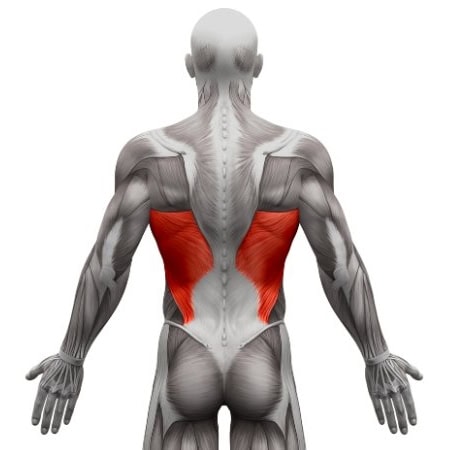
Lats
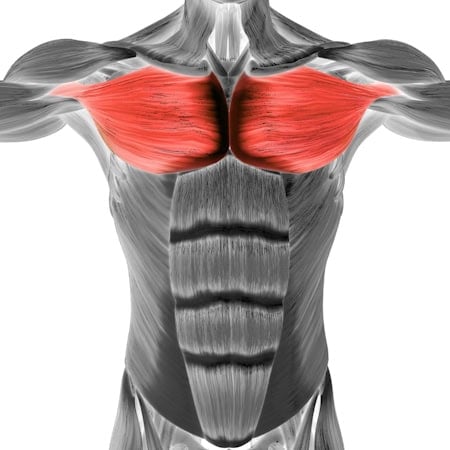
Lower chest
Secondary Muscle(s):
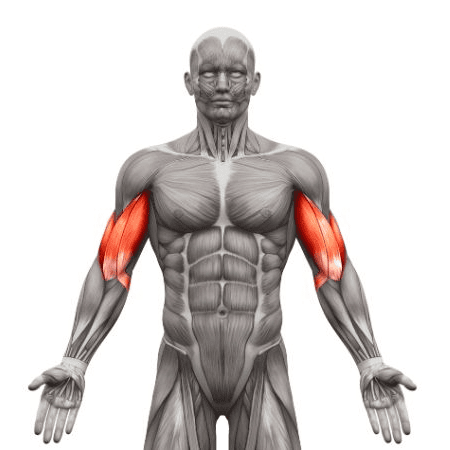
Biceps
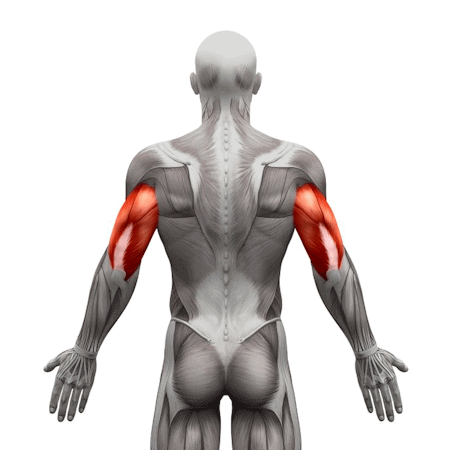
Triceps
Equipment needed for Ring Muscle-Up
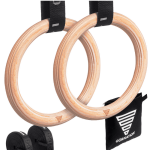
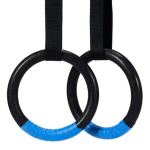

Adjust the difficulty of Ring Muscle-Up
How to make Ring Muscle-Up harder?
How to make Ring Muscle-Up easier?
How to make Ring Muscle-Up harder?
To make Ring Muscle-Up harder:
-
Slow down the pull, transition and dip while maintaining continuous control.
-
Pause briefly with the rings held against your lower chest before beginning the transition.
-
Pause in the deepest part of the transition before pressing upward.
-
Lower from support to the straight-arm hang with a slow and controlled negative.
-
Turn the rings outward and hold a stable ring turn-out support at the top.
-
Perform the muscle-up while maintaining an L-sit position.
-
Add external resistance with a securely fitted weighted vest.
-
Perform consecutive strict repetitions without releasing or readjusting the false grip.
-
Perform a strict no-false-grip ring muscle-up only after mastering the standard variation.
How to make Ring Muscle-Up easier?
To make Ring Muscle-Up easier:
-
Practise feet-assisted muscle-ups on low rings while using your legs only as much as necessary.
-
Perform seated low-ring transitions to learn how the chest and elbows move over the hands.
-
Use a resistance band to assist the pull and transition while maintaining strict body control.
-
Perform jumping ring muscle-ups on low rings and gradually reduce the assistance from your legs.
-
Practise slow negative ring muscle-ups from the top support position to the hang.
-
Build wrist strength and confidence with ring false grip hangs.
-
Use ring false grip pull-ups to develop the high pulling strength required for the transition.
-
Train deep ring dips and stable support holds separately before combining the movement phases.