
Negative Bar Muscle-Up
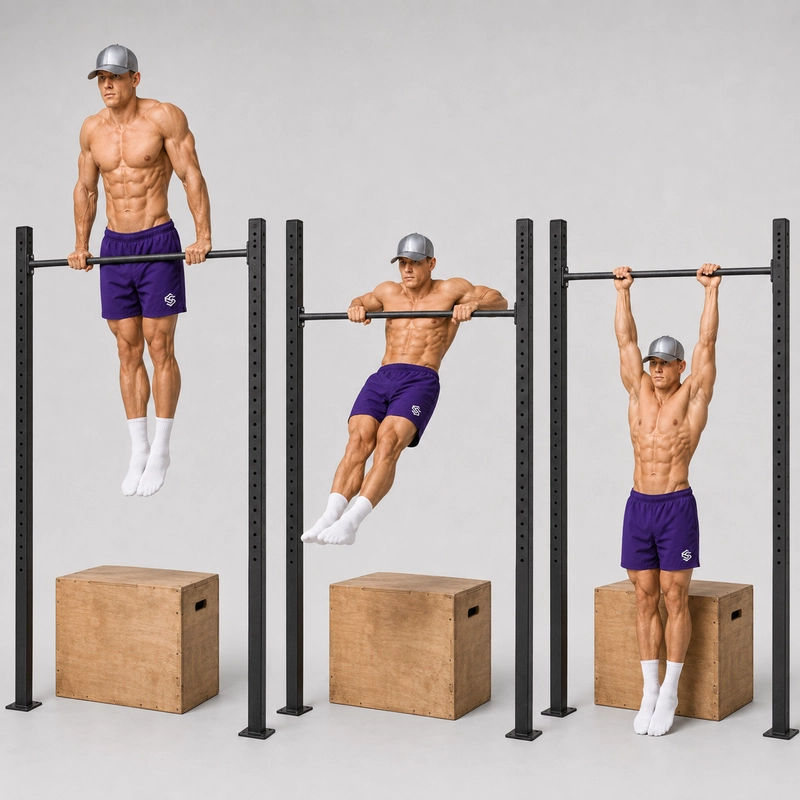
How to do Negative Bar Muscle-Up?
The negative bar muscle-up is an eccentric muscle-up progression in which you begin above a pull-up bar and slowly lower your body through the complete movement. A stable plyo box allows you to step into the starting support position without first performing a muscle-up.
From straight-arm support, you lower through a straight bar dip, rotate your torso behind and underneath the bar, and finish by controlling the pulling phase into a hang. The most important part is the transition: the bar must remain close while the hands and wrists rotate from the support position into a conventional hanging grip.
Unlike a negative pull-up, the negative bar muscle-up includes the pressing and transition phases above the bar. It can help you understand the complete muscle-up pathway, but it should be combined with high pulling, transition and straight-bar pressing work. See our muscle-up progression guide for the broader training sequence.
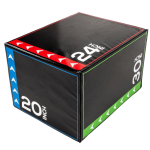
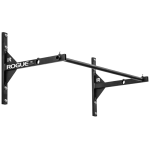
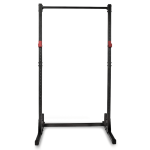
Use a fixed pull-up bar with enough height for a complete hang and a sturdy, non-slip plyo box that can support your full bodyweight. Position the box where you can reach the top support safely while still creating enough clearance for your legs during the negative.
How to perform a negative bar muscle-up
- Position the plyo box: Place the box beneath or slightly beside the bar according to the available space. Test the setup before starting and make sure your legs will not strike the box during the descent.
- Take an overhand grip: Grip the bar approximately shoulder-width or slightly wider with your palms facing away and your thumbs wrapped securely around it.
- Step into straight-bar support: Use the box to bring your torso above the bar and establish a stable support position with both elbows extended and the bar close to your hips or lower abdomen.
- Remove your feet from the box: Brace your abdominals and glutes, move both feet into clear space and confirm that your shoulders and elbows are stable before beginning the negative.
- Lower through the straight-bar dip: Bend your elbows gradually while leaning your chest slightly forward over the bar. Keep the bar close to your torso and avoid dropping into the bottom position.
- Approach the transition: Continue lowering until the bar reaches the lower chest or upper-abdominal area. Keep the elbows close and resist the movement instead of resting your torso on the bar.
- Rotate underneath the bar: Allow your chest and shoulders to move from above the bar to behind it as your hands rotate around the bar. Maintain a firm grip and keep the bar close throughout the transition.
- Control the pulling phase: Once your chest is behind and below the bar, continue resisting as the bar passes the upper chest and chin and your elbows gradually extend.
- Finish in a controlled hang: Reach straight elbows without dropping suddenly, stabilize your shoulders and body, and then place your feet back onto the plyo box.
- Reset the repetition: Step back into support from the box instead of attempting to pull yourself up when the objective of the set is eccentric practice.
What counts as a clean negative bar muscle-up?
A clean repetition begins in a stable straight-bar support with extended elbows and both feet off the box. The athlete controls the dip, passes symmetrically through the transition without dropping and finishes beneath the bar with straight elbows. The bar remains close to the torso and neither foot touches the box during the negative.
Common mistakes to avoid
- Using an unstable box: Confirm that the plyo box is level, non-slip and capable of supporting your full bodyweight before stepping onto it.
- Jumping into an uncontrolled support: Use a sufficiently tall box so you can enter the starting position with minimal momentum.
- Leaving the box in the movement path: Position the box so your feet and shins cannot collide with it during the descent.
- Starting with shrugged shoulders: Establish an active support position with the shoulders stable and away from the ears.
- Allowing the bar to move away: Keep the hips, abdomen and chest close to the bar as you descend through the dip and transition.
- Dropping through the transition: Reduce the range or use foot assistance if you cannot resist the point where the torso moves behind the bar.
- Transitioning one elbow at a time: Keep both sides moving together instead of allowing one shoulder and elbow to fall beneath the bar first.
- Loosening the grip: Let the hands rotate around the bar without opening the fingers or releasing thumb contact.
- Forcing the wrists into an uncomfortable angle: Allow the grip to roll gradually as your body moves beneath the bar rather than fixing the wrists rigidly in the support position.
- Falling into the hang: Continue resisting until the elbows are straight instead of relaxing immediately after passing the transition.
- Performing too many fatigued repetitions: Stop the set when you can no longer slow the transition or keep both elbows moving symmetrically.
Benefits of negative bar muscle-ups
- Practises the complete movement pathway: The exercise connects the support, dip, transition, high-pull and hanging positions in one repetition.
- Develops eccentric transition strength: You learn to resist the part of the muscle-up where many athletes lose control.
- Improves bar proximity: The controlled descent teaches you how closely the torso must travel around the fixed bar.
- Builds grip-transition awareness: The hands must rotate from a support grip into a hanging grip without releasing the bar.
- Combines pulling and pressing control: The exercise loads the muscles used in both the pull-up and straight-bar dip portions of a muscle-up.
- Exposes side-to-side differences: A slow negative makes an uneven elbow or shoulder transition easier to notice.
- Provides a scalable muscle-up progression: Foot assistance, resistance bands, partial ranges and pauses can adjust the difficulty before an unsupported negative is possible.
Readiness and safety
Before attempting a fully unsupported negative, you should be able to hold a stable straight-bar support and control at least part of a straight-bar dip. Basic pulling strength from the strict pull-up and eccentric control from the negative pull-up are also useful foundations. The transition can place substantial demand on the shoulders, elbows, wrists and grip. Use a box high enough to avoid an uncontrolled jump, keep the surrounding area clear and stop if you experience sharp pain, joint instability, tingling or numbness.
Frequently asked questions
How should the plyo box be used?
Use the box to step into the top straight-bar support and to reset after reaching the hang. In the defining unsupported variation, both feet leave the box before the descent begins and remain clear until the repetition is complete.
How tall should the plyo box be?
Choose a height that allows you to reach straight-bar support with a small step or minimal jump. The box should not be so tall that you must crouch underneath the bar or so low that entering the support position becomes an explosive exercise.
Where should I place the box?
Place it beneath or slightly beside the bar according to the equipment geometry. You must be able to enter support safely and then move your legs into unobstructed space without the box tipping or interfering with the descent.
How slowly should I perform the negative?
A useful initial target is approximately five to eight seconds for the complete descent, with visible control through every phase. A slower repetition is only better if the movement remains continuous and the shoulders, elbows and wrists stay comfortable.
Should I use a false grip?
A false or wrist-over grip may make the transition easier for some athletes, but it is not required for a conventional bar muscle-up. Use a secure overhand grip that allows the hands to rotate around the bar without slipping or causing wrist pain.
Why do I drop suddenly through the transition?
The transition is usually the weakest and least familiar part of the movement. The drop may result from allowing the bar to move away, losing wrist control or attempting more range than you can resist. Practise feet-assisted low-bar transitions or partial negatives before repeating the full movement.
Will negative bar muscle-ups give me my first muscle-up?
They can develop useful eccentric strength and transition awareness, but they do not train the explosive upward pull by themselves. Combine them with high pulls, straight-bar dips and an appropriate assisted muscle-up variation.
How many negative bar muscle-ups should I perform?
A practical starting point is three to five sets of one to three controlled repetitions with generous rest. End the set when you can no longer slow the transition or maintain a symmetrical descent.
Tips for the proper execution of Negative Bar Muscle-Up
Use a stable plyo box that allows you to reach the top support position with minimal jumping.
Position the box so your feet and shins cannot strike it during the negative.
Wrap your thumbs around the bar and maintain firm hand contact throughout the transition.
Begin in a stable straight-bar support with both elbows fully extended.
Remove both feet from the box before starting the unsupported descent.
Keep the bar close to your hips, abdomen and chest throughout the movement.
Lower slowly through the straight-bar dip instead of dropping into the transition.
Move both elbows and shoulders symmetrically as your torso passes behind the bar.
Allow your hands to rotate gradually around the bar without loosening your grip.
Brace your abdominals and glutes to minimize swinging during the descent.
Continue resisting after the transition until both elbows are fully extended.
Place your feet back onto the box only after stabilizing beneath the bar.
Use short sets and stop when you can no longer control the transition.
Regress the exercise if the movement causes sharp wrist, elbow or shoulder pain.
Muscles worked when doing Negative Bar Muscle-Up
The negative bar muscle-up is primarily an eccentric exercise, but different muscle groups control different sections of the descent. The pressing muscles control the straight-bar dip, the pulling muscles resist the transition and pull-up phases, and the trunk and grip stabilize the body throughout the repetition.
Primary muscles
- Latissimus dorsi: The lats resist shoulder flexion as the body lowers from the transition through the high-pull and hanging positions.
- Pectoralis major: The chest controls the descent through the straight-bar dip and helps stabilize the torso as it approaches the bar.
- Triceps: The triceps work eccentrically as the elbows bend during the dip portion of the negative.
- Biceps brachii, brachialis and brachioradialis: These elbow flexors resist elbow extension as the body moves from the transition into the hang.
Secondary muscles
- Anterior deltoids: The front shoulders assist the chest and triceps while controlling the dip and transition positions.
- Trapezius and rhomboids: These muscles control the shoulder blades as the body moves from support to a hanging position.
- Teres major and posterior deltoids: These muscles assist the lats in controlling the upper arms during the transition and pulling phases.
- Rotator-cuff muscles: The rotator cuff stabilizes the shoulder joints as the arms move through changing angles around the bar.
- Forearms, wrist flexors and hand muscles: These muscles maintain the grip and control the rotation of the hands around the bar.
- Rectus abdominis, obliques and transverse abdominis: The abdominal wall stabilizes the torso and limits excessive swinging or spinal extension.
- Glutes and quadriceps: These muscles help keep the lower body controlled and prevent the legs from creating unwanted momentum.
The negative bar muscle-up does not isolate one muscle group. Its value comes from coordinating the pressing, transition and pulling muscles through the complete reverse muscle-up pathway.
Primary Muscle(s):
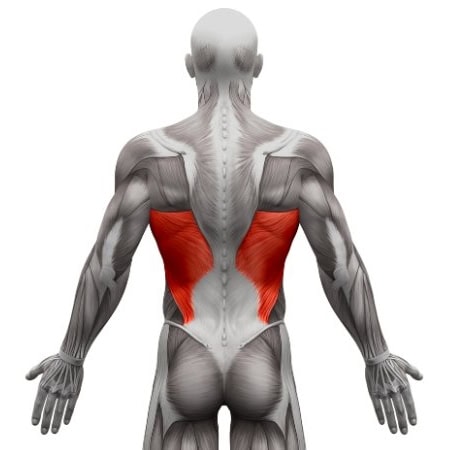
Lats
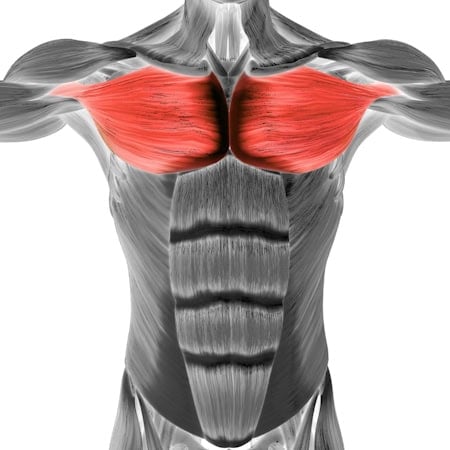
Lower chest
Secondary Muscle(s):
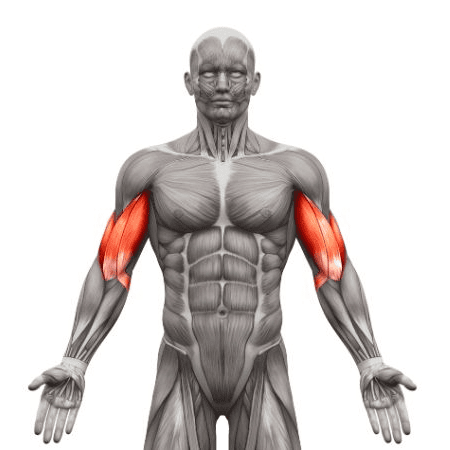
Biceps
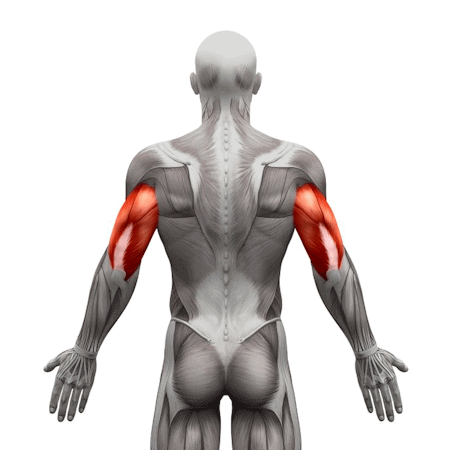
Triceps
Equipment needed for Negative Bar Muscle-Up
Adjust the difficulty of Negative Bar Muscle-Up
How to make Negative Bar Muscle-Up harder?
How to make Negative Bar Muscle-Up easier?
How to make Negative Bar Muscle-Up harder?
To make Negative Bar Muscle-Up harder:
-
Increase the total descent time while keeping the movement smooth and continuous.
-
Pause briefly at the bottom of the straight-bar dip before entering the transition.
-
Pause with the lower chest close to the bar at the most difficult point of the transition.
-
Slow the transition more than the dip and lower pulling phases.
-
Perform the negative without allowing the torso to rest on the bar.
-
Maintain a strict hollow or lightly arched body position without swinging the legs.
-
Perform several high-quality negatives with an identical tempo across the set.
-
Add a very small amount of external resistance only after bodyweight negatives are consistently controlled.
-
Progress to a band-assisted bar muscle-up that includes the upward phase.
-
Progress to a jumping bar muscle-up using progressively less assistance from the plyo box.
-
Progress to a strict bar muscle-up after developing sufficient high-pull and transition strength.
How to make Negative Bar Muscle-Up easier?
To make Negative Bar Muscle-Up easier:
-
Practise a straight-bar support hold before adding any downward movement.
-
Perform a negative straight-bar dip and step back onto the box before reaching the transition.
-
Lower only to the beginning of the transition and gradually increase the range.
-
Keep one or both feet lightly supported on the plyo box during the negative.
-
Use a low bar and keep the toes on the ground for assistance throughout the transition.
-
Use a resistance band to reduce the amount of bodyweight being lowered.
-
Practise feet-assisted low-bar muscle-up transitions in both directions.
-
Perform negative pull-ups separately to develop control below the transition.
-
Use a taller box so you can enter the support position without an uncontrolled jump.
-
Ask a spotter to support your hips lightly during the transition.