
Straight Bar Dip
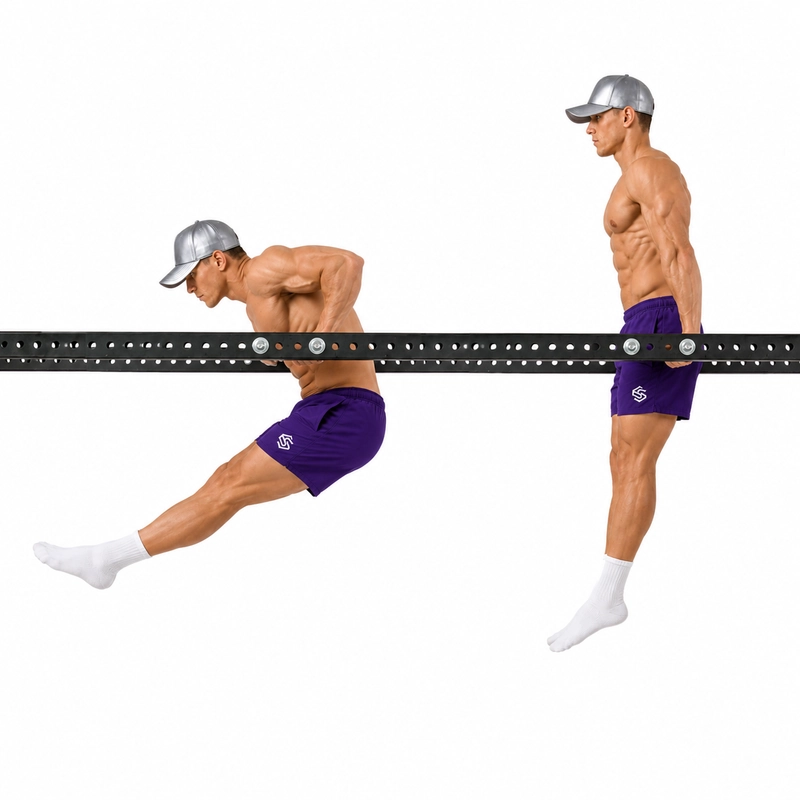
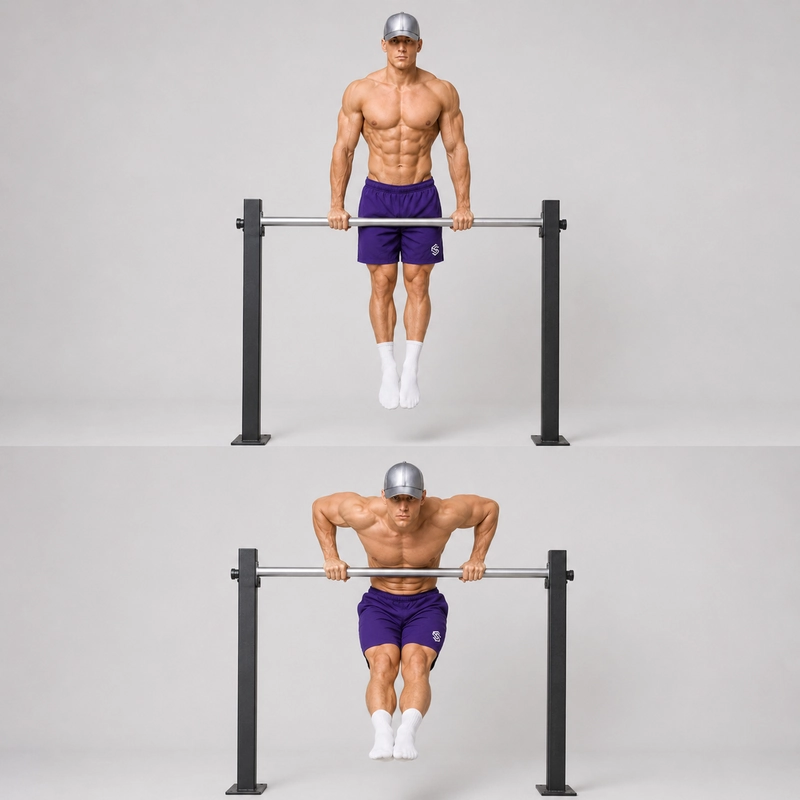
How to do Straight Bar Dip?
The Straight Bar Dip is a bodyweight pressing exercise performed above a single horizontal bar. From a straight-arm support position, you lean over the bar, lower your chest toward it and press back to full elbow extension.
Unlike a parallel bar dip, both hands remain fixed on the same bar in front of the body. This requires a more pronounced forward lean, greater wrist extension and a different pressing path. The bar should remain close to your hips and torso throughout the repetition rather than drifting away from your body.
Straight bar dips directly strengthen the final pressing phase of the bar muscle-up. They are one of the key exercises included in our muscle-up training guide, alongside high pull-ups, transition drills and hollow-body control.
You should already be comfortable supporting yourself above a bar with locked elbows before performing full repetitions. If you are still developing general dip strength, begin with assisted repetitions, negatives or stable parallel bar dips. Ring Dips are another useful but more stability-dependent dip variation.
Tips for the proper execution of Straight Bar Dip
Use a secure platform to reach the top of a high bar safely.
Grip the bar approximately shoulder-width apart with both thumbs wrapped around it.
Place the bar close to the heel of each palm instead of holding it in the fingertips.
Keep the bar close to your hips, upper abdomen and lower chest throughout the repetition.
Lean your torso forward before beginning the descent.
Allow your elbows to travel backward rather than flaring widely.
Lower only as deeply as you can maintain stable shoulders and wrists.
Avoid bouncing your chest or abdomen against the bar.
Brace your core and keep your legs together to prevent swinging.
Press the bar down as you extend your elbows.
Finish every repetition with complete elbow lockout.
Stabilize at the top before beginning the next repetition.
Muscles worked when doing Straight Bar Dip
The Straight Bar Dip primarily trains the chest and triceps through a fixed-bar pressing pattern. The forward position of the torso increases the demand on the chest and anterior shoulders, while the triceps extend the elbows to complete the repetition and muscle-up lockout.
Primary Muscles
- Lower chest: Produces much of the pressing force as the torso moves upward and away from the bar.
- Triceps: Extend the elbows during the upward phase and create the final straight-arm lockout.
- Anterior deltoids: Assist the chest and stabilize the shoulders while the torso remains forward of the hands.
Secondary Muscles
- Upper chest: Assists with pressing and shoulder stabilization throughout the repetition.
- Serratus anterior and scapular stabilizers: Control the shoulder blades and prevent the upper body from collapsing around the bar.
- Abdominals and obliques: Stabilize the torso and reduce unwanted swinging.
- Forearms and grip muscles: Secure the overhand grip and help control wrist position.
- Lats: Assist with shoulder stability and keeping the bar close to the body.
- Glutes and quadriceps: Maintain lower-body tension and keep the legs together.
The Straight Bar Dip is particularly specific to the pressing phase of the bar muscle-up. Parallel bar dips develop similar chest and triceps strength, but they do not reproduce the fixed hand position, forward torso angle or bar contact used above a single bar.
Primary Muscle(s):
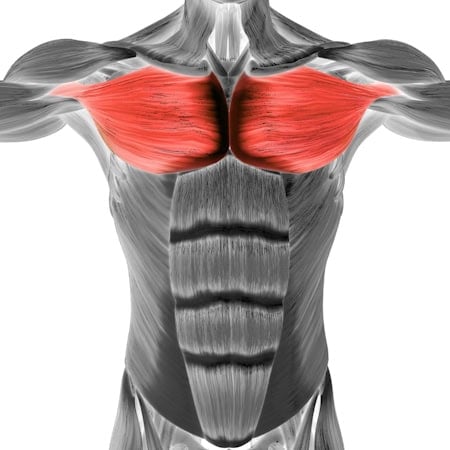
Lower chest
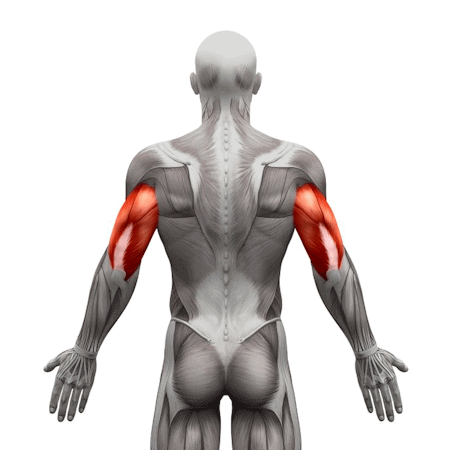
Triceps
Secondary Muscle(s):
Upper chest
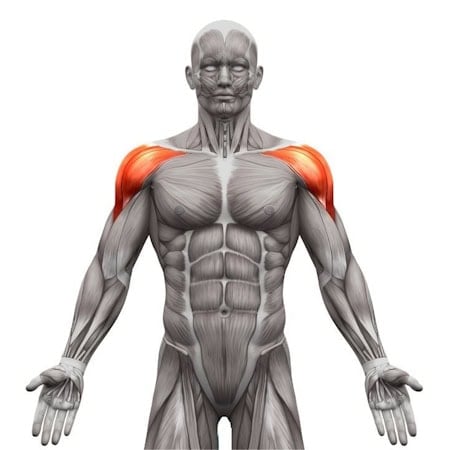
Anterior delt
Equipment needed for Straight Bar Dip
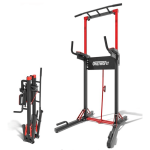
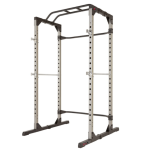
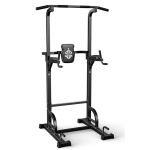
Adjust the difficulty of Straight Bar Dip
How to make Straight Bar Dip harder?
How to make Straight Bar Dip easier?
How to make Straight Bar Dip harder?
To make Straight Bar Dip harder:
-
Deeper Straight Bar Dip: Gradually increase the depth while maintaining stable shoulders and close bar contact.
-
Slow-Eccentric Straight Bar Dip: Lower for five or more seconds before pressing back to lockout.
-
Paused Straight Bar Dip: Hold the bottom position without resting on the bar before pressing upward.
-
Weighted Straight Bar Dip: Add resistance with a weighted vest or dip belt after strict bodyweight repetitions are controlled.
-
Explosive Straight Bar Dip: Press upward rapidly while maintaining the same controlled descent and body position.
-
L-Sit Straight Bar Dip: Hold the legs straight in front of the body while performing the dip.
-
Archer Straight Bar Dip: Shift more bodyweight toward one arm while keeping the other arm more extended.
-
Straight Bar Dip to Negative Muscle-Up: At the top, lower slowly through the muscle-up transition and return beneath the bar.
-
Bar Muscle-Up: Combine a high pull, transition and straight bar dip into one complete movement.
How to make Straight Bar Dip easier?
To make Straight Bar Dip easier:
-
Straight Bar Support Hold: Hold the top position with locked elbows and the bar close to the hips.
-
Feet-Assisted Straight Bar Dip: Use a low bar and keep the toes lightly supported on the floor or a box.
-
Negative Straight Bar Dip: Begin at full lockout and lower toward the bar slowly before stepping back onto a platform.
-
Partial-Range Straight Bar Dip: Lower only through the range in which the shoulders and wrists remain stable.
-
Band-Assisted Straight Bar Dip: Secure a resistance band to the bar and place it beneath the knees or feet for assistance.
-
Box-Assisted Straight Bar Dip: Keep one foot lightly on an elevated platform to reduce the amount of bodyweight being pressed.
-
Parallel Bar Dip: Build pressing strength using two stable bars and a neutral grip before returning to the single-bar variation.
-
Bench Dip: Use a stable bench for a lighter triceps-focused pressing exercise while developing basic elbow-extension strength.