
Bodyweight Biceps Curl
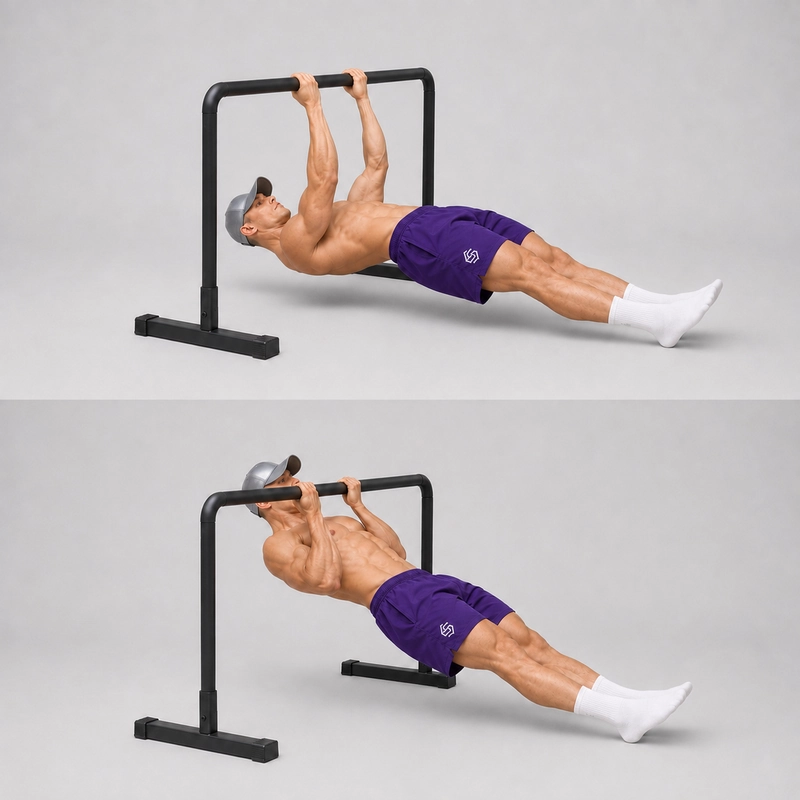
How to do Bodyweight Biceps Curl?
The bodyweight biceps curl is a calisthenics arm exercise performed using a low fixed bar, such as one side of a stable dip station or an adjustable pull-up bar. Instead of curling a dumbbell toward your body, your hands remain fixed while you curl your body toward the bar.
Begin with an underhand, or supinated, grip and lean backward with your feet on the floor. Keep your upper arms elevated and bend your elbows to bring your forehead toward your hands. The movement primarily trains the biceps brachii, brachialis and other elbow flexors while the shoulders, core and lower body stabilize your position.
The exercise resembles an Australian pull-up or inverted row, but the movement standard is different. During an inverted row, the upper arms travel behind the torso as the chest moves toward the bar. During a bodyweight biceps curl, the upper arms remain relatively fixed and the elbows bend to bring the forehead toward the bar. This reduces the contribution from the lats and upper back and places greater emphasis on elbow flexion.
A supinated grip is used because it matches the conventional biceps-curl position. A peer-reviewed comparison of biceps-curl grips found that hand position changes the relative excitation of the biceps brachii, brachioradialis and anterior deltoid, although those results were obtained with conventional resistance exercises rather than this bodyweight variation.
The difficulty is easy to adjust. Bending your knees, placing your feet closer to the bar or using a more upright body angle reduces the resistance. Keeping your legs straight, moving your heels farther forward or positioning your body closer to horizontal makes the curl harder.
If the fixed underhand grip feels uncomfortable, the existing ring bicep curl is a useful equipment alternative because the rings can rotate independently. For a heavier compound exercise that trains both the biceps and back, use the chin-up.
How to Do a Bodyweight Biceps Curl
Equipment and bar setup
- Use a fixed horizontal bar that can safely support your body weight.
- A low pull-up bar, one side of a stable dip station or another securely anchored horizontal bar can be used.
- The bar should generally be between hip and lower-chest height, depending on your proportions and chosen difficulty.
- Make sure there is enough room in front of the bar for your legs and behind it for your upper body.
- Use a non-slip floor so your heels or feet cannot slide during the exercise.
Portable dip bars must be stable enough that pulling against one side will not tip or slide the equipment. If you are choosing equipment for fixed-bar curls and other bodyweight exercises, see the Calisthenics.com guide to the best dip bars for home workouts.
Starting position with straight legs
- Stand facing the bar and take an underhand grip approximately shoulder-width apart.
- Wrap your thumbs securely around the bar.
- Walk your feet forward while leaning backward with your arms straight.
- Keep your legs fully extended and place your heels on the floor with your toes pointing upward.
- Brace your abdominal muscles and glutes to create a straight line from your head to your heels.
- Keep your shoulders down and position your upper arms so your elbows remain elevated in front of your body.
Easier bent-knee starting position
- Take the same shoulder-width underhand grip.
- Bend your knees and place your feet flat on the floor.
- Move your feet closer to the bar to create a shorter body lever.
- Keep your hips extended so your torso and thighs form a controlled line from shoulders to knees.
- Begin with straight arms and your body leaning backward.
Step-by-step instructions
- Set your grip. Hold the bar with your palms facing toward you and keep your wrists aligned with your forearms.
- Brace your body. Tighten your abdominals and glutes so your hips do not sag or rise during the repetition.
- Stabilize your upper arms. Keep your elbows elevated and resist the urge to pull them down toward your ribs.
- Begin by bending your elbows. Curl your body toward the bar while keeping the movement concentrated around the elbow joints.
- Bring your forehead toward the bar. Think about pulling your hands toward your forehead even though the bar remains stationary.
- Keep your body rigid. Your head, torso and hips should move together rather than the neck reaching forward independently.
- Reach the top position. Finish when your forehead approaches the bar and your elbows are fully flexed without the wrists collapsing.
- Pause briefly. Hold the top for approximately one second while maintaining tension in the biceps.
- Lower under control. Slowly extend your elbows and allow your body to move away from the bar.
- Complete the repetition. Return to straight elbows without dropping suddenly or aggressively forcing the joints into hyperextension.
The primary movement should be elbow flexion. Some movement at the shoulders is unavoidable because your hands are fixed and your body travels through an arc, but excessive shoulder extension turns the exercise into an inverted row.
The general principles of controlled elbow flexion also apply to traditional curls. The National Strength and Conditioning Association’s biceps-curl technique resource provides an external reference for the basic curling movement.
Completion standard
Count a repetition when all of the following standards are met:
- The repetition begins with both elbows straight.
- The hands remain in a secure underhand grip.
- The upper arms remain elevated instead of dropping toward the ribs.
- The body stays rigid without the hips sagging or thrusting.
- The forehead approaches the bar through elbow flexion.
- The chest does not become the primary contact target.
- The lowering phase remains controlled until the elbows are straight again.
- The feet or heels remain in the same position throughout the repetition.
Bodyweight Biceps Curl vs. Similar Exercises
Bodyweight biceps curl vs. Australian pull-up
The bodyweight biceps curl emphasizes elbow flexion while the upper arms remain relatively fixed. The Australian pull-up uses greater shoulder extension and scapular retraction to bring the chest toward the bar, making it primarily an upper-back exercise.
Bodyweight biceps curl vs. chin-up
The chin-up is a compound vertical pull that trains the lats, upper back and biceps while lifting almost the entire body. The bodyweight biceps curl is a more adjustable horizontal exercise designed to emphasize the elbow flexors.
Fixed-bar curl vs. ring bicep curl
The fixed bar holds both hands in one underhand position throughout the repetition. During ring bicep curls, each hand can rotate and move independently, increasing stabilization demands and allowing a more individualized wrist position.
Straight-leg vs. bent-knee bodyweight curl
The straight-leg variation creates a longer lever and generally places more body weight through the arms. Bending the knees and placing the feet flat on the floor shortens the lever and allows the legs to provide more support.
Common Mistakes
Turning the curl into an inverted row
If the elbows travel down toward the ribs and the chest becomes the target, the back takes over more of the movement. Keep the elbows elevated and curl your forehead toward the bar.
Letting the elbows drop
Dropping the elbows changes the shoulder angle and reduces the emphasis on elbow flexion. Imagine that your upper arms are resting on an invisible shelf.
Reaching forward with the neck
Moving only the head toward the bar creates the appearance of greater range without completing the curl. Keep your head neutral and move your body as one controlled unit.
Allowing the hips to sag
Sagging shortens the body lever and changes the resistance during the repetition. Brace the abdominals and squeeze the glutes to maintain your chosen body line.
Driving the hips upward
Thrusting the hips can generate momentum and turn the curl into a different movement. Keep the pelvis at the same height throughout the repetition.
Bending the wrists
Excessive wrist extension or flexion may create discomfort and weakens the connection to the bar. Keep the wrists approximately aligned with the forearms.
Using a grip that is too wide
A very wide grip can make the fixed underhand position uncomfortable and encourage the elbows to flare. Begin around shoulder width and adjust slightly for comfort.
Using only a partial range
Stopping before the arms straighten removes the most lengthened portion of the repetition. Reduce the difficulty if you cannot reach controlled elbow extension.
Dropping through the eccentric
Falling away from the bar reduces control and can place an abrupt load on the elbows. Take approximately two to three seconds to extend the arms.
Choosing an angle that is too difficult
If your hips sag, your elbows drop or you cannot bring your forehead toward the bar, bend your knees or move into a more upright position.
Using unstable equipment
Pulling horizontally against a lightweight dip bar can cause it to slide or tip. Test the equipment conservatively before placing your full body weight against it.
Benefits of Bodyweight Biceps Curls
- Emphasizes elbow flexion: The movement places more direct emphasis on the biceps and brachialis than a conventional inverted row.
- Requires no weights: A suitable low bar and floor space are the only equipment needed.
- Provides scalable resistance: Knee angle, foot position, bar height and body angle can all change the difficulty.
- Trains the biceps through a useful range: Controlled repetitions move from nearly straight elbows to a strongly flexed top position.
- Develops eccentric control: The biceps and other elbow flexors control the body as the arms extend.
- Reinforces full-body tension: The abdominals, glutes and legs maintain the chosen body position.
- Complements compound pulling: The exercise can add direct arm work after rows, pull-ups or chin-ups.
- Works in home and outdoor gyms: It can be performed on suitable dip bars, low rails and adjustable fixed bars.
Readiness and Safety
You should be able to hold a leaned-back position with straight arms without discomfort in the hands, wrists, elbows or shoulders. Beginners can start with bent knees, a high bar and an upright torso.
A fixed underhand grip may be uncomfortable for athletes with limited wrist or forearm mobility. Adjust the hand spacing or use the ring variation if the fixed position causes discomfort. Do not continue through sharp pain, tingling, numbness or pain that persists after training.
Because the biceps and its tendons are loaded most heavily near the extended-arm position, avoid suddenly dropping into the bottom. Increase the difficulty gradually and maintain control as the elbows straighten.
Bodyweight Biceps Curl Progression
- High-bar bodyweight curl with deeply bent knees
- Bent-knee bodyweight curl with feet close to the bar
- Bent-knee bodyweight curl with feet farther forward
- Straight-leg bodyweight curl with an upright torso
- Straight-leg bodyweight curl with the body closer to horizontal
- Paused bodyweight biceps curl
- Slow-eccentric bodyweight biceps curl
- Feet-elevated bodyweight biceps curl
- Weighted-vest bodyweight biceps curl
- Assisted one-arm bodyweight biceps curl
Progress by changing one variable at a time. For example, straighten your legs before lowering the bar or elevating your feet. Advance only when you can maintain elevated elbows, a rigid body and complete range of motion.
Programming Bodyweight Biceps Curls
- General strength and muscle development: Perform 2–4 sets of 6–15 controlled repetitions.
- Beginner practice: Perform 2–3 sets of 6–10 bent-knee repetitions.
- Tempo: Curl up in one to two seconds, pause briefly and lower over two to three seconds.
- Rest: Rest approximately 60–120 seconds between sets.
- Frequency: Include the exercise one to three times per week depending on your total pulling and arm-training volume.
For direct biceps work, select an angle that lets you finish the set with approximately one to three technically clean repetitions still possible. End the set when your elbows begin dropping, your hips lose position or the movement turns into an inverted row.
Bodyweight biceps curls work well after compound exercises such as chin-ups and rows. They can also be paired with a bodyweight triceps exercise such as triceps extensions on a parallette.
Frequently Asked Questions
Is it called a bodyweight bicep curl or bodyweight biceps curl?
Both terms are commonly used. Biceps is the anatomical name of the muscle, so Bodyweight Biceps Curl is the recommended canonical title. Bodyweight bicep curl should remain an alternate search term.
Where should the bar touch?
Bring your forehead close to the bar or hands. Pulling the chest to the bar usually indicates that the movement has become an inverted row.
Should my legs be straight or bent?
Both versions are valid. Straight legs create a longer and generally harder lever, while bent knees and flat feet make the exercise easier.
Should I keep my heels or entire feet on the floor?
Use the heels with straight legs and allow the toes to point upward. In the bent-knee variation, place the entire foot securely on the floor.
How high should the bar be?
Use a height that lets you begin with straight arms and complete the curl without your back or hips touching the floor. A higher bar creates a more upright and easier position.
Why do my elbows keep dropping?
The exercise may be too difficult, or you may be performing it like a row. Bend your knees, move your feet closer or use a more upright body angle.
Can bodyweight biceps curls build muscle?
They can provide a meaningful resistance-training stimulus when performed through a controlled range and progressively made harder. Results also depend on total training volume, recovery, nutrition and individual response.
Are bodyweight biceps curls better than chin-ups?
They serve different purposes. Chin-ups are heavier compound exercises for the back and arms, while bodyweight curls place more focused emphasis on elbow flexion. They can be used together.
Can I perform this exercise on rings?
Yes, but the ring version has its own canonical page because the hands can rotate and move independently. See ring bicep curls.
What should I do if the underhand grip hurts my wrists?
Try a slightly different grip width or make the exercise easier. If discomfort continues, use rings that allow a self-selected hand position and avoid training through sharp pain.
How do I make bodyweight biceps curls harder?
Move your feet farther forward, straighten your legs, lower the bar, elevate your feet, slow the descent or add resistance with a securely fitted weighted vest.
Tips for the proper execution of Bodyweight Biceps Curl
Use an underhand grip approximately shoulder-width apart.
Wrap your thumbs securely around the bar before leaning backward.
Keep your wrists aligned with your forearms throughout the repetition.
Maintain elevated elbows instead of pulling them down toward your ribs.
Think about curling your forehead toward your hands rather than rowing your chest to the bar.
Brace your abdominals and glutes to keep your hips from sagging.
Move your head, torso and hips as one controlled unit.
Keep your heels planted during the straight-leg variation.
Keep your feet flat and hips extended during the bent-knee variation.
Pause briefly when your forehead reaches the bar.
Lower for approximately two to three seconds to maintain eccentric control.
Return to straight elbows without dropping or forcefully hyperextending them.
Make the body angle easier when your elbows begin to drop.
Stop the set when the movement starts resembling an inverted row.
Muscles worked when doing Bodyweight Biceps Curl
The bodyweight biceps curl is primarily an elbow-flexion exercise. The biceps and brachialis curl the body toward the fixed bar, while the shoulders, upper back, forearms and trunk stabilize the position.
Biceps brachii
The biceps brachii is the primary target muscle. It flexes the elbows as the forehead moves toward the bar and controls elbow extension during the lowering phase. The underhand grip also places the forearms in supination, another function of the biceps.
Brachialis
The brachialis lies beneath the biceps and is a strong elbow flexor regardless of forearm position. It assists throughout both the upward and downward phases.
Brachioradialis and forearms
The brachioradialis assists with elbow flexion, while the forearm and hand muscles maintain a secure grip and stabilize the wrists against the fixed bar.
Anterior deltoids
The anterior deltoids help maintain the elevated upper-arm position and stabilize the shoulders while the elbows bend and straighten.
Upper-back and scapular stabilizers
The trapezius, rhomboids, rotator cuff and other shoulder-blade stabilizers keep the shoulder girdle organized. Their role should remain primarily stabilizing rather than turning the exercise into a row.
Abdominals and spinal stabilizers
The trunk muscles resist sagging, arching and twisting so the body maintains the selected angle throughout the repetition.
Glutes and hamstrings
The glutes and hamstrings help maintain hip extension during the straight-leg variation. Their stabilization demand decreases when the knees are bent and the feet are placed closer to the bar.
Primary Muscle(s):
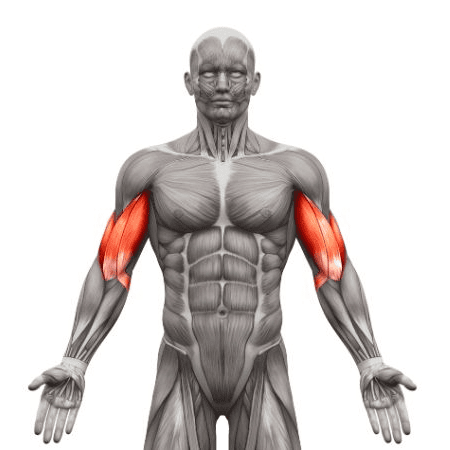
Biceps
Secondary Muscle(s):
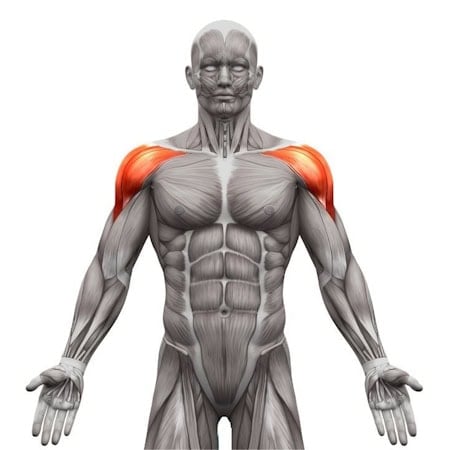
Anterior delt
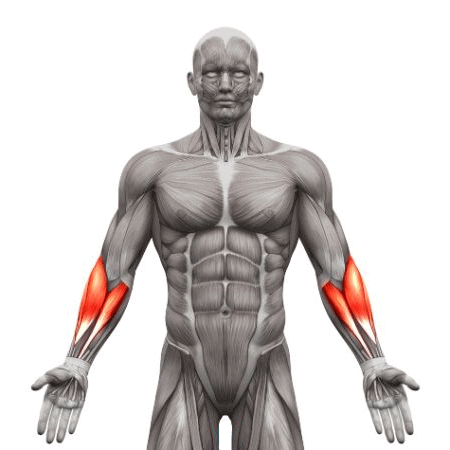
Forearm
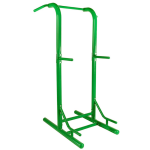
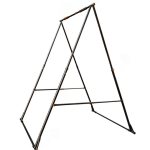
Equipment needed for Bodyweight Biceps Curl
Adjust the difficulty of Bodyweight Biceps Curl
How to make Bodyweight Biceps Curl harder?
How to make Bodyweight Biceps Curl easier?
How to make Bodyweight Biceps Curl harder?
To make Bodyweight Biceps Curl harder:
-
Straighten your knees and support yourself only through your heels.
-
Move your heels farther away from the bar to make your body more horizontal.
-
Lower the bar while preserving enough clearance for a complete repetition.
-
Elevate your heels on a stable plyo box or bench.
-
Pause for two to three seconds with your forehead close to the bar.
-
Use a three-to-five-second eccentric lowering phase.
-
Perform one-and-a-half repetitions by lowering halfway, curling up again and then extending fully.
-
Wear a securely fitted weighted vest.
-
Perform assisted archer curls by shifting more body weight toward one arm.
-
Progress toward assisted and then full one-arm bodyweight biceps curls.
How to make Bodyweight Biceps Curl easier?
To make Bodyweight Biceps Curl easier:
-
Bend your knees and place both feet flat on the floor.
-
Move your feet closer to the bar to shorten the body lever.
-
Raise the bar to create a more upright body position.
-
Limit the backward lean while learning the elbow-flexion movement.
-
Perform a smaller range of motion and gradually work toward straight elbows.
-
Use light assistance from a training partner around the upper back.
-
Perform slow negative repetitions by assisting the upward phase with your legs.
-
Use freely moving rings if a fixed underhand grip limits your wrist comfort.