
Human Flag Support Press
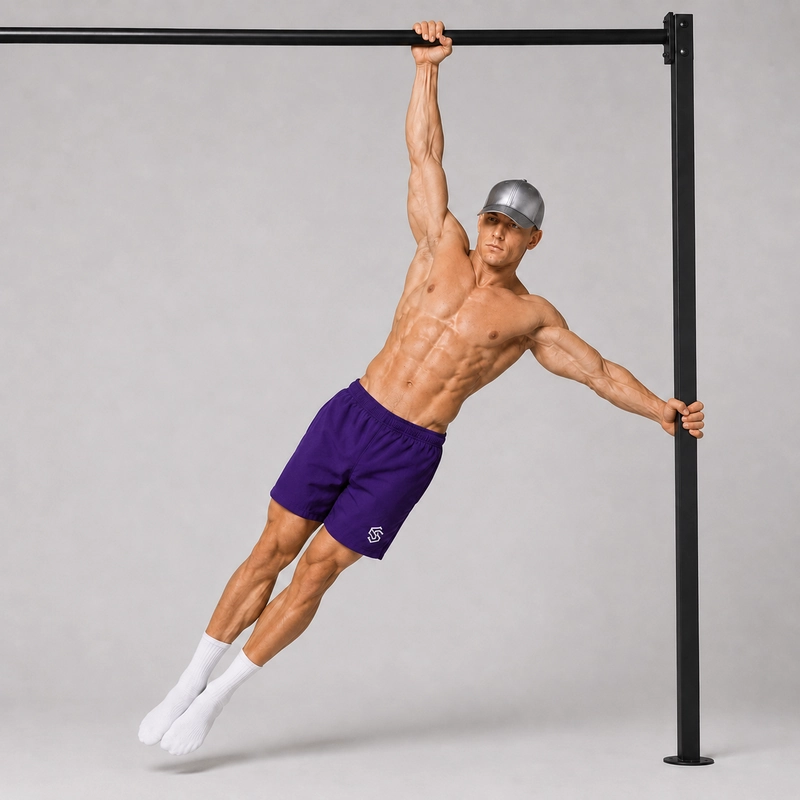
How to do Human Flag Support Press?
The human flag support press is a flag-specific exercise performed on a pull-up station that has both a horizontal bar and a rigid vertical upright. One hand hangs from the horizontal bar while the opposite hand presses against the side of the upright. By combining these pulling and pushing forces, you lift your straight body sideways until it forms an angle of approximately 45 degrees to the floor.
The exercise is also known as a 45-degree hang, hanging press flag, decline human flag, or simply a support press. The movement appears as the 45-Degree Hang in our complete Human Flag Progression and Training Guide. These names describe the same movement and should not receive separate canonical exercise pages.
Unlike the standard human flag, the hands do not grip two vertically aligned points on the same pole. The upper hand hangs from the horizontal bar while the lower hand uses an open-palm press against the adjacent upright. The diagonal body position and favorable equipment geometry make this a useful way to learn the opposing pulling and pushing actions before attempting an unsupported horizontal flag.
The exercise should not be confused with a hanging side pull. A hanging side pull primarily uses pulling strength, whereas the human flag support press combines an active one-arm hang with a straight-arm press from the opposite side. Exercise databases such as Calistree similarly describe the hanging press flag as a progression using a horizontal bar and an adjacent vertical support.
You need a firmly anchored pull-up station, outdoor calisthenics structure, or power tower with a reachable vertical upright. A simple doorway pull-up bar or freestanding bar without a suitable side support cannot be used for this exercise.
How to Do the Human Flag Support Press
Equipment and Setup
Use a pull-up station with a horizontal bar and a rigid vertical upright positioned close enough for your opposite hand to reach while hanging. Confirm that the entire structure is firmly anchored and designed to tolerate both downward hanging force and sideways pressure. Place an exercise mat beneath the training area and make sure your straight legs will not strike the ground or surrounding equipment. Prepare your shoulders, elbows, wrists, grip, and trunk with a controlled joint warm-up routine.
Step-by-Step Instructions
- Choose your training side. Decide which hand will hang from the horizontal bar and which hand will press against the vertical upright.
- Grip the horizontal bar. Place the pulling hand on the bar near enough to the upright that the opposite palm can reach the vertical support. Use a secure overhand grip with the thumb wrapped around the bar.
- Establish an active one-arm hang. Straighten the hanging arm, engage the shoulder, and maintain tension through the lat instead of relaxing completely into the joint.
- Place the pressing hand. Press the heel of the opposite palm firmly against the side of the vertical upright at approximately lower-chest-to-hip height, depending on your proportions and the equipment.
- Straighten the pressing arm. Extend the elbow and create active pressure through the palm and shoulder. Do not grip the upright, rest the forearm against it, or support your body with the elbow.
- Set your body line. Bring your legs together, straighten your knees, point your toes, and tighten your abdominals and glutes before lifting your feet.
- Initiate the support press. Pull down through the hanging arm while simultaneously pressing the upright away with the opposite hand.
- Lift the body sideways. Raise your feet and hips together without swinging until your body forms a straight diagonal line at approximately 45 degrees to the floor.
- Pause at the target angle. Maintain straight arms, level hips, and one continuous line from your shoulders through your ankles while continuing to pull and press.
- Return under control. Gradually reduce the pressing force and lower your body back toward the vertical hang without dropping or swinging.
- Place the feet down safely. Re-establish contact with the floor or a suitable platform before releasing the hanging hand.
- Repeat on the opposite side. Change the arm roles so each side practises both the hanging pull and the support press.
Completion Standard
A successful repetition begins from a controlled active hang and finishes with the body held in a straight diagonal line at approximately 45 degrees to the floor. The upper hand must be hanging from the horizontal bar, while the opposite open palm presses against the vertical upright. Both elbows remain straight, the legs stay together, and no part of the forearm, elbow, torso, or legs rests against the structure. The athlete should reach the target position without kipping or swinging and return to the starting hang under control. A small difference from exactly 45 degrees is acceptable, but the shoulders, hips, knees, and ankles must remain aligned.
Common Human Flag Support Press Mistakes
- Using unsuitable equipment: Do not perform the exercise on a doorway bar or unstable structure that is not designed to tolerate sideways pressure.
- Placing the hanging hand too far from the upright: Choose a position that allows the opposite palm to reach the support without twisting or overstretching.
- Relaxing the hanging shoulder: Maintain an active shoulder and lat instead of allowing the body to hang passively from the joint.
- Bending the pulling elbow: Keep the hanging arm straight so the movement develops the intended straight-arm pulling strength.
- Gripping the upright: The support hand should press with an open palm rather than wrapping the fingers around the structure.
- Resting the forearm or elbow against the support: Only the hand should contact the upright during the completed repetition.
- Bending the pressing elbow: Extend the lower arm and create pressure through the shoulder instead of performing a bent-arm push.
- Raising the feet before the hips: Move the shoulders, torso, hips, and legs together rather than creating a piked position.
- Sagging through the hips: Brace the abdominals and squeeze the glutes to maintain one continuous body line.
- Rotating the chest: Keep the shoulders, chest, pelvis, and legs facing the same direction instead of turning toward the floor or ceiling.
- Using a leg swing: Generate the movement through the coordinated pull and press rather than throwing the legs sideways.
- Forcing a horizontal position: Stop near 45 degrees and progress gradually instead of sacrificing alignment to lift higher.
- Training only one side: Alternate sides so each shoulder develops experience in both movement roles.
- Dropping back into the hang: Control the return and keep the hanging shoulder active until your feet reach the ground.
Benefits of the Human Flag Support Press
- Teaches the human flag push-pull pattern: One arm pulls from the bar while the opposite arm presses against the upright.
- Introduces diagonal flag loading: The 45-degree position provides a bridge between basic hanging exercises and unsupported horizontal flag variations.
- Develops unilateral pulling strength: The hanging arm, lat, and grip support a substantial portion of the bodyweight.
- Strengthens straight-arm pressing: The support arm learns to maintain elbow extension while pushing the body away from the structure.
- Builds scapular control: Each shoulder must remain active while performing a different role.
- Improves lateral trunk strength: The obliques and other trunk stabilizers prevent the hips from dropping or rotating.
- Reinforces full-body tension: The abdominals, glutes, quadriceps, and hip muscles maintain the straight diagonal body line.
- Provides measurable progression: You can gradually increase the body angle, hold duration, and control without immediately attempting a horizontal flag.
Are You Ready for the Human Flag Support Press?
You should be comfortable hanging from the chosen bar with a secure grip and active shoulder position. Build foundational pulling strength with the strict pull-up and practise straight-arm scapular control before placing most of your weight through one hanging arm. The side plank develops the lateral trunk tension needed to keep the shoulders, hips, and feet aligned. The chest-to-wall handstand can help develop straight-arm support strength for the pressing shoulder. Begin with both feet on the floor or a box and rehearse the pull-and-press action before attempting an unsupported repetition. Progress only when both elbows remain straight and the hanging shoulder feels stable. Stop the exercise if you experience sharp pain, sudden instability, numbness, tingling, or a pulling sensation in the shoulder, elbow, wrist, or hand. Persistent symptoms should be assessed by an appropriately qualified healthcare professional.
Human Flag Support Press FAQs
What angle should I reach?
Aim for a straight body line at approximately 45 degrees to the floor, midway between a vertical hang and a horizontal human flag. Precise measurement is unnecessary; body alignment and control are more important than reaching an exact number.
Should the support hand grip the vertical bar?
No. Press the heel of your open palm against the side of the upright. Gripping the post changes the exercise and can conceal whether you are generating a genuine pressing force.
Should both elbows be straight?
Yes. Keep the hanging arm and pressing arm extended throughout the lift, pause, and controlled return.
Which hand should hang from the pull-up bar?
Either hand can be the hanging hand, but you should train both configurations. The hanging arm performs the dominant pulling role, while the opposite arm performs the pressing role.
Is this easier than a full human flag?
Generally, yes. The body remains diagonal rather than horizontal, and the protruding horizontal bar can provide more favorable leverage than two grips positioned on the same vertical pole.
How is this different from a hanging side pull?
A hanging side pull primarily lifts the body through pulling strength. The human flag support press adds an open-palm pressing contact against the vertical upright, making it a combined pulling, pushing, and bracing exercise.
Can I perform it on any pull-up bar?
No. The station must have a rigid, reachable vertical upright and must remain stable under sideways pressure. Doorway bars and simple freestanding bars without an appropriate support surface are unsuitable.
How long should I hold the 45-degree position?
Begin with three to five sets of three-to-eight-second holds on each side. Alternatively, perform three to five controlled presses per side with a brief pause at the highest technically correct position.
Why do my hips remain below my feet?
You may be swinging the legs instead of moving the body as one unit. Reduce the angle, brace before lifting, and focus on raising the hips and feet together.
What should I learn after the support press?
Gradually press to a higher angle, increase the pause, or practise a slower return. You can then progress into the vertical human flag, the tuck human flag, the straddle human flag, and eventually the full human flag.
Tips for the proper execution of Human Flag Support Press
Grip the horizontal bar close enough to the upright that your opposite palm can reach it without twisting.
Wrap your thumb around the horizontal bar to create a secure one-hand grip.
Keep the hanging shoulder active instead of relaxing completely into the joint.
Press the heel of the open palm into the upright rather than gripping it with the fingers.
Straighten both elbows before lifting your feet away from the floor.
Pull through the hanging arm while simultaneously pressing through the opposite hand.
Brace your abdominals and squeeze your glutes before beginning the press.
Raise the hips and feet together so the body moves as one rigid unit.
Keep the shoulders, pelvis, knees, and ankles in one straight diagonal line.
Press only to the highest angle you can reach without bending the arms or sagging at the hips.
Keep the chest facing sideways rather than rotating toward the ground or ceiling.
Use a slow controlled press instead of swinging the legs to create momentum.
Lower back to the starting hang without losing tension through the hanging shoulder.
Practise both sides so each arm develops the pulling and pressing roles.
Place your feet securely on the ground before releasing the bar.
Muscles worked when doing Human Flag Support Press
The human flag support press is an asymmetrical full-body exercise combining straight-arm pulling, straight-arm pressing, lateral trunk stabilization, and a brief isometric hold. The hanging arm and pressing arm perform different roles, while the torso and legs maintain the diagonal body line.
Primary Muscles
- Latissimus dorsi: The lat on the hanging side contributes substantially to the straight-arm pulling force and active shoulder position. The NCBI overview of latissimus dorsi anatomy explains its role in shoulder adduction and extension.
- Deltoids: The pressing-side deltoid helps push the body away from the upright, while both deltoids contribute to shoulder stability. See the NCBI deltoid anatomy reference for further anatomical detail.
- Obliques: The internal and external obliques resist lateral flexion and help prevent the hips from dropping below the shoulders.
- Rectus abdominis and transverse abdominis: These muscles brace the torso and prevent excessive spinal extension or loss of pelvic control.
Secondary and Stabilizing Muscles
- Teres major: The teres major assists the latissimus dorsi in the hanging-side pulling action.
- Serratus anterior: The serratus supports scapular control and the active straight-arm press against the upright.
- Trapezius and rhomboids: These muscles stabilize and coordinate the shoulder blades during the combined pull and press.
- Rotator-cuff muscles: The rotator cuff stabilizes both shoulder joints as they perform different actions.
- Triceps: The triceps maintain elbow extension, particularly in the arm pressing against the support.
- Biceps and other elbow flexors: These muscles contribute to stabilization of the hanging arm and elbow.
- Pectoralis major and minor: The chest assists the pressing-side shoulder and helps stabilize the shoulder girdle.
- Forearms and hand muscles: The hanging hand maintains a secure grip while the opposite hand transfers pressure into the upright.
- Quadratus lumborum and spinal erectors: These muscles assist the obliques in maintaining the diagonal trunk position.
- Glutes: The glutes extend and stabilize the hips so the body does not fold at the pelvis.
- Quadriceps: The quadriceps keep both knees straight during the extended-body variation.
- Hip adductors: The adductors keep the legs together and prevent them from separating during the press.
The leverage and trunk demands increase as the body moves closer to horizontal. The exercise therefore provides a useful bridge toward the tuck human flag, straddle human flag, and full human flag.
Primary Muscle(s):
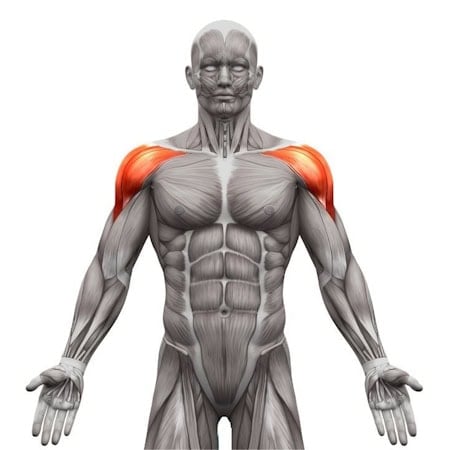
Anterior delt
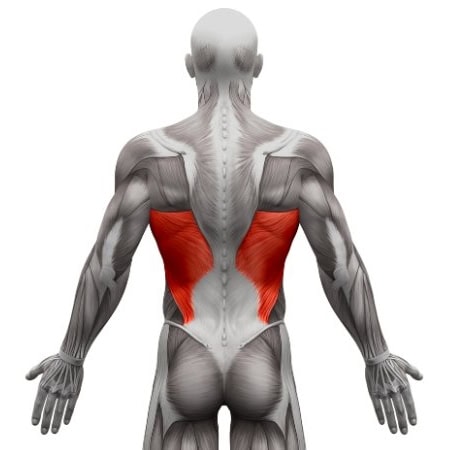
Lats
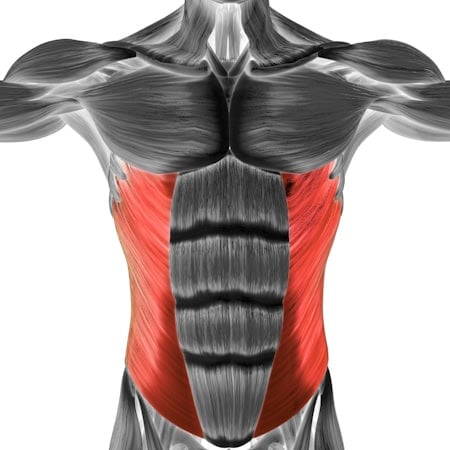
Oblique
Secondary Muscle(s):
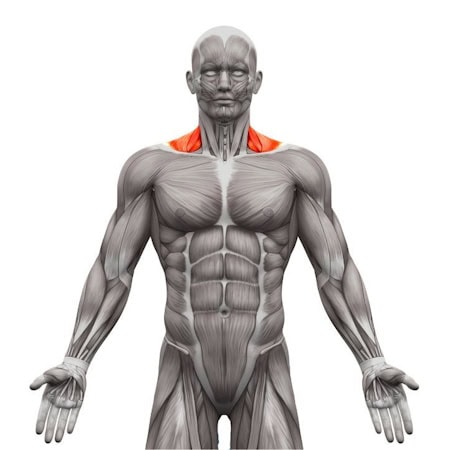
Trapezius
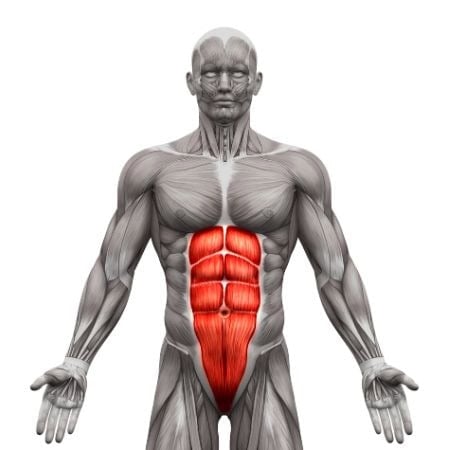
Abdominal
Equipment needed for Human Flag Support Press
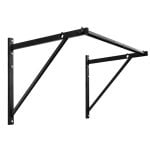
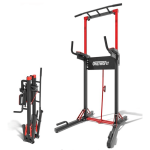
Adjust the difficulty of Human Flag Support Press
How to make Human Flag Support Press harder?
How to make Human Flag Support Press easier?
How to make Human Flag Support Press harder?
To make Human Flag Support Press harder:
-
Longer Support Press Hold — Increase the pause at 45 degrees while preserving straight arms and body alignment.
-
Slow Support Press Negative — Take several seconds to return from the 45-degree position to the vertical hang.
-
Higher-Angle Support Press — Gradually lift the body closer to horizontal without bending the elbows.
-
Strict Support Press Repetitions — Perform repeated controlled presses without touching the feet down between repetitions.
-
Straight-Leg Support Press — Keep the knees locked and the legs together throughout the complete movement.
-
Vertical Human Flag — Progress to an unsupported feet-above-head candlestick position using human flag grips.
-
Tuck Human Flag — Move to two flag-specific grips and hold the torso horizontally with both knees tucked.
-
Straddle Human Flag — Extend both legs into a wide straddle while maintaining the horizontal position.
-
Full Human Flag — Hold the body horizontal with both legs straight and together.
How to make Human Flag Support Press easier?
To make Human Flag Support Press easier:
-
Feet-Assisted Support Press — Keep both feet on the floor while practising the opposing pull and press.
-
Box-Assisted Support Press — Place the feet on a plyo box to reduce the amount of bodyweight supported by the arms.
-
Partial-Angle Support Press — Lift only 15 to 30 degrees from the vertical hang before returning under control.
-
Bent-Knee Support Press — Bend the knees to shorten the body line and reduce the leverage.
-
Toe-Assisted 45-Degree Hold — Maintain light contact with one foot while learning the final diagonal position.
-
Spotter-Assisted Support Press — Ask a spotter to support the hips or ankles while you practise the straight body line.
-
Band-Assisted Support Press — Use a resistance band to support the hips while coordinating the pulling and pressing actions.
-
Short-Pause Support Press — Hold the highest controlled position briefly instead of attempting a long isometric hold.