
Vertical Human Flag
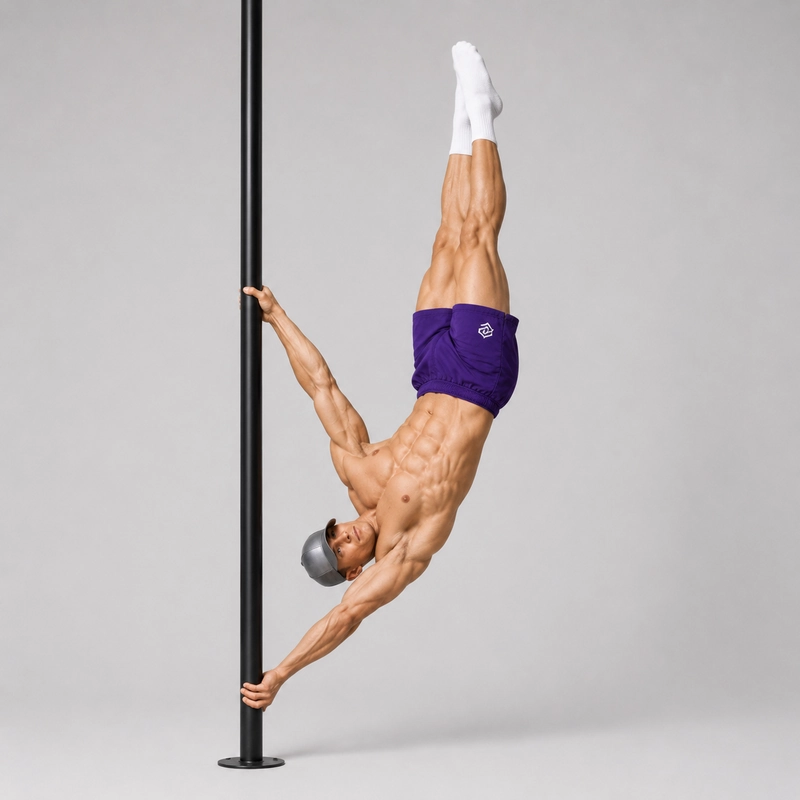
How to do Vertical Human Flag?
The vertical human flag is a human flag progression in which you hold your body beside a secure structure with your feet above your head in a straight, approximately vertical candlestick position. The top arm pulls against the structure, the bottom arm pushes away, and both elbows remain extended while the body is supported entirely by the hands.
This exercise is also called a vertical flag, high flag, or candlestick human flag in some progression systems. On this page, the name refers specifically to the unsupported top position with the feet above the head—not a feet-supported upright drill and not the horizontal full human flag.
Keeping the body vertical places more of its mass near the grip axis and creates less leverage than lowering into a horizontal flag. This makes the movement a useful bridge between feet-assisted flag drills and the tuck human flag. It teaches you to coordinate the top-arm pull, bottom-arm push, straight elbows, and stable shoulder positions before the lower body is moved farther away from the structure.
The vertical flag is commonly treated as an early flag-specific progression in coaching systems such as Antranik’s Human Flag Tutorial. For the complete progression from foundational strength exercises to horizontal variations, follow our Human Flag Progression and Training Guide.
The exercise is easiest to learn on secure stall bars or a rigid outdoor structure with horizontal rungs because you can climb into the position and use your feet while establishing balance. It can also be performed on a vertical pole or suitable multi-grip pull-up station, but the grip and entry will differ. Always confirm that the structure is firmly anchored and offers a controlled way to return your feet to the ground.
How to Do the Vertical Human Flag
Equipment and Setup
Use securely anchored stall bars, a vertical pole, or another rigid structure that permits two vertically aligned grips. Place an exercise mat beneath the training area and remove nearby objects that you could contact during the entry or exit. Prepare your shoulders, elbows, wrists, and trunk with a gradual joint warm-up routine. Beginners should use stall bars or another structure that allows the feet to assist the climb into the candlestick position.
Step-by-Step Instructions
- Choose your training side. Stand sideways beside the structure and decide which arm will be the top pulling arm and which will be the bottom pushing arm.
- Place the bottom hand. Grip a rung or the pole at approximately hip-to-chest height, allowing enough room between your hands to create a strong support base.
- Place the top hand. Reach overhead and grip the structure directly above the bottom hand. On horizontal rungs, a pronated top grip and supinated bottom grip are a common starting configuration, although the best orientation depends on the apparatus.
- Align the hands. Position the top hand directly above the bottom hand so your body does not rotate around the structure as you become inverted.
- Create opposing pressure. Pull strongly through the top arm while pushing the structure away with the bottom arm. Straighten both elbows before removing your foot support.
- Climb into the top position. Use the available rungs or light assistance from a spotter to bring your feet above your hips and shoulders. Avoid attempting a powerful unsupported kick-up until you can control the supported entry.
- Move into the candlestick. Bring your legs together, straighten your knees, and position your body approximately parallel to the upright structure with your feet pointing toward the ceiling.
- Remove the foot support. Gradually reduce pressure through your feet until both legs are supported entirely by the opposing actions of your arms and shoulders.
- Brace the body. Tighten your abdominals, obliques, glutes, and quadriceps so the torso and legs remain connected without folding at the hips.
- Hold the position. Keep both elbows straight, continue pulling with the top arm and pushing with the bottom arm, and maintain a stable feet-above-head position without resting on the structure.
- Exit under control. Return one or both feet to a secure rung before releasing either hand, or lower into a previously mastered tuck position with assistance.
- Repeat on the other side. Change the arm roles so each shoulder develops experience in both the upper pulling and lower pushing positions.
Completion Standard
A successful vertical human flag is held using only the two hands, with the feet above the head and the body approximately parallel to the upright structure. Both elbows should remain straight, the knees should be locked, and the legs should be together without resting on a rung, pole, or supporting surface. The position must be visibly stable and followed by a controlled exit.
Common Vertical Human Flag Mistakes
- Resting the feet on the structure: Foot contact can be used while learning the entry, but the completed hold must be unsupported.
- Leaving the body diagonal: Continue bringing the hips and feet upward until the body reaches the intended vertical candlestick position.
- Bending the bottom elbow: Lock the bottom arm before removing foot assistance and maintain active pressure through the shoulder.
- Over-bending the top elbow: Pull against the structure with a straight arm instead of trying to hold the position like a one-arm pull-up.
- Allowing the bottom shoulder to collapse: Push continuously through the bottom hand and keep deliberate tension around the shoulder.
- Failing to pull with the top arm: The position requires simultaneous pulling and pushing rather than relying entirely on the bottom arm.
- Misaligning the hands: Placing one hand to the side of the other encourages unwanted rotation around the structure.
- Piking at the hips: Squeeze the glutes and brace the abdominals so the legs remain in line with the torso.
- Separating or bending the legs: Contract the quadriceps, press the legs together, and point the toes to maintain the candlestick shape.
- Rotating the chest: Keep the shoulders, chest, pelvis, and legs in the same plane instead of turning toward or away from the structure.
- Kicking up too forcefully: Learn a supported climbing entry before using momentum to reach the inverted position.
- Training only one side: Alternate sides so each arm practises both the pulling and pushing roles.
- Releasing a hand before securing the feet: Re-establish stable foot contact before changing or releasing either grip.
Benefits of the Vertical Human Flag
- Teaches the flag-specific arm actions: You learn to pull through the top arm while simultaneously pushing through the bottom arm.
- Introduces unsupported flag training: The vertical position creates less leverage than the horizontal variations while retaining the essential grip and shoulder mechanics.
- Develops straight-arm strength: Both arms must remain extended while the shoulders support the body.
- Improves inverted body awareness: The candlestick position teaches you to control your hips and legs while supported beside a structure.
- Builds shoulder and scapular control: The two shoulders perform different but coordinated stabilization roles.
- Strengthens the grip: The hands and forearms must maintain two secure grips while the body is inverted.
- Improves total-body tension: The abdominals, glutes, and legs keep the body straight and prevent folding or rotation.
- Prepares human flag negatives: The position provides a controlled starting point for gradually lowering toward a diagonal or horizontal flag.
Are You Ready for the Vertical Human Flag?
Before attempting an unsupported candlestick, become comfortable with a feet-assisted upright flag and with holding your body beside the structure while the top arm pulls and the bottom arm pushes. You should be able to maintain straight elbows without shoulder, elbow, or wrist discomfort. Useful general preparation includes the side plank for lateral trunk control, the strict pull-up for pulling strength, and the chest-to-wall handstand for straight-arm overhead support. These exercises do not guarantee readiness, but they help develop the component qualities used in the flag. A supported climbing entry is preferable while learning. The progression descriptions in the Berg Movement human flag guide similarly treat the high flag as a base position from which later flag variations can be developed. Stop the exercise if you experience sharp pain, sudden instability, numbness, tingling, or a pulling sensation around the shoulder, elbow, or wrist. Persistent symptoms should be assessed by an appropriately qualified healthcare professional.
Vertical Human Flag FAQs
Is the vertical human flag easier than the horizontal human flag?
Yes, generally. The vertical position keeps more of the body’s mass close to the grip axis, producing less leverage than the long horizontal position of the full human flag.
Is the vertical human flag the same as an upright flag?
The terms are sometimes used interchangeably, but they can also describe different drills. On this page, the vertical human flag specifically means an unsupported candlestick position with the feet above the head, while an upright flag may still use foot assistance.
Is it the same as a handstand?
No. In a handstand, the hands support the body from a surface beneath the athlete. In the vertical human flag, the hands grip the side of a structure at two different heights while the upper arm pulls and the lower arm pushes.
What is the safest way to enter the position?
Use stall bars or another structure that allows you to climb your feet upward while establishing the arm position. Gradually remove foot support after both elbows are straight and your shoulders feel stable.
Can I perform it on a vertical pole?
Yes, but a pole usually offers fewer options for foot assistance and may require a more difficult kick-up or press. Learn the position on stall bars or with a spotter before attempting an unsupported pole entry.
How far apart should my hands be?
Use a comfortably wide spacing that allows both elbows to straighten and provides strong opposing leverage. Extremely narrow spacing reduces control, while excessively wide spacing may place the shoulders in an uncomfortable position.
Which grip should I use?
On horizontal rungs, a pronated top grip and supinated bottom grip are a common learning configuration. A pole produces a different hand orientation, so prioritize a secure grip, aligned hands, and pain-free wrists rather than forcing one universal position.
How long should I hold the vertical human flag?
Begin with three to five sets of controlled five-to-fifteen-second holds on each side. Increase the duration only while the arms remain straight, the feet remain unsupported, and the exit stays controlled.
What should I learn after the vertical human flag?
Begin performing controlled vertical flag negatives by lowering slightly away from the top position. You can then progress toward a diagonal tuck and the tuck human flag before moving to the straddle human flag and full horizontal position.
Tips for the proper execution of Vertical Human Flag
Align the top hand directly above the bottom hand to reduce unwanted rotation around the structure.
Pull continuously through the top arm while pushing the structure away with the bottom arm.
Straighten both elbows before removing your feet from the supporting rungs.
Keep active pressure through the bottom shoulder instead of collapsing toward the lower hand.
Use the rungs to climb into position before attempting an unsupported kick-up.
Bring the hips and feet upward until the body is approximately parallel to the upright structure.
Press the legs together and contract the quadriceps to maintain a clean candlestick position.
Squeeze the glutes and brace the abdominals to prevent the body from folding at the hips.
Keep the chest, pelvis, and legs in the same plane rather than rotating around the structure.
Remove foot support gradually instead of suddenly pushing away from the bars.
Practise over a mat with a clear area beneath and beside the structure.
Use short, technically clean holds and stop when either elbow begins to bend.
Practise both sides so each shoulder learns the top pulling and bottom pushing roles.
Secure your feet on the structure or ground before releasing either hand.
Muscles worked when doing Vertical Human Flag
The vertical human flag is a full-body isometric exercise in which the two sides of the upper body perform different roles. The top arm pulls against the structure, the bottom arm pushes away, and the trunk and legs maintain the inverted candlestick position. The vertical body position creates less leverage than the horizontal human flag, but the same fundamental push-pull coordination is present.
Primary Muscles
- Latissimus dorsi: The lat on the top-arm side contributes to shoulder adduction and the pulling force that supports the upper end of the body. See the NCBI overview of latissimus dorsi anatomy for additional anatomical detail.
- Deltoids: The shoulders stabilize both arms, with particularly high demand on the bottom shoulder as it pushes the structure away. The NCBI deltoid anatomy reference describes the muscle’s different roles across the shoulder joint.
- Obliques: The internal and external obliques resist side bending and rotation while helping maintain the inverted body position.
- Rectus abdominis and transverse abdominis: These muscles brace the torso and help keep the ribs, spine, and pelvis controlled.
Secondary and Stabilizing Muscles
- Teres major: The teres major assists the latissimus dorsi in the top-arm pulling action.
- Serratus anterior: The serratus supports scapular control and the active pushing position of the bottom shoulder.
- Trapezius and rhomboids: These muscles control the shoulder blades while the arms apply opposing forces.
- Rotator-cuff muscles: The rotator cuff stabilizes both shoulder joints during the straight-arm hold.
- Triceps: The triceps maintain elbow extension, particularly in the bottom pushing arm.
- Biceps and other elbow flexors: These muscles contribute to grip-side stability and tension through the top arm.
- Forearms and hand muscles: The grip muscles secure both hands and resist slipping or unwanted wrist movement.
- Quadratus lumborum and spinal erectors: These muscles help stabilize the trunk and resist uncontrolled side bending.
- Glutes: The glutes maintain hip extension and prevent the body from folding at the pelvis.
- Quadriceps: The quadriceps keep both knees fully extended.
- Hip adductors: The adductors keep the legs pressed together in the candlestick position.
As the athlete lowers from vertical toward the tuck human flag, straddle human flag, or full horizontal flag, the increasing leverage substantially raises the strength demand on the shoulders, lats, trunk, and grip.
Primary Muscle(s):
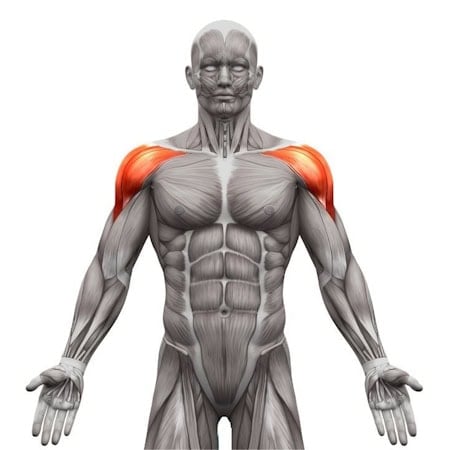
Anterior delt
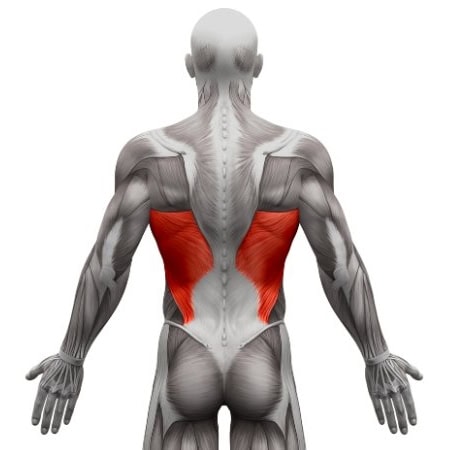
Lats
Secondary Muscle(s):
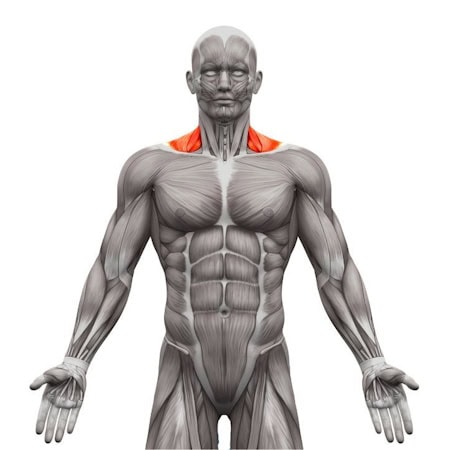
Trapezius
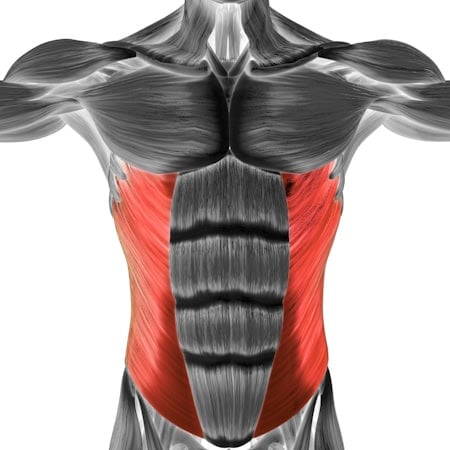
Oblique
Equipment needed for Vertical Human Flag
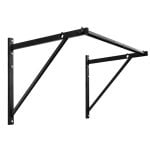
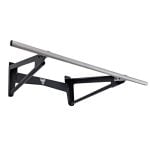
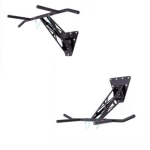
Adjust the difficulty of Vertical Human Flag
How to make Vertical Human Flag harder?
How to make Vertical Human Flag easier?
How to make Vertical Human Flag harder?
To make Vertical Human Flag harder:
-
Longer Vertical Human Flag — Increase the unsupported hold while maintaining straight elbows and a controlled exit.
-
Strict Vertical Flag Entry — Enter the position with progressively less assistance from the feet or a spotter.
-
Vertical Human Flag Negative — Lower slowly from the candlestick toward a diagonal flag position.
-
Vertical-to-Tuck Transition — Move from the vertical position into a compact tuck while keeping both arms straight.
-
Tuck Human Flag — Lower the tucked body until the torso approaches a horizontal position.
-
Straddle Human Flag — Extend both legs into a wide straddle while holding the body horizontally.
-
Full Human Flag — Hold the body horizontally with both legs straight and together.
-
Human Flag Raise — Raise the body from a lower flag position back toward the vertical candlestick.
How to make Vertical Human Flag easier?
To make Vertical Human Flag easier:
-
Feet-Assisted Upright Flag — Keep both feet on the structure while practising the top-arm pull and bottom-arm push.
-
Feet-Assisted Vertical Flag — Climb into the candlestick and maintain light contact with one or both feet.
-
Toe-Release Vertical Flag — Briefly lift the feet away from the structure before returning them to support.
-
Bent-Knee Vertical Flag — Bend the knees to make the body easier to organize while learning the inverted position.
-
Spotter-Assisted Vertical Flag — Ask a spotter to support your hips or ankles while you establish balance.
-
Wide-Grip Vertical Flag — Use a slightly wider comfortable hand spacing to increase your mechanical advantage.
-
Short Vertical Flag Holds — Perform several brief, controlled holds instead of extending one deteriorating attempt.