
Bar Muscle-Up
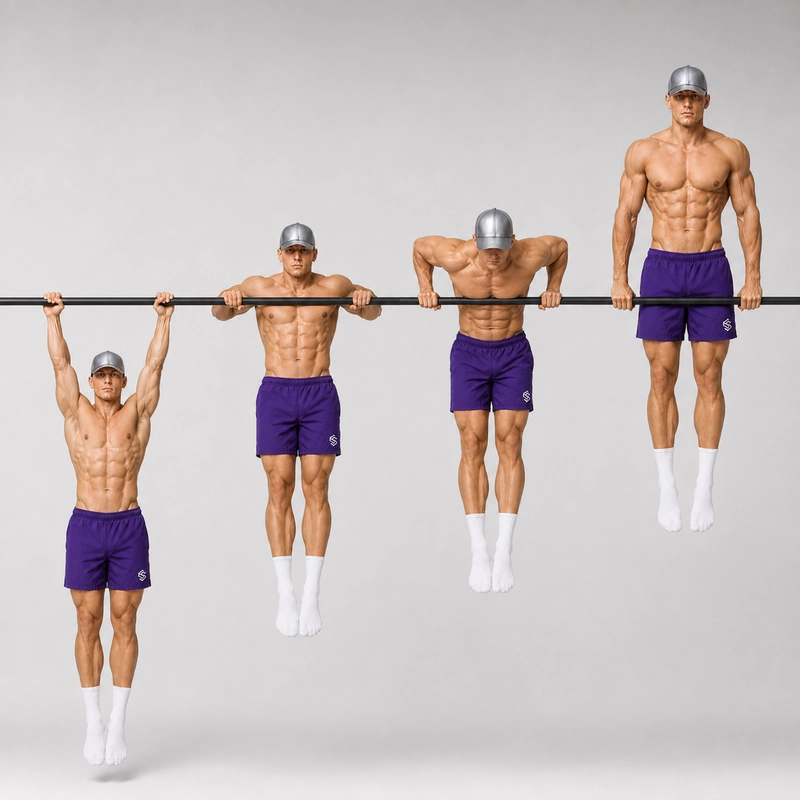
How to do Bar Muscle-Up?
The bar muscle-up is an advanced calisthenics exercise that moves you from a straight-arm hang beneath a pull-up bar to a locked-out support position above it. A complete repetition combines a powerful high pull, a coordinated transition over the bar and a straight bar dip.
This page covers the strict bar muscle-up. The movement is performed without a kip, deliberate swing, knee drive or explosive hip extension. Your upper body must generate enough pulling height for your chest to pass over the fixed bar while your core keeps the lower body controlled.
A normal strict pull-up finishes when the chin passes the bar, but this is not high enough for a smooth muscle-up transition. During a bar muscle-up, you must pull the bar toward your lower chest or upper abdomen before rolling your wrists and bringing both elbows above it. The chest-to-bar pull-up is therefore an important progression toward the complete skill.
The fixed bar cannot move around your body as gymnastics rings can. Your body must instead travel slightly behind the bar during the high pull and then forward over it during the transition. This change of direction requires explosive pulling strength, precise timing and control of the shoulders, elbows and wrists.
A low-bar muscle-up transition can help you learn the turnover with assistance from your feet, while the band-assisted bar muscle-up allows you to practise the complete movement with reduced resistance.
The bar muscle-up develops upper-body strength, pulling power, coordination and body control. A peer-reviewed study comparing bar and ring muscle-ups confirms that the exercise combines pulling and pushing phases involving muscles across the back, chest, shoulders and arms. For a complete learning pathway, see our guide on how to do a muscle-up.
How to Perform a Strict Bar Muscle-Up
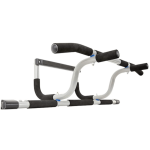
- Check your equipment and clearance. Use a sturdy pull-up bar that allows your entire body to hang freely. Make sure there is sufficient space above the bar for your head and torso to rise into support.
- Take an overhand grip. Hold the bar approximately shoulder-width or slightly wider with your palms facing away. Wrap your thumbs around the bar and position the hands in a slight overgrip, with the knuckles angled above the bar, to make the wrist turnover easier.
- Begin from a controlled hang. Straighten your elbows, brace your abdominals and glutes, and keep your legs together. Allow any existing swing to stop before starting the repetition.
- Engage your shoulders. Pull your shoulders down away from your ears and initiate the movement by driving your elbows forcefully toward the floor.
- Perform an explosive high pull. Accelerate upward and pull beyond ordinary chest-to-bar height. Allow your torso to move slightly behind the bar while keeping the legs quiet and the trunk braced.
- Pull the bar toward the lower chest. Continue driving your elbows down and back until the bar approaches your lower chest or upper abdomen. Do not stop when your chin or upper chest reaches the bar.
- Move over the bar. As you reach maximum pulling height, bring your chest forward over the bar while rolling your wrists around it. Keep the bar close to your torso throughout the change of direction.
- Turn both elbows over together. Bring both elbows from below the bar to a position above and behind it at approximately the same time. Avoid leading with one shoulder.
- Control the bottom dip position. Arrive with your chest above the bar, your wrists on top of it and both elbows flexed. Maintain control instead of dropping suddenly onto the bar.
- Press into support. Extend both elbows until your arms are completely straight. Finish with the bar close to your hips and demonstrate a stable support position.
- Descend under control. Bend your elbows and reverse the transition while keeping the bar close. Lower into a straight-arm hang without dropping uncontrollably.
Strict Bar Muscle-Up Completion Standard
- Begin from a motionless hang with both elbows fully extended.
- Use an overhand grip with both hands remaining on the bar throughout the repetition.
- Do not use a kip, leg swing, knee drive or forceful hip extension to create upward momentum.
- Pull the bar toward the lower chest or upper abdomen before transitioning.
- Keep the bar close to the torso during the high pull and turnover.
- Bring both elbows above the bar together.
- Do not use a one-arm or chicken-wing transition.
- Finish with both elbows fully extended in a stable support position.
- If returning to the hang, descend through the transition under control.
Benefits of the Strict Bar Muscle-Up
- Develops upper-body pulling power: The high pull requires considerably more speed and force than a standard pull-up.
- Combines pulling and pressing strength: Each repetition integrates a vertical pull, transition and straight-bar dip.
- Builds strength through an extended range: The exercise continues far beyond chin-over-bar height and finishes above the apparatus.
- Improves upper-body coordination: The athlete must connect the high pull, wrist turnover and dip without losing control.
- Develops transition-specific strength: The shoulders, chest and arms work through the demanding change from pulling to pressing.
- Strengthens the grip and wrists: The hands must remain secure while the wrists rotate from below to above the bar.
- Challenges core control: The abdominals, spinal stabilizers and glutes keep the lower body quiet while the torso moves around the bar.
- Creates a foundation for harder bar skills: A strict muscle-up can be progressed with pauses, slow tempos, external resistance and advanced body positions.
Common Strict Bar Muscle-Up Mistakes
- Pulling only to chin height: A standard pull-up does not provide enough height for a controlled transition over the bar.
- Using an excessively wide grip: A very wide hand position can reduce pulling height and make the turnover more difficult.
- Hanging from the fingers: A shallow grip increases the amount of wrist rotation required during the transition.
- Starting with a swing: Beginning before the body becomes still turns the attempt into a momentum-assisted repetition.
- Driving the knees or hips upward: Leg drive may help you clear the bar, but it does not meet the strict exercise standard.
- Pulling vertically into the bar: The torso must move slightly behind the bar during the high pull so it has space to pass over it.
- Letting the bar move away from the torso: A large gap creates a longer and less efficient transition path.
- Transitioning too early: Trying to lean over the bar before achieving enough height often causes the chest to collide with it.
- Transitioning too late: Waiting until upward movement has stopped can leave you hanging below the bar without enough momentum to turn over.
- Using a chicken-wing transition: Leading with one shoulder creates an asymmetrical repetition and unevenly loads the upper body.
- Collapsing onto the bar: Dropping heavily into the transition indicates insufficient height or control.
- Failing to finish the dip: The repetition is incomplete until both elbows are fully extended above the bar.
- Dropping through the descent: An uncontrolled fall from support can place unnecessary stress on the shoulders, elbows and wrists.
- Repeating failed attempts under fatigue: Stop the set when pulling height decreases or the transition becomes asymmetrical.
Frequently Asked Questions
What is a strict bar muscle-up?
A strict bar muscle-up moves the body from a straight-arm hang to support above a fixed bar without using a kip, deliberate swing, knee drive or explosive hip extension. The movement is powered by the upper-body pull, transition and dip.
What is the difference between a strict and kipping bar muscle-up?
A strict bar muscle-up keeps the lower body controlled and relies on upper-body strength to generate height. A kipping bar muscle-up deliberately uses a body swing and hip action to produce momentum, allowing the athlete to pass over the bar with less strict pulling strength.
How strong should I be before attempting a strict bar muscle-up?
There is no universal prerequisite number. A practical guideline is approximately eight to ten controlled strict pull-ups, several chest-to-bar or lower-chest pull-ups, multiple straight-bar dips and a smooth feet-assisted transition. Movement quality and pulling height matter more than achieving an exact repetition count.
How high do you need to pull for a bar muscle-up?
Aim to bring the bar toward your lower chest or upper abdomen. Reaching only chin or upper-chest height usually leaves too much of your torso below the bar for a strict, controlled transition.
Do you need a false grip for a bar muscle-up?
No. Most athletes perform the bar muscle-up with a closed overhand grip and a slight overgrip. Positioning the knuckles more on top of the bar reduces the amount of wrist rotation required, but a full ring-style false grip is not necessary.
Should your thumbs wrap around the bar?
A closed grip with the thumbs wrapped around the bar generally provides a more secure hold during the explosive pull and transition. Avoid changing your grip while moving over the bar.
Why can I do chest-to-bar pull-ups but not a bar muscle-up?
You may still lack the pulling height needed to reach the lower chest or upper abdomen, or you may need more practice coordinating the turnover. Low-bar transitions, band-assisted muscle-ups and slow negatives can help develop the missing transition skill.
Why do I keep hitting my chest against the bar?
You may be pulling too vertically or leaning forward before reaching sufficient height. Allow your torso to travel slightly behind the bar during the high pull, keep the bar close and move your chest forward only as you approach maximum height.
Is a chicken-wing muscle-up a valid strict repetition?
No. A clean strict repetition brings both elbows above the bar together. A chicken-wing transition uses one arm first and creates an uneven movement that should not be reinforced through repeated practice.
Is the bar muscle-up harder than the ring muscle-up?
The answer depends on the athlete. A fixed bar is more stable, but the body must travel around it and usually requires a very high pull. Rings can move around the torso more freely, but they demand a false grip and considerably more stabilization.
How many strict bar muscle-ups should I perform?
For strength and skill development, begin with three to five sets of one to three clean repetitions and take two to four minutes of rest between sets. Stop when your pulling height falls, your legs begin generating momentum or your transition becomes uneven.
Can I train bar muscle-ups every day?
Daily full-effort attempts are unnecessary for most athletes and may irritate the elbows, wrists or shoulders. Two or three focused sessions per week generally provide more opportunity for recovery, while lighter transition drills can be practised separately.
Is the strict bar muscle-up safe?
The bar muscle-up is an advanced exercise that places substantial demands on the shoulders, elbows and wrists. Use a secure bar with adequate clearance, develop the component exercises first and stop if you experience sharp pain or repeatedly lose control during the transition.
Tips for the proper execution of Bar Muscle-Up
Use a secure pull-up bar with sufficient space above and around it.
Grip the bar overhand at approximately shoulder-width or slightly wider.
Angle your knuckles slightly over the bar to reduce the required wrist turnover.
Begin each repetition from a motionless hang with straight elbows.
Brace your abdominals and glutes before initiating the pull.
Drive your elbows down forcefully and accelerate through the entire pulling phase.
Pull the bar toward your lower chest or upper abdomen rather than stopping at chin height.
Allow your torso to move slightly behind the bar without swinging your legs.
Keep the bar close as your chest moves forward over it.
Roll both wrists and elbows over the bar at the same time.
Control the bottom dip position instead of collapsing onto the bar.
Finish every repetition with both elbows fully extended.
Stop the set when you lose pulling height or begin using a chicken-wing transition.
Muscles worked when doing Bar Muscle-Up
The bar muscle-up is a compound upper-body exercise whose muscular emphasis changes throughout the repetition. The back and elbow flexors generate the high pull, the chest and shoulders control the transition, and the triceps complete the straight-bar dip. The grip and core remain active throughout the entire movement.
Latissimus Dorsi
The latissimus dorsi produces much of the force during the high pull. It extends and adducts the shoulders as the body rises from the hang and the bar approaches the torso.
Biceps, Brachialis and Brachioradialis
The elbow flexors bend the arms and contribute strongly as you accelerate upward. The brachialis and brachioradialis are particularly important during the overhand pulling position.
Trapezius and Rhomboids
The middle and lower trapezius and the rhomboids control the shoulder blades during the high pull. They help draw the upper body toward the bar and support the high finishing position.
Pectoralis Major
The chest becomes increasingly active as the torso passes over the bar. It then contributes to the pressing phase from the bottom of the straight-bar dip.
Triceps Brachii
The triceps extend the elbows during the dip and complete the repetition by locking the arms in the support position.
Anterior Deltoids
The front deltoids help move and stabilize the shoulders as the exercise changes from pulling below the bar to pressing above it.
Forearms and Grip Muscles
The forearms maintain a secure overhand grip and control the wrist turnover as the hands move from a hanging position to support above the bar.
Serratus Anterior and Rotator Cuff
The serratus anterior and rotator-cuff muscles stabilize the shoulder blades and upper-arm bones throughout the pull, transition and dip.
Abdominals and Obliques
The abdominal muscles brace the trunk and limit unwanted arching, swinging and rotation. Their control is especially important when distinguishing a strict muscle-up from a kipping variation.
Spinal Stabilizers and Glutes
The spinal stabilizers and glutes connect the torso and lower body so that pulling force is transferred efficiently without using the legs to generate momentum.
Primary Muscle(s):
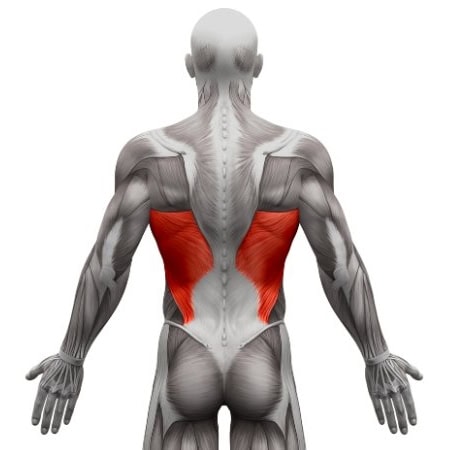
Lats
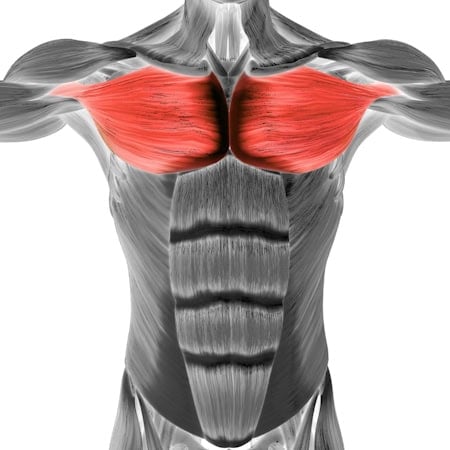
Lower chest
Secondary Muscle(s):
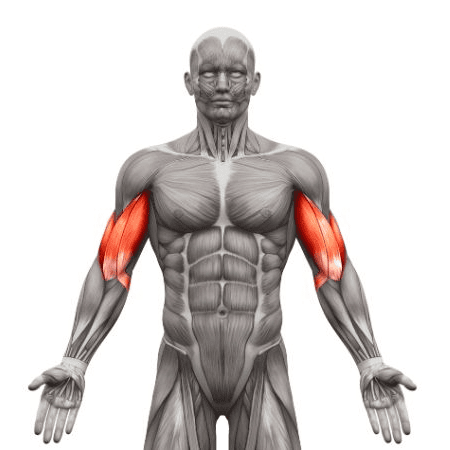
Biceps
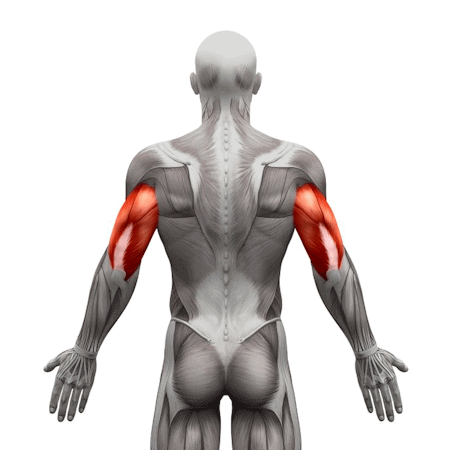
Triceps
Equipment needed for Bar Muscle-Up

Adjust the difficulty of Bar Muscle-Up
How to make Bar Muscle-Up harder?
How to make Bar Muscle-Up easier?
How to make Bar Muscle-Up harder?
To make Bar Muscle-Up harder:
-
Slow down the high pull and transition while keeping the movement strict.
-
Pause briefly with the bar held against your lower chest before beginning the turnover.
-
Pause in the deepest transition position before pressing into support.
-
Lower from support to the straight-arm hang over five to eight seconds.
-
Perform consecutive strict repetitions without creating a swing between reps.
-
Add resistance with a securely fitted weighted vest while preserving the same pulling height.
-
Perform an L-sit bar muscle-up while keeping both legs straight and elevated.
-
Use a wider grip while maintaining a high, symmetrical pull and controlled turnover.
How to make Bar Muscle-Up easier?
To make Bar Muscle-Up easier:
-
Practise the muscle-up turnover on a low bar while keeping both feet supported on the floor.
-
Use a resistance band to reduce the load while practising the complete movement.
-
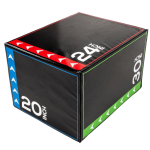
Perform jumping bar muscle-ups from a stable box and gradually reduce assistance from your legs.
-
Practise negative bar muscle-ups by lowering slowly from support through the transition to the hang.
-
Build pulling height with strict chest-to-bar pull-ups and lower-chest pull-ups.
-
Perform explosive pull-ups while attempting to bring the bar progressively lower on your torso.
-
Strengthen the pressing phase with straight-bar dips through a controlled range of motion.
-
Practise a straight-bar support hold to develop confidence and stability above the bar.